

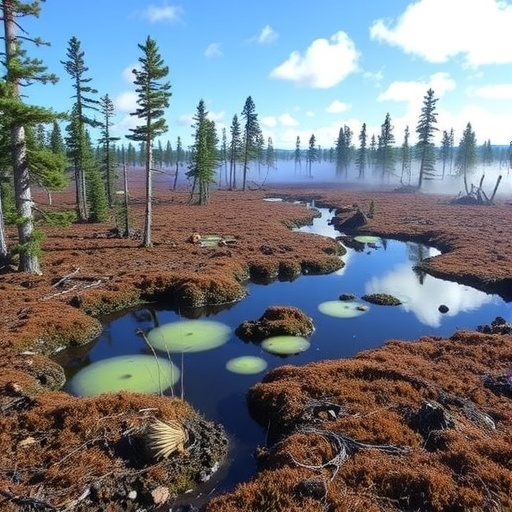
In the ongoing global efforts to understand and mitigate climate change, scientists have increasingly turned their attention to the subtle yet significant impacts of human-induced disturbances on natural carbon sinks. Among these ecosystems, boreal peatlands have emerged as critical players due to their vast stores of carbon accumulated over millennia. A new study by Korsah, Davidson, and Strack, published in Communications Earth & Environment in 2026, sheds light on an alarming consequence of linear disturbances such as roads, pipelines, and seismic lines: a marked increase in methane emissions that could undermine climate mitigation efforts.
Boreal peatlands, sprawling across northern latitudes, represent one of the planet’s largest terrestrial carbon reservoirs. These waterlogged ecosystems accumulate organic matter slowly because of cool temperatures and saturated soil conditions that inhibit decomposition. This slow decay process allows peatlands to store carbon effectively, acting as a buffer against rising atmospheric greenhouse gases. However, they are not impervious to external pressures. Linear disturbances, which are increasingly prevalent due to expanding resource extraction activities, forest management, and infrastructure development, disrupt these fragile systems in ways inordinately detrimental to their methane balance.
Methane, a greenhouse gas more potent than carbon dioxide over short time scales, is produced abundantly in anaerobic environments like those found beneath peatlands. The study conducted by Korsah and colleagues demonstrates that disturbances such as seismic lines cut across peatlands and break their hydrological continuity, leading to localized drying and subsurface oxygenation. While this might intuitively reduce methane production by enabling more aerobic decomposition pathways, the researchers found an intriguing counterintuitive dynamic that actually amplifies methane emissions.
The core of the paradox lies in how linear disturbances alter peatland microtopography and water table depths. When these landscapes are sliced by narrow clearings, subtle shifts in water movement emerge. Some areas experience drying, but adjacent zones frequently become wetter due to impeded drainage, creating hotspots of methane production by methanogenic archaea. This hydrological rearrangement causes an uneven spatial pattern of methane fluxes, with intensified emissions from wetter patches overshadowing reductions elsewhere. As a result, the net effect across disturbed peatlands is an overall increase in atmospheric methane release.
Korsah et al. employed a combination of field measurements and modeling techniques to quantify these emissions accurately. Using greenhouse gas flux chambers and high-resolution water table monitoring, they captured the nuanced temporal variations in methane production tied to seasonal thaw, precipitation events, and disturbance age. The authors then integrated these empirical datasets within mechanistic biogeochemical models that simulate peatland carbon and methane dynamics under varying environmental scenarios. This dual approach enabled a robust extrapolation of emission changes attributable specifically to linear disturbance footprints.
The findings reveal that methane emissions from disturbed peatlands can be elevated by as much as 30 to 50 percent compared to undisturbed baseline conditions. This amplification of methane release represents a significant feedback mechanism not previously accounted for in many global climate models. Given the extensive network of linear disturbances already present and planned expansion across boreal regions, this feedback has the potential to accelerate warming trends, undermining carbon neutrality goals and challenging the perception of peatlands as stable carbon sinks.
Furthermore, this research highlights a critical gap in environmental impact assessments for infrastructure development. Traditionally, emission inventories focus on carbon dioxide and landscape-scale deforestation or drainage impacts. However, the subtle, spatially heterogeneous increase in methane fluxes identified here demands a more nuanced understanding of how small-scale disturbances collectively impact global biogeochemical cycles. These findings advocate for the incorporation of methane flux monitoring into regulatory frameworks, particularly in boreal and subarctic regions undergoing rapid industrialization.
This study also prompts reconsideration of restoration priorities and methodologies. Efforts to rehabilitate disturbed peatlands often emphasize rewetting and revegetation to restore hydrological function. While beneficial, the presence of linear disturbance corridors introduces complex spatial variability in water regimes that complicate simple restoration metrics. More innovative approaches that account for the fine-scale heterogeneity of water table adjustments and microbial responses will be necessary to mitigate the heightened methane emissions effectively.
The implications extend to climate policy and carbon accounting schemes as well. Peatlands are frequently featured in carbon offset projects due to their carbon sequestration potential. However, the elevated methane emissions following linear disturbances introduce uncertainty into the actual climate benefits provided by these ecosystems under human pressure. Policymakers must therefore exercise caution when relying on peatland preservation or restoration as a straightforward climate mitigation strategy without considering the compounded methane flux risks.
Moreover, the study stresses the importance of interdisciplinary collaboration, combining hydrology, microbiology, ecosystem science, and remote sensing technologies to build a comprehensive understanding of disturbance impacts. As linear disturbances proliferate in boreal landscapes, ongoing monitoring programs using drones, satellite data, and in situ sensors will be vital for detecting early signs of methane emission spikes and informing adaptive management strategies.
The relevance of this research transcends boreal peatlands, potentially offering insights into other wetland systems globally where linear disturbances are encroaching. Tropical peat swamp forests, temperate fens, and even Arctic tundra wetlands might exhibit comparable responses, suggesting a widespread underestimation of methane emissions linked to infrastructure development. Expanding similar investigative frameworks to diverse biomes will enhance predictive capabilities and refine global greenhouse gas budgeting.
Significantly, the revelation that seemingly minor linear disturbances can have outsized climatic ramifications serves as a stark reminder of the intertwined nature of anthropogenic activities and Earth’s feedback loops. Each road or pipeline inserted through pristine peatlands is not merely a physical alteration but a catalyst triggering complex ecological cascades with global consequences. This insight underscores the urgency of adopting more holistic environmental stewardship practices that anticipate and mitigate unforeseen greenhouse gas emissions.
In conclusion, the groundbreaking work by Korsah, Davidson, and Strack challenges long-held assumptions about the resilience of boreal peatlands to human disturbance by exposing a hidden methane emission pathway. Their meticulous research draws attention to an underappreciated dimension of climate change feedback, emphasizing the need for refined environmental impact frameworks, advanced restoration paradigms, and comprehensive methane monitoring. As the world grapples with accelerating climate risks, understanding and managing these nuanced emission sources will be critical in any credible strategy to stabilize global temperatures and protect the planet’s vital carbon sinks.
Subject of Research: Increased methane emissions from boreal peatlands following linear disturbances.
Article Title: Increased methane emissions from boreal peatlands following linear disturbances.
Article References:
Korsah, P., Davidson, S.J. & Strack, M. Increased methane emissions from boreal peatlands following linear disturbances. Commun Earth Environ (2026). https://doi.org/10.1038/s43247-026-03273-w
Image Credits: AI Generated


