


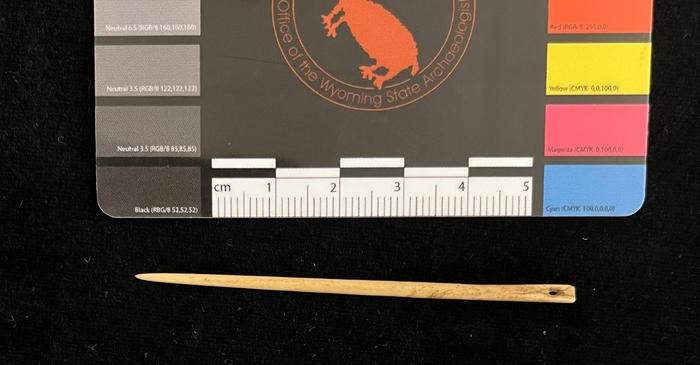
In a groundbreaking study shedding new light on human adaptability, recent research spearheaded by Dr. McKenna Litynski, an anthropologist from the University of Wyoming, uncovers the pivotal role that ancient bone needles and awls played in human survival across some of the harshest, coldest environments on Earth. This research not only confirms the long-held hypothesis regarding the significance of sewing technology in thermoregulation but also reveals unexpected cultural functions of these tools that extend far beyond mere clothing production.
Approximately 100,000 years ago, the global dispersal of Homo sapiens marked an evolutionary leap that brought humans into extraordinarily diverse and challenging climates. One aspect that has eluded comprehensive scientific validation until now was the idea that the invention of bone needles was a critical technological innovation enabling humans to craft tailored leather clothing. Such clothing would have been imperative for conserving body heat and thus surviving in subzero temperatures and frigid environments. Through a meticulous quantitative meta-analysis, Dr. Litynski’s study propels this theory from conjecture into robust scientific evidence.
The study utilized an extensive database encompassing hundreds of ethnographic records documented between the 18th and 20th centuries across North America. By systematically analyzing patterns of needle and awl usage, the research team was able to statistically link the prominence of these tools to climatic conditions, showing a marked increase in cold environments. This significant correlation supports the assertion that these artifacts were more than mere implements—they were life-sustaining technologies directly tied to human thermoregulation.
Moreover, the study makes a compelling case for the multifunctionality of bone needles and awls, challenging the traditional archaeological understanding that confines their use solely to garment manufacture. While clothing-related activities constituted the majority of usage instances, the research illuminates an array of alternative applications, ranging from medical suturing and fishing line creation to tattooing, basketry, and ceremonial practices. This broad spectrum of functions underscores the adaptability and cultural significance of these tools throughout human history.
From a technical standpoint, the study represents an innovative intersection of archaeology, ethnography, and statistical modeling. Employing meta-analytical methods allowed the researchers to transcend regional and temporal boundaries, synthesizing diverse ethnographic accounts into a cohesive narrative that reveals universal patterns of needle and awl use. Importantly, the modeling techniques highlighted how environmental variables, particularly temperature, predict the frequency of needle-related technologies, thereby reinforcing the thermoregulatory hypothesis with quantitative rigor.
The revelation that needles were not exclusively tied to cold-region survival but were integral to various cultural and practical domains paints a richer picture of early human ingenuity. These tools, fashioned from readily available bones, became symbols of multifunctional utility, bridging subsistence, health, artistic expression, and spiritual life. Such versatility reveals a nuanced relationship between humans and their environment, where technological innovations fulfilled both survival imperatives and social needs.
Archaeologically, bone needles and awls are among the most commonly discovered artifacts, yet their interpretation has often been limited by a narrow focus on their use in clothing manufacture. This study’s findings invite a paradigm shift, urging scholars to consider the broader socio-cultural contexts in which these artifacts operated. Integrating environmental and ethnographic data enriches archaeological interpretations, fostering deeper insights into human adaptation strategies, cultural complexity, and the evolution of material culture.
The implications of this research resonate well beyond anthropology. By elucidating how early humans engineered solutions to survive and thrive amid climatic extremes, the study enhances our understanding of the interplay between technology, environment, and culture. It highlights the intrinsic link between human innovation and ecological challenges—a relationship that continues to shape humanity’s developmental trajectory today.
Dr. Litynski emphasizes that the significance of these ancient tools lies not only in their physical form but in the stories they tell about the people who wielded them. Each needle and awl embodies a narrative of resilience, creativity, and cultural transmission woven throughout millennia. These artifacts offer invaluable windows into the adaptive strategies that allowed human populations to colonize a myriad of environments, establishing the foundations for our species’ global dominance.
This research exemplifies how interdisciplinary approaches can unravel complex historical phenomena. By synthesizing zooarchaeological evidence, experimental archaeology, and ethnographic records with advanced statistical analyses, the team constructed a comprehensive understanding of needle and awl utility. Such methodological innovation embodies the future of anthropological inquiry, opening avenues to reinterpret other commonplace artifacts within their multifaceted cultural landscapes.
Ultimately, this study reiterates a profound principle: technological artifacts are mediums of human adaptability and cultural evolution. Through the lens of ancient bone needles and awls, scholars can trace the contours of human ingenuity, revealing how simple tools catalyzed survival and social cohesion in environments characterized by formidable climatic challenges. As researchers continue to explore the archaeological record, such insights will be vital to constructing narratives that honor the complexity and resilience of our ancestors.
The connection between environmental pressures and technological innovation, as elucidated in this work, offers contemporary relevance amidst ongoing global climate challenges. Understanding how early humans harnessed simple yet effective tools to navigate harsh conditions can inspire present-day approaches toward sustainable adaptations. This research thus bridges past and present, underscoring the enduring relationship between humans, their technology, and the environments they inhabit.
In conclusion, the study led by Dr. McKenna Litynski fundamentally redefines the role of bone needles and awls in human history. Far from being limited to garment production, these tools were instrumental in survival, health, artistry, and ceremonial life. This multifaceted understanding enriches the narrative of human evolution, emphasizing adaptability, innovation, and cultural complexity that have defined our species for over a hundred thousand years.
Cite Scienmag News
Courtney Benton. (March 9, 2026). Ancient Needles and Awls Found to Have Multiple Uses, Study Finds. Scienmag. https://scienmag.com/ancient-needles-and-awls-found-to-have-multiple-uses-study-finds/
Courtney Benton. "Ancient Needles and Awls Found to Have Multiple Uses, Study Finds." Scienmag, 9 March 2026, https://scienmag.com/ancient-needles-and-awls-found-to-have-multiple-uses-study-finds/. Accessed 3 September 2026.
Courtney Benton. "Ancient Needles and Awls Found to Have Multiple Uses, Study Finds." Scienmag. March 9, 2026. https://scienmag.com/ancient-needles-and-awls-found-to-have-multiple-uses-study-finds/


