

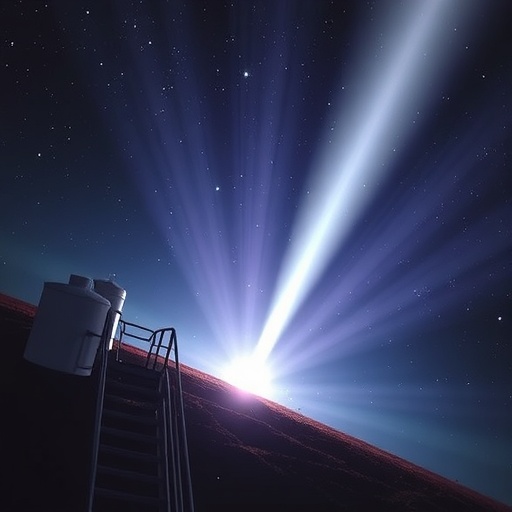
Three years ago, deep beneath the Mediterranean Sea, an unprecedented cosmic event was captured by the KM3NeT/ARCA neutrino detector—an ultra-high-energy neutrino exhibiting energy levels far beyond any previously recorded. The neutrino’s energy exceeded that of all prior detections by over an order of magnitude, sparking widespread intrigue across the international scientific community. This remarkable observation challenged existing models of particle astrophysics and opened a new chapter in the quest to unravel the origins of the most energetic particles known in the universe. The source of this enigmatic neutrino remains unknown, presenting massive implications for our understanding of cosmic accelerators and high-energy particles.
KM3NeT/ARCA, an underwater neutrino observatory nestled off the coast of Sicily, is designed to detect neutrinos by capturing the faint Cherenkov radiation emitted as secondary particles traverse the Mediterranean water. Despite still being under construction at the time of the event, with only a fraction of its full volume operational, the detector recorded a neutrino of approximately 220 petaelectronvolts (PeV). This energy level is considerably higher than those previously measured by detectors like IceCube at the South Pole, representing a fundamentally new data point in high-energy neutrino astronomy. The collaboration behind KM3NeT meticulously analyzed this extraordinary signal, aiming to trace the astrophysical origin of such a rare and energetic particle.
To uncover potential sources, researchers employed a forensic-like methodology, simulating various astrophysical scenarios to generate theoretical predictions and comparing them rigorously against all available observational data. Their hypothesis centers on blazars—extremely energetic active galactic nuclei that house supermassive black holes emitting jets of plasma pointed almost directly at Earth. Blazars have long been suspected as prolific sources of high-energy cosmic rays and neutrinos, owing to their extreme environments where particles can be accelerated to near-light speeds. By modeling blazar populations with physically motivated parameters, researchers sought to determine if these celestial engines could plausibly account for the observed neutrino event.
Crucially, the analysis accounts for the absence of any electromagnetic counterpart—no coincident signals were detected in radio, optical, X-ray, or gamma-ray wavelengths at the time the neutrino passed through the detector. Typically, neutrino detections linked to astrophysical transient events are accompanied by flare emissions observable across the electromagnetic spectrum. The lack of such signals hints at a diffuse origin, rather than a singular explosive or flare event. This observation steered scientists toward modeling a population of blazars contributing collectively to a diffuse neutrino background, rather than attributing the event to one isolated source.
Utilizing the open-source simulation framework AM3, the research team incorporated known parameters such as magnetic field strength and emission region size, while varying critical factors like baryonic loading—the ratio of energy carried by protons relative to electrons—and the proton energy spectral index. These adjustments informed predictions on how efficiently neutrinos could be produced in blazar jets while maintaining consistency with known astrophysical characteristics. By iterating over these parameters, comprehensive simulations generated expectations for both neutrino and gamma-ray fluxes, establishing a robust framework for comparison with actual astronomical data.
In a novel interdisciplinary effort, the researchers integrated observational constraints not only from KM3NeT but also from the IceCube Neutrino Observatory and the Fermi Gamma-ray Space Telescope. This multi-instrument approach enabled cross-validation of results, leveraging strengths and observational limits of each detector. IceCube’s extensive data set lacked signals comparable to KM3NeT’s ultra-high-energy neutrino, a factor that any viable explanation must accommodate by suggesting the rarity of such high-energy events. Concurrently, gamma-ray data measured by Fermi allowed the team to ensure that the hypothesized blazar population does not overproduce gamma rays, which would conflict with the observed extragalactic gamma-ray background.
The results compellingly indicate that a realistic blazar population could account for the source of this extraordinary neutrino event. The nuanced interplay between neutrino and gamma-ray data supports a scenario where blazars act as cosmic accelerators capable of propelling particles to energies exceeding prior expectations. This reconciles observed ultra-high-energy neutrinos with existing astrophysical phenomena while abiding by known constraints from complementary observational channels. These findings provide fresh insight into the mechanisms behind particle acceleration in extreme environments and underscore blazars as prime candidates for sources of ultra-high-energy cosmic neutrinos.
Despite these exciting advances, significant challenges and uncertainties remain. The hypothesis still awaits further confirmation, primarily hinging on the availability of additional data. At the time of the neutrino detection, KM3NeT was only partially operational, with just 21 detection lines active—approximately 10% of the final detector configuration planned. As construction progresses and more detection lines come online, the completed KM3NeT array will possess enhanced sensitivity and volume, enabling more frequent and statistically robust observations of ultra-high-energy neutrinos. This will elevate KM3NeT’s role in unraveling the mysteries of the high-energy universe.
The broader scientific implications of confirming blazars as sources of ultra-high-energy neutrinos are profound. It would necessitate revisiting existing models of jet physics in active galactic nuclei, potentially reshaping our comprehension of particle acceleration processes at cosmic scales. Such neutrinos also provide a unique probe into astrophysical environments otherwise inaccessible through electromagnetic observations alone, offering new windows into the extreme conditions surrounding supermassive black holes. Bridging the gap between neutrino astronomy and traditional photon-based observations, this discovery could spearhead future multi-messenger astrophysics breakthroughs.
Furthermore, the exceptional energy scale of the KM3NeT/ARCA event challenges current theoretical frameworks on cosmic ray generation and propagation. The observed neutrino’s energy surpasses that expected from interactions with the cosmic microwave background radiation, indicating the necessity for alternative or more complex acceleration mechanisms within blazar jets. These findings propel theoretical exploration into novel particle acceleration scenarios, encompassing shock acceleration, magnetic reconnection, and interactions within relativistic jets. The high energies probed by neutrinos thus provide critical constraints for particle physics and astrophysics models at the most extreme frontiers.
In sum, the detection of the ultra-high-energy neutrino by KM3NeT, coupled with the nuanced multi-source modeling implicating blazars, heralds a new era in high-energy astrophysics. As KM3NeT expands and other observatories continue to improve, the accumulation of more data will allow the scientific community to rigorously test these hypotheses, ultimately elucidating the origin of such cosmic neutrinos. These insights promise to enrich our understanding of the energetic processes sculpting the cosmos, reaffirming the transformative power of neutrino astronomy as a complementary tool in exploring our universe’s most violent and energetic realms.
Subject of Research: Ultra-high-energy neutrinos and their astrophysical origins
Article Title: Blazars as a Potential Origin of the KM3-230213A Event
News Publication Date: 9-Mar-2026
Image Credits: Credits KM3NeT
Keywords
Neutrinos, Blazars, Observatories, Universe, Astroparticle physics


