


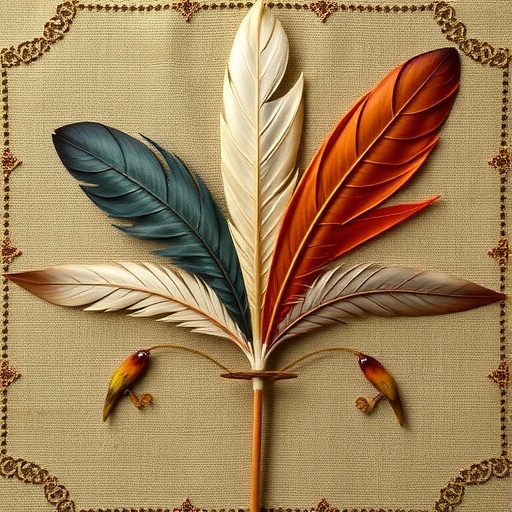
The intricate art of featherwork has long captivated historians and art enthusiasts alike, with its vibrant hues and delicate craftsmanship telling stories of cultural heritage and natural beauty. Among these, the traditional Chinese technique known as tian-tsui stands out, showcasing the extraordinary use of iridescent bird feathers—particularly those of the kingfisher—to create dazzling works of art during the Qing Dynasty. For centuries, these feathered masterpieces, often used in decorative screens and ceremonial headdresses, have defied detailed scientific scrutiny due to the fragile nature of their constituent materials.
Traditional analytical methods, which often require physical sampling or invasive procedures, have been ineffective or damaging when applied to these delicate artifacts. Recognizing this challenge, a team of researchers has developed novel, non-destructive techniques to probe the structural and chemical makeup of tian-tsui featherworks, enabling unprecedented insights into their composition and the artistry behind them. Their groundbreaking study, recently published in ACS Omega, leverages advanced spectroscopic and imaging modalities to decode the complex colors and materials that compose these cultural treasures.
At the heart of tian-tsui’s mesmerizing color palette lies the phenomenon of structural color—a physical effect that arises not from pigments but from microscopic nanostructures within bird feathers. These structures manipulate light through reflection, refraction, and scattering at a nanoscale, producing vivid blues, purples, and greens with an intensity and depth rarely achieved by pigments alone. In kingfisher feathers, for instance, arrays of melanosomes are arranged in precise layers that interfere with incoming light waves, selectively amplifying certain wavelengths and creating the bird’s signature iridescence.
To unravel the intricacies of these feathers without damaging them, the researchers employed a combination of hyperspectral imaging, confocal microscopy, and Raman spectroscopy. These complementary techniques harness the interaction of light with feather nanostructures and chemical constituents to generate high-resolution images and spectral fingerprints. Such approaches allowed the team to distinguish between feathers from different bird species and to detect underlying pigment layers that contribute to the overall visual effect of the artifacts.
Analysis focused on a particularly elaborate tian-tsui screen dating back to the late 18th or early 19th century. This decorative panel presented a mosaic of colors and textures, each corresponding to feathers sourced from various avian species. By carefully mapping the optical and molecular characteristics, the team identified the brilliant blues as belonging to the common kingfisher, while the subtle purples were linked to the black-capped kingfisher. Interestingly, the green feathers displayed distinct nanostructural features, revealing that they originated from an entirely different bird, the mallard duck.
Beyond feather identification, the study uncovered evidence of materials layered beneath the feather surfaces that contributed further to the artwork’s complexity. The researchers detected mercury(II) sulfide, also known as cinnabar, a traditional red pigment used in ancient Chinese art. This pigment was found beneath magenta regions, coupled with the feathery blues and purples, indicating sophisticated layering techniques employed by the artisans to enrich color saturation and depth. This intricate interplay between structural color and pigment highlights the artisans’ profound understanding of material science.
The implications of this research extend beyond mere identification; they illuminate the comprehensive material knowledge and artistic mastery instrumental in creating these culturally significant artifacts. The integration of biological nanostructures with traditional pigments exemplifies a nuanced synthesis of natural resources and human creativity. Such findings challenge simplistic notions of featherworks as mere decorative objects and elevate them to the status of technologically advanced artworks.
Looking forward, the research team plans to apply their suite of investigative methods to other tian-tsui items, including a collection of ornate headdresses dating from similar periods. Understanding the structural and chemical basis of their coloration will not only enrich historical scholarship but also guide conservation efforts by providing detailed knowledge of the materials’ aging and degradation mechanisms. Moreover, the use of synchrotron radiation methods offers the promise of even more refined nanoscale insights into the morphology and optical properties of feathers.
This pioneering research underscores the transformative power of interdisciplinary collaboration, uniting chemistry, materials science, art conservation, and natural history. Conducted at the Center for Scientific Studies in the Arts, in partnership with natural and art museums, the project exemplifies how modern analytical technologies can breathe new life into ancient artworks. Insights garnered from this study will likely influence future approaches to examining other structural color-based cultural artifacts globally.
The researchers emphasize that understanding color in historical artifacts is a multifaceted challenge spanning multiple scales, from the macroscopic arrangement to the nanoscopic structural designs. The delicate balance between the physical structuring of feathers and the chemical properties of layered pigments creates a dynamic optical environment that demands sophisticated characterization tools. The innovative combination of imaging and spectroscopic techniques developed here sets a new standard for non-invasive cultural heritage science.
Ultimately, this study not only preserves the legacy of Qing Dynasty artisans but also invites a reevaluation of natural materials in art history. The use of feathers as a pigment-like medium highlights a sustainable and renewable resource whose physical properties have been harnessed with remarkable ingenuity. As science continues to illuminate the subtleties of these historical artefacts, it fosters a deeper appreciation for the intersection of nature’s brilliance and human craftsmanship.
The findings published by this research group mark a significant milestone in the scientific investigation of featherwork art, paving the way for further explorations into the nanotechnology of natural materials used in cultural expressions. With ongoing advances in imaging and synchrotron-based techniques, the color science community stands poised to unlock secrets held within other ancient materials, broadening the understanding of historical artistry around the world.
News Publication Date: 12-May-2026
Web References:
http://dx.doi.org/10.1021/acsomega.6c02770
Keywords
Structural color, tian-tsui, featherwork art, kingfisher feathers, Qing Dynasty, non-destructive analysis, hyperspectral imaging, Raman spectroscopy, mercury(II) sulfide, cinnabar, nanostructures, cultural heritage, art conservation
Cite Scienmag News
Bethany Barker. (May 12, 2026). Illuminating the Science Behind Historical Featherwork Art. Scienmag. https://scienmag.com/illuminating-the-science-behind-historical-featherwork-art/
Bethany Barker. "Illuminating the Science Behind Historical Featherwork Art." Scienmag, 12 May 2026, https://scienmag.com/illuminating-the-science-behind-historical-featherwork-art/. Accessed 3 September 2026.
Bethany Barker. "Illuminating the Science Behind Historical Featherwork Art." Scienmag. May 12, 2026. https://scienmag.com/illuminating-the-science-behind-historical-featherwork-art/


