


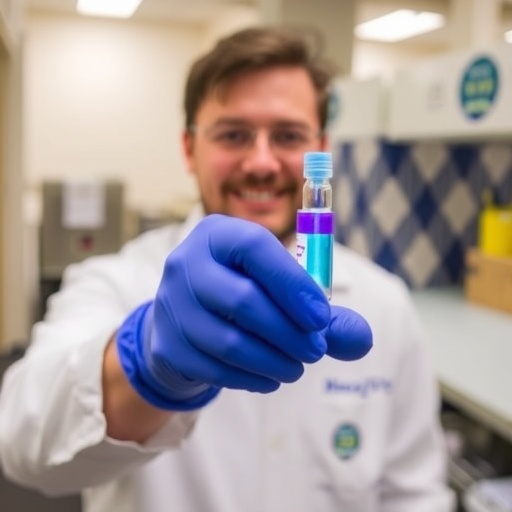
In a groundbreaking collaboration bridging academia and industry, researchers at Boise State University together with Pearlhill Technologies, LLC, have unveiled a pioneering portable device that detects per- and polyfluoroalkyl substances (PFAS) in water with unprecedented speed and precision. PFAS, often dubbed “forever chemicals,” represent a global public health emergency due to their persistence in the environment and detrimental health impacts, including links to cancer and immune system disorders. The newly developed Environmental Optically Gated Transistor (ENVIR-OGT) leverages advanced transistor technology integrated with machine learning algorithms, delivering real-time PFAS detection in the field at trace concentration levels aligned with stringent EPA standards.
PFAS contamination presents a critical challenge; these synthetic chemicals permeate drinking water, food packaging, cookware, apparel, and myriad consumer goods. The most hazardous variants, including perfluorooctane sulfonic acid (PFOS) and perfluorooctanoic acid (PFOA), accumulate in biological systems, causing severe health consequences such as infertility, developmental impairments in infants, and various malignancies. Traditional methods for detecting PFAS rely predominantly on sophisticated laboratory setups employing liquid chromatography-mass spectrometry (LC-MS). These methods are labor-intensive, time-consuming—with sample turnaround times extending to several weeks—and financially prohibitive due to equipment complexity and the cost of specialized reagents.
Addressing these limitations, the ENVIR-OGT device embodies a quantum leap forward by concretely transforming PFAS detection from a slow, centralized laboratory process into a rapid, decentralized, and cost-effective field analysis tool. The device’s design ingeniously incorporates optically gated transistors that are inherently sensitive to the unique chemical signatures of PFAS molecules. By coupling these advanced sensors with tailored machine learning models, the system differentiates between closely related PFAS species, accurately identifying compounds at concentrations as low as one part per trillion. Such sensitivity meets or exceeds current U.S. EPA regulatory thresholds, marking an extraordinary achievement for on-site water quality assessment.
A significant innovation lies in the device’s capacity to detect not only the well-studied long-chain PFAS like PFOS and PFOA but also ultra-short chain molecules such as perfluoropropanoic acid (PFPrA) with an accuracy of 97 percent. This adaptation is crucial as regulatory agencies and scientists increasingly recognize the varied toxicokinetic profiles of different PFAS compounds, necessitating comprehensive detection tools. The real-time detection capability, combined with portability and affordability, positions ENVIR-OGT as a disruptive technology with vast applications ranging from environmental monitoring to industrial wastewater control.
The inception of this technology traces back to an unanticipated observation in an electrical engineering laboratory at Boise State, where exposure to human breath inadvertently altered transistor responses during routine experiments. This serendipitous discovery sparked curiosity that blossomed into a robust research endeavor, characterized by the fusion of microfabrication techniques and artificial intelligence. Master’s student Jacob Jackson pioneered the application of machine learning to decode complex transistor response patterns, enabling chemical discrimination. His colleague, doctoral candidate Lukas Crockett, recalls the painstaking early phases, describing a gradual transition from ambiguous signals to consistent PFAS detection, marking a pivotal validation moment.
Over several years, Professor Kris Campbell and Pearlhill Technologies President Bamidele Omotowa directed their expertise toward customizing transistor structures and refining machine learning algorithms to enhance sensitivity and selectivity. This iterative development process took place within Boise State’s Idaho Microfabrication Lab, where micro- and nano-fabrication techniques were employed to optimize device architecture. The resultant technology amalgamates semiconductor device physics with advanced data science, producing a low-cost apparatus capable of transforming environmental toxicology screening.
The project’s significance has garnered national recognition supported by competitive research funding, notably an NIH Small Business Technology Transfer award awarded to Pearlhill Technologies with Boise State as a subawardee. This collaborative funding facilitated intellectual property protection and commercialization pathways, reflecting the high priority public health community places on PFAS mitigation. The award underscores the technology’s potential societal impact by accelerating environmental monitoring and enabling timely regulatory responses.
Further emphasizing the regional relevance, the technology promises to address Idaho’s burgeoning semiconductor manufacturing sector, an industry identified as a notable PFAS emission source. Planned investigations, supported by the national UPWARDS program, aim to validate ENVIR-OGT’s efficacy in analyzing semiconductor wastewater streams. This initiative exemplifies how scientific innovation can intersect with local industrial needs to formulate sustainable pollution control strategies. Collaborations with Boise State’s School of the Environment and Department of Chemistry ensure multidisciplinary approaches in understanding the device’s performance across complex aqueous environments.
The implications of portable, machine learning-enhanced PFAS detection reverberate beyond academia, holding transformative possibilities for public health agencies, environmental regulators, and industries. By enabling rapid on-site decision-making, the ENVIR-OGT device may revolutionize monitoring protocols, significantly reducing latency between sampling and intervention. Additionally, its low operational cost broadens accessibility for resource-limited regions, democratizing environmental data acquisition previously unattainable due to infrastructural constraints.
Beyond environmental applications, the underlying principles—integrating optically gated transistors with artificial intelligence—hint at versatile prospects in chemical sensing technologies. Insights gained through this research could spur innovations in biosensing, hazardous material detection, and beyond. The cross-disciplinary collaboration between electrical engineering, environmental science, and data analytics epitomizes contemporary scientific inquiry’s complexity and the necessity of integrative problem-solving.
Professor Campbell remarks on the system’s transformative potential for field deployment, emphasizing its affordability and speed alongside sensitivity comparable to laboratory systems. Such statements underscore the aspirational shift toward decentralized, real-time environmental diagnostics, a paradigm enabled by this unique combination of advanced hardware and intelligent software. The journey from an unintentional laboratory finding to a life-saving innovation exemplifies ingenuity fueled by perseverance and collaborative efforts.
As environmental challenges escalate globally, tools like the ENVIR-OGT device are crucial for proactive and informed management of contamination. Its capacity to detect PFAS in situ provides immediate feedback essential for environmental stewardship, pollution control, and public health protection. In this context, the device represents much more than a sensor—it embodies hope for mitigating the pernicious effects of persistent pollutants threatening ecosystems and human well-being.
Boise State University continues to champion transformative educational research integrating engineering innovation with societal impact. The partnership fostering this technology illustrates academic institutions’ pivotal role in nurturing inventions that translate into practical solutions, accelerating the transition from laboratory proof-of-concept to real-world application. The NIH-funded research further exemplifies sustained national investment in tackling complex environmental health crises using cutting-edge science.
Looking forward, ongoing interdisciplinary collaboration aims to expand the device’s operational repertoire, testing diverse water matrices and refining detection algorithms. These efforts will inform industry standards and regulatory frameworks, empowering stakeholders with reliable, actionable data. With further development and scaling, the ENVIR-OGT device promises to become an indispensable instrument in safeguarding water quality, preserving ecosystems, and protecting public health against the persistent threat of PFAS contamination.
Cite Scienmag News
Denise Maddox. (May 12, 2026). Boise State University Researchers Pioneer Rapid, Affordable On-Site Detection Technology for ‘Forever Chemicals’. Scienmag. https://scienmag.com/boise-state-university-researchers-pioneer-rapid-affordable-on-site-detection-technology-for-forever-chemicals/
Denise Maddox. "Boise State University Researchers Pioneer Rapid, Affordable On-Site Detection Technology for ‘Forever Chemicals’." Scienmag, 12 May 2026, https://scienmag.com/boise-state-university-researchers-pioneer-rapid-affordable-on-site-detection-technology-for-forever-chemicals/. Accessed 3 September 2026.
Denise Maddox. "Boise State University Researchers Pioneer Rapid, Affordable On-Site Detection Technology for ‘Forever Chemicals’." Scienmag. May 12, 2026. https://scienmag.com/boise-state-university-researchers-pioneer-rapid-affordable-on-site-detection-technology-for-forever-chemicals/


