


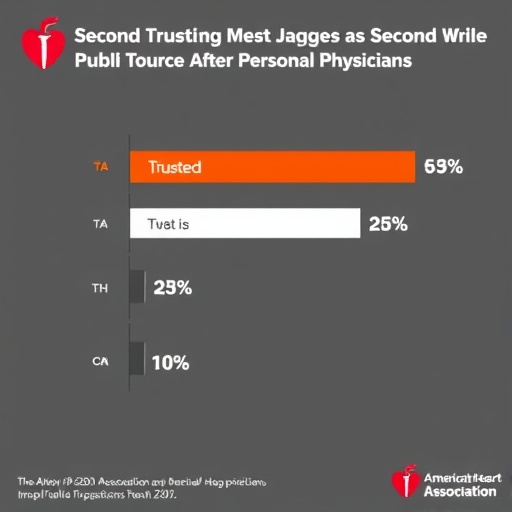
At a time marked by an unprecedented erosion of public confidence in health information, the American Heart Association (AHA) has emerged as a beacon of trust, according to new data released by the independent Annenberg Public Policy Center (APPC) at the University of Pennsylvania. The latest poll reveals that a significant majority of Americans—over 82%—express strong confidence in the AHA as a reliable source of public health information, ranking it directly after their own personal physicians in trustworthiness.
This survey underscores a crucial dynamic in the current health communication landscape: while individuals predominantly rely on their healthcare providers for credible information, there is a conspicuous and robust trust in professional health and scientific bodies that adhere to rigorous evidence-based standards. The American Heart Association, with its century-long legacy of advancing cardiovascular and cerebrovascular health, clearly occupies a central role in this network of trusted institutions.
The APPC study involved a nationally representative sample of 1,650 adults and was conducted amid a complex ecosystem of health information dissemination characterized by the proliferation of misinformation and disinformation. It highlights Americans’ discernment in differentiating between advice from personal clinicians, career scientists at U.S. health agencies, and organizational leaders, with the former two categories receiving substantially higher confidence ratings.
Nancy Brown, CEO of the American Heart Association, interprets the findings as a testament to the Association’s unrelenting commitment to scientific rigor, transparency, and integrity. She emphasizes that maintaining public trust in an era saturated with conflicting health narratives necessitates ongoing diligence and adherence to the highest standards of evidence. The AHA’s multidisciplinary volunteers, professional staff, community advocates, and philanthropic partners collectively underpin this formidable trust.
For over 100 years, the AHA has been at the forefront of research and guideline development relating to the prevention, diagnosis, and treatment of cardiovascular diseases and stroke. Its capacity to convert complex scientific findings into actionable, understandable, and trustworthy guidance has positioned it as a critical instrument in public health. This expertise and careful stewardship are vital in combating the increasing tide of health misinformation that challenges public understanding and decision-making.
The broader implications of the APPC’s findings are significant for the entire public health communication field. In an information environment that is not only crowded but often polarized and fragmented, the role of independent, science-driven organizations in mediating trustworthy health guidance becomes indispensable. The public’s alignment with such entities suggests a foundation upon which credible health promotion initiatives can be reliably built.
From a technical standpoint, the methodology of this survey leveraged robust sampling techniques to ensure representation across multiple demographic strata, enhancing the reliability and applicability of its conclusions. The margin of error, approximately 3.5 percentage points, affords a high confidence level in the accuracy of the reported trust metrics. Notably, the American Heart Association had no influence on the poll design or data analysis, affirming the independence and objectivity of the findings.
These revelations emerge in parallel with a growing scientific emphasis on transparency in public health messaging, especially amid the COVID-19 pandemic and other ongoing health crises. The clear delineation between trusted clinical sources and health agencies reflects the importance of evidence-based policy originally evolved through such institutions—a dynamic vividly captured by this APPC survey.
The American Heart Association’s enduring relevance is further reinforced through its dynamic approach to integrating science, policy advocacy, and grassroots engagement. The synergy of these elements helps combat health disparities and promotes equitable health outcomes, responding to the pressing needs of diverse communities, including those disproportionately affected by cardiovascular diseases.
Further, the findings shed light on the psychological underpinnings of public trust. Trust is not merely a function of information accessibility but the perceived integrity, competence, and values alignment of information sources. The AHA’s engagement in continuous scientific scrutiny and open communication likely fosters these attributes, promoting resilience in public trust compared to fragmented or politically influenced information sources.
This landscape also emphasizes how professional health organizations can play a pivotal role in the ecosystem of health literacy, empowering individuals to make informed decisions amidst competing narratives. By maintaining an unwavering foundation in scientific evidence, such bodies provide a counterbalance to misinformation, helping to stabilize public health behaviors and outcomes.
The APPC results invite a reconsideration of how public health information is disseminated and consumed in the digital age. As new technological platforms proliferate, the centrality of trusted, evidence-driven organizations like the American Heart Association becomes more necessary than ever, requiring innovative communication strategies to sustain and expand public confidence.
In sum, the Annenberg Public Policy Center’s 2026 survey paints a compelling portrait of public trust in health information sources within the U.S., highlighting the American Heart Association’s distinguished position immediately following personal physicians. It underscores the critical importance of transparency, scientific rigor, and integrity in health communication and serves as a call to action for all health organizations to uphold these principles in the face of challenges posed by misinformation and evolving public health demands.
News Publication Date: March 6, 2026
Web References:
- APPC news release: https://www.annenbergpublicpolicycenter.org/stark-divide-americans-more-confident-in-career-scientists-at-u-s-health-agencies-than-leaders/
- American Heart Association newsroom: https://newsroom.heart.org/news/new-poll-american-heart-association-most-trusted-public-health-source-after-personal-physician
- American Heart Association official site: http://www.heart.org/en
References:
Annenberg Public Policy Center, “Stark Divide: Americans More Confident in Career Scientists at U.S. Health Agencies Than Leaders,” March 5, 2026.
Cite Scienmag News
Phoebe Ingram. (March 6, 2026). New Poll Reveals American Heart Association as Second Most Trusted Public Health Source After Personal Physicians. Scienmag. https://scienmag.com/new-poll-reveals-american-heart-association-as-second-most-trusted-public-health-source-after-personal-physicians/
Phoebe Ingram. "New Poll Reveals American Heart Association as Second Most Trusted Public Health Source After Personal Physicians." Scienmag, 6 March 2026, https://scienmag.com/new-poll-reveals-american-heart-association-as-second-most-trusted-public-health-source-after-personal-physicians/. Accessed 3 September 2026.
Phoebe Ingram. "New Poll Reveals American Heart Association as Second Most Trusted Public Health Source After Personal Physicians." Scienmag. March 6, 2026. https://scienmag.com/new-poll-reveals-american-heart-association-as-second-most-trusted-public-health-source-after-personal-physicians/


