


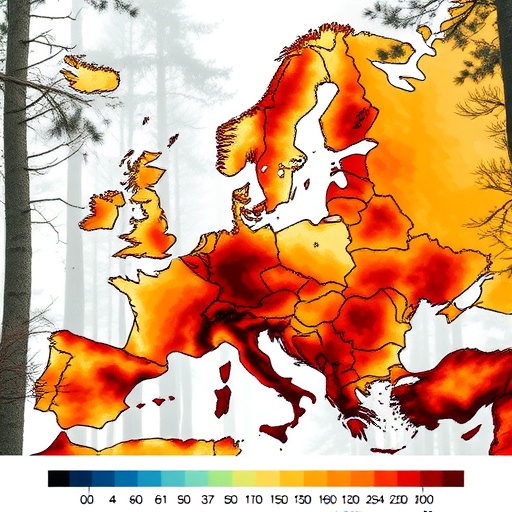
A groundbreaking international study published in the prestigious journal Science has revealed a troubling projection for the future of European forests under climate change. Forest damage caused by wildfires, storms, and bark beetle outbreaks is expected to rise significantly throughout the 21st century, regardless of climate mitigation efforts. This alarming trend underscores the urgent need for enhanced forest management strategies and aggressive emissions reductions in other sectors to mitigate the cascading effects on carbon cycles.
The research utilizes state-of-the-art computational simulation and modeling techniques to quantify the extent of forest disturbances across Europe, revealing that even in optimistic scenarios limiting global warming to approximately 2°C, the area of annually disturbed forest could increase substantially. From an already unprecedented annual average of around 180,000 hectares between 1986 and 2020, disturbed forest areas may reach approximately 216,000 hectares by the century’s end. This projection depicts a worrying escalation in ecosystem stress tied directly to changing climate parameters.
The situation deteriorates further under scenarios where fossil fuel consumption persists unabated. In these high-emission scenarios, the annual impacted forest area could nearly double, hitting close to 370,000 hectares per year by 2100. Such substantial losses in forest integrity would not only diminish Europe’s terrestrial carbon sinks but would also recalibrate the continent’s ecological balance, with widespread repercussions on biodiversity, soil health, and hydrological cycles.
Forests have long been recognized as critical components in the global carbon budget because they sequester and store vast amounts of CO2, mitigating the pace of climate change. However, the increasing frequency and intensity of disturbances compromise this function severely. Christopher Reyer, a scientist at the Potsdam Institute for Climate Impact Research (PIK) and co-author of the study, highlights the profound implications by noting that future European forests might absorb less carbon or, in some instances, even become net carbon sources. This shift would place additional pressure on industrial and agricultural sectors to accelerate their reduction in greenhouse gas emissions to compensate for diminished forest carbon uptake.
The geographical distribution of projected forest damage is uneven across the continent. Southern and Western Europe are predicted to bear the brunt of climate-induced disturbances, with these regions experiencing the most pronounced changes in disturbance regimes due to greater climatic stressors such as heatwaves and prolonged droughts. Conversely, Northern Europe, while expected to face comparatively milder impacts, is not exempt. The study points out the likely emergence of damage hotspots even in these cooler regions, signaling a continent-wide vulnerability.
Meteorological phenomena such as increasingly intense wildfires and storms are primary contributors to forest disturbances. The exacerbation of wildfire frequency and scale is linked to rising temperatures and decreased precipitation patterns, creating fuel-rich environments susceptible to ignition. Similarly, severe storms are poised to cause extensive structural damage to forests, uprooting trees and creating opportunities for pests and pathogens to spread rapidly.
An equally pernicious driver of forest degradation highlighted in the study is the proliferation of bark beetle outbreaks, which thrive under warmer conditions and weakened tree defenses. Bark beetle infestations cause large-scale mortality, creating vast stands of deadwood that further elevate wildfire risks and disrupt ecosystem services.
The research team, led by experts at the Technical University of Munich (TUM) and including collaborators from the Potsdam Institute for Climate Impact Research, employed advanced ecosystem and climate models integrating a multitude of variables. These models simulate forest growth dynamics, disturbance frequencies, and feedback mechanisms under various climate change scenarios to provide robust forecasts over the 21st century.
This interdisciplinary approach underscores the complex interactions between climatic drivers and biological processes and highlights the importance of continuous monitoring and adaptive forest management. Enhancing forest resilience may involve strategies such as promoting species diversity, maintaining forest structure heterogeneity, and implementing early-warning systems for disturbances.
The current projections also have significant policy implications. They reveal that mitigation efforts focusing solely on fossil fuel emissions without parallel strategies to bolster forest health and resilience may fall short in meeting climate stabilization goals. Preserving Europe’s forests demands integrated approaches combining climate action, sustainable forestry practices, and biodiversity conservation.
The study provides critical data for stakeholders across government, forestry, conservation, and climate science fields to recalibrate priorities and investments. It invites a reconsideration of forest policies, advocating for proactive measures to counterbalance the intensifying impact of climate change on forest ecosystems.
In summary, the findings from this comprehensive study emphasize a clear and pressing message: without substantial reductions in greenhouse gas emissions and strategic enhancements in forest management, European forests will face unprecedented disturbances. These changes threaten not only the ecological integrity of forest landscapes but also the vital carbon sequestration services forests provide in the global climate system.
Cite Scienmag News
Sloane Callahan. (March 5, 2026). European forest damage projected to increase by approximately 20% by 2100, even with warming capped at 2°C. Scienmag. https://scienmag.com/european-forest-damage-projected-to-increase-by-approximately-20-by-2100-even-with-warming-capped-at-2c/
Sloane Callahan. "European forest damage projected to increase by approximately 20% by 2100, even with warming capped at 2°C." Scienmag, 5 March 2026, https://scienmag.com/european-forest-damage-projected-to-increase-by-approximately-20-by-2100-even-with-warming-capped-at-2c/. Accessed 5 September 2026.
Sloane Callahan. "European forest damage projected to increase by approximately 20% by 2100, even with warming capped at 2°C." Scienmag. March 5, 2026. https://scienmag.com/european-forest-damage-projected-to-increase-by-approximately-20-by-2100-even-with-warming-capped-at-2c/


