


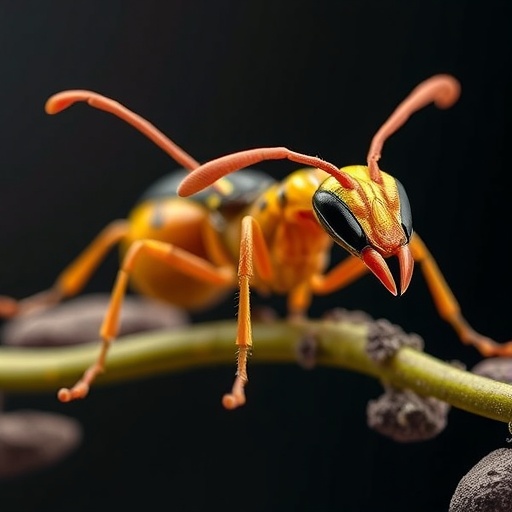
For over a decade, researchers in Evan Economo’s laboratory have relied on micro-computed tomography (micro-CT) to delve into the intricate world of insect morphology. Utilizing this advanced X-ray technology, they have painstakingly scanned insect specimens, capturing detailed structural data that affords unparalleled insight into the physical form and internal anatomy of these creatures. However, the traditional micro-CT process is fundamentally constrained by the sheer duration required: a single scan can occupy up to ten hours, creating significant bottlenecks for large-scale studies.
Addressing these limitations, Economo and his collaborators have pioneered an innovative, high-throughput imaging workflow that combines the power of synchrotron radiation, robotic automation, and cutting-edge artificial intelligence. Central to this breakthrough is the deployment of a synchrotron particle accelerator at the Karlsruhe Institute of Technology (KIT) in Germany, which emits an ultra-intense X-ray beam capable of rapidly scanning thousands of specimens with remarkable precision. The integration of automated robotic handlers enables seamless specimen exchange every 30 seconds, allowing continuous, efficient data capture at unprecedented scale.
These combined technological advancements have facilitated the creation of Antscan, a comprehensive digital repository consisting of high-resolution 3D models representing more than 800 ant species from across the globe. The synchrotron-driven scans generate stacks of two-dimensional X-ray images, which are converted into three-dimensional renderings that reveal subsurface anatomical features such as musculature, nervous networks, digestive tracts, and stinger apparatus with micrometer-scale resolution. This volumetric data lays the foundation for a transformative resource that can serve researchers, educators, and even entertainment industries alike.
While the raw scans deliver extraordinary detail, the specimens appear in various unnatural poses due to preservation constraints, complicating direct biological interpretation. To overcome this, students in University of Maryland’s Computer Science department, under Associate Professor James Purtilo’s supervision, have applied machine learning techniques for automated pose reconstruction. By training AI models on Antscan datasets, they have developed algorithms capable of repositioning contorted ant models into lifelike stances encountered in natural environments. This step dramatically enhances the utility of the database, enabling realistic animations and immersive virtual reality experiences.
The scope and depth of Antscan’s digitized biodiversity surpass prior efforts in entomology and morphology. Economo emphasizes that the repository is not merely a static collection; rather, it functions as a dynamic living library that democratizes access to biological form, allowing scientists globally to parse morphological diversity at scale and temporal speed previously unattainable. The open availability of raw 3D data alongside intuitive web-based visualization tools accelerates discovery and interdisciplinary collaboration.
The implications of this methodology are far-reaching. For example, the precise quantification of cuticle volume across ant species facilitates studies linking morphology with ecological traits and evolutionary strategies. In a recent investigation supported by Antscan, Economo and colleagues discovered an inverse relationship between cuticle thickness and colony size among over 500 species. This finding suggests evolutionary trade-offs where colonies optimize population size and diversity over individual physical armament, reflecting resource allocation pressures on nitrogen and mineral investments inherent in exoskeletal development.
Beyond ecological insights, the Antscan project establishes a framework to integrate morphological phenomics with burgeoning genomic datasets. Complementary studies that have sequenced high-quality ant genomes provide an exciting opportunity to correlate genetic variation with detailed phenotypic traits captured in these 3D scans. Such integrative approaches promise to unravel the complex genetic architectures underpinning biodiversity and adaptation in unprecedented detail.
From a technical perspective, the scalability achieved by the combined synchrotron, robotics, and AI pipeline is staggering. Julian Katzke, a lead author on the foundational paper, notes that what would have required six uninterrupted years of traditional lab scanning to complete was condensed into a single week using this state-of-the-art infrastructure. This dramatic acceleration opens the door to digitizing vast collections housed in museums and research institutions worldwide with unparalleled efficiency.
Looking ahead, the research team envisions expanding the Antscan library, scanning additional specimens to broaden species coverage and refine morphological representations. Concurrently, ongoing collaborations with computer science experts aim to enhance AI-driven pose estimation, develop advanced segmentation algorithms, and enable machine learning models capable of detecting ants in natural field environments from image and video data. This fusion of biology, engineering, and data science exemplifies modern interdisciplinary research pushing the boundaries of biodiversity exploration.
Antscan also holds educational potential, allowing students from primary to tertiary levels to interact virtually with detailed models of organisms that are otherwise difficult to observe firsthand. Such immersive access can foster interest in entomology, evolutionary biology, and computational sciences. Similarly, the entertainment industry can leverage these scientifically accurate models to enhance visual effects, virtual realities, and documentary storytelling with authentic biological detail.
Ultimately, the advent of Antscan heralds a new era in organismal biology, where high-throughput phenomics integrates seamlessly with genomics, artificial intelligence, and digital archiving. By harnessing these technologies, scientists can systematically capture, analyze, and disseminate the diverse shapes and internal architectures of life on Earth, creating foundational resources that advance science and enrich public understanding for years to come.
News Publication Date: 5-Mar-2026
Web References:
References:
- Economo, E.P., Katzke, J., van de Kamp, T., et al. (2026). High-throughput phenomics of global ant biodiversity. Nature Methods. DOI: 10.1038/s41592-026-03005-0
- Supporting studies in Science Advances and Cell, exploring ant society dynamics and genomic diversity.
Cite Scienmag News
Drew Townsend. (March 5, 2026). UMD Entomologist Brings Global Ant Diversity to Life with Stunning 3D Imagery. Scienmag. https://scienmag.com/umd-entomologist-brings-global-ant-diversity-to-life-with-stunning-3d-imagery/
Drew Townsend. "UMD Entomologist Brings Global Ant Diversity to Life with Stunning 3D Imagery." Scienmag, 5 March 2026, https://scienmag.com/umd-entomologist-brings-global-ant-diversity-to-life-with-stunning-3d-imagery/. Accessed 3 September 2026.
Drew Townsend. "UMD Entomologist Brings Global Ant Diversity to Life with Stunning 3D Imagery." Scienmag. March 5, 2026. https://scienmag.com/umd-entomologist-brings-global-ant-diversity-to-life-with-stunning-3d-imagery/


