


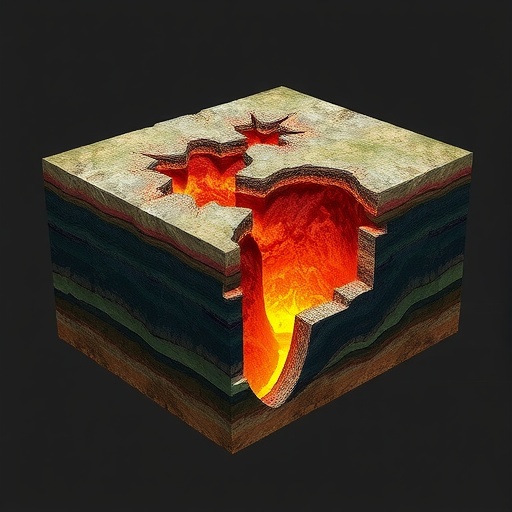
The Earth’s mantle, traditionally considered a vast reservoir of reduced materials, is now increasingly recognized as a dynamic environment influenced by complex redox processes. A groundbreaking study published in Nature Geoscience reveals how the Mariana-type subduction zones play a pivotal role in the oxidation state of the mantle, influencing not only localized geological phenomena but also the planet’s broader oxygenation history. By employing cutting-edge thermomechanical-thermodynamic numerical modeling, researchers have unveiled the intricate mechanisms by which oxidized materials are transported from Earth’s surface deep into its interior, fundamentally altering our understanding of mantle chemistry and the evolution of Earth’s redox budget.
Subduction zones—regions where oceanic plates dive beneath continental or other oceanic plates—have long been known as crucial agents in Earth’s recycling system. The Mariana subduction zone, situated in the western Pacific, stands as the archetype of modern plate tectonic regimes, offering a wealth of data spanning geological, geochemical, and geodynamical observations. These zones are natural laboratories that record the journey of materials from the surface into the deep Earth. The study in question harnesses this exceptional setting to dissect the transfer and transformation of oxidized substances, shedding light on processes that occur over millions of years beneath the Earth’s crust.
Central to the findings is the identification of two distinct but intertwined mechanisms by which mantle oxidation is enhanced during subduction. The first mechanism focuses on the oxidation of sulfides within the subducting slab. As oceanic lithosphere, laden with sulfide minerals, descends into the mantle, these sulfides undergo oxidation reactions. This mineral transformation is critical, as it enables fluids released during subduction to gain a substantial redox capacity. These oxidized fluids then infiltrate the sub-arc mantle—the mantle region lying beneath the volcanic arc built above the subduction zone—significantly altering its chemical environment.
A remarkable component highlighted by the study is the role of partially hydrated mantle rocks. Hydration occurs as seawater penetrates the oceanic lithosphere, altering its mineralogy and physical properties. Such hydrated mantle sections serve as primary carriers of oxidized fluids into the mantle wedge, with altered oceanic crust also contributing but to a lesser extent. This discovery redefines previous perspectives that emphasized altered crust as the dominant oxidized fluid source, demonstrating that the mantle itself, once hydrated, becomes an active conveyor of redox components.
The second oxidation pathway is linked to the behavior of iron-rich partial melts originating from the slab-top sediments and altered oceanic crust. These melts are enriched in ferric iron (Fe^3+), the oxidized form of iron, which is pivotal in controlling the oxidation state of the mantle. As these oxidized melts ascend and interact with the back-arc mantle—the mantle region behind the volcanic arc—they exert powerful oxidizing influences. This process increases the oxidation potential of back-arc mantle domains, with significant implications for magmatism and volcanic gas emissions in the area.
Interestingly, the study reveals that the majority of the oxidized materials subducted at these Mariana-type margins do not remain confined to shallow portions of the mantle but are transported further into the deep Earth. This process marks a crucial vector for the global redistribution of oxidation states, suggesting that the effects initiated at the Earth’s surface extend deep into its interior, potentially influencing the long-term evolution of mantle chemistry and geodynamics.
These findings underscore the intricacies of Earth’s internal chemical cycles, where the interplay between fluids, melts, and solid materials governs the redox landscape. The sophisticated thermomechanical-thermodynamic modeling approach employed by the researchers integrates the physics of mantle deformation with the chemistry of mineral reactions and fluid phases. This holistic perspective provides unprecedented insight into the dynamic evolution of subduction-related oxidation processes over geological timescales.
Understanding mantle oxidation is not only a matter of academic interest but also has profound implications for the Earth’s surface environment. The oxidation state of the mantle influences the composition of volcanic gases emitted at arcs, which in turn impact atmospheric chemistry and climate. Furthermore, these processes are linked to the cycling of volatiles like carbon and sulfur, essential elements in the habitability equation of our planet. The study therefore bridges deep Earth processes with the critical aspects of Earth’s surface environments and its biosphere.
Another striking implication of this work is the historical context it provides for Earth’s oxygenation. The transition to modern plate tectonics, characterized by efficient lithospheric recycling and subduction dynamics similar to the Mariana system, appears intrinsically tied to shifts in the mantle redox state. This link hints that the onset of such tectonic regimes billions of years ago may have catalyzed the gradual oxygenation of Earth’s mantle and, subsequently, the atmosphere.
Moreover, the recognition that oxidized melts derived from sediments and altered crust significantly impact mantle oxidation opens new avenues to assess how surface materials influence deep Earth chemistry. Sediments, which accumulate oxidized materials from biological and atmospheric sources at the ocean floor, effectively serve as a conveyor belt transferring surface redox signals to the deep mantle. This liaison between biosphere-derived oxidation states and geosphere processes adds complexity to the Earth system framework.
The observed dominance of the subducted mantle wedge’s hydration state as the primary carrier of oxidized fluids challenges classical subduction models that often emphasized oceanic crust alteration alone. It prompts a reevaluation of how fluid sources are quantified and integrated in global redox budgets, emphasizing a need to consider mantle hydration dynamically and spatially. This recognition requires improved geophysical and geochemical constraints on mantle hydration patterns within subduction zones worldwide.
In parallel, the influence of oxidized partial melts on back-arc mantle oxidation raises questions about the feedback loops between mantle redox state and arc magmatism. Volcanic arcs are hotspots of melt generation and crustal growth, and their redox state governs the stability of volatile components and the style of volcanic eruptions. By controlling oxidation conditions, oxidized melts from the slab-top sediments and altered crust might directly influence magma composition, eruption dynamics, and element cycling at convergent margins.
The study also deepens our understanding of mass transfer in subduction environments by highlighting the comprehensive journey of oxidized materials. Instead of a simplistic model of oxidation confined to the shallow mantle, the research illustrates a multistage pathway where oxidized fluids and melts sequentially influence the mantle wedge and back-arc mantle before the majority of oxidized material descends into the deeper mantle. This transport mechanism supports a mantle redox heterogeneity narrative and underpins geochemical signatures observed in basalts erupted far from subduction zones.
This research is not only a milestone for Earth sciences but also offers a template for assessing redox processes on other terrestrial bodies with tectonic activity or subduction-like behaviors. Understanding how redox budgets evolve in the interiors of rocky planets is essential for constraining their geological histories and potential habitability, drawing intriguing parallels between Earth and other planetary systems.
Ultimately, the comprehensive modeling and integration of various chemical and physical processes in this study exemplify the power of interdisciplinary approaches in Earth sciences. The findings present a compelling story where dynamic plate tectonics and the chemistry of Earth’s lithosphere converge, contributing fundamentally to the oxygenation and chemical evolution of our planet, and shaping the environmental conditions that sustain life.
As modern plate tectonics continue to sculpt the Earth’s surface and interior, studies like these illuminate the profound connections linking surface processes with deep Earth dynamics. By tracing the pathways and transformations of oxidized components from subduction zones such as the Mariana trench, scientists can refine models of global geochemical cycles, atmospheric evolution, and ultimately, the habitability of our planet on geological timescales.
Cite Scienmag News
Violet Maxwell. (March 4, 2026). Mantle Oxidation Shaped by Mariana Subduction Zones. Scienmag. https://scienmag.com/mantle-oxidation-shaped-by-mariana-subduction-zones/
Violet Maxwell. "Mantle Oxidation Shaped by Mariana Subduction Zones." Scienmag, 4 March 2026, https://scienmag.com/mantle-oxidation-shaped-by-mariana-subduction-zones/. Accessed 7 September 2026.
Violet Maxwell. "Mantle Oxidation Shaped by Mariana Subduction Zones." Scienmag. March 4, 2026. https://scienmag.com/mantle-oxidation-shaped-by-mariana-subduction-zones/


