


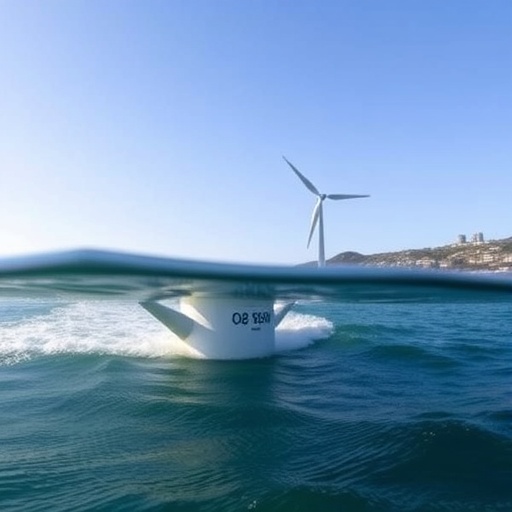
The University of Manchester is spearheading a groundbreaking research initiative aimed at illuminating the complex dynamics of underwater noise produced by tidal-stream turbines and its implications for marine ecosystems. As tidal energy stands poised to become a vital component of the UK’s renewable energy portfolio, this project addresses a pressing need to understand how acoustic emissions from turbine arrays propagate through marine environments and potentially impact wildlife.
Unlike intermittent renewable sources such as wind or solar, tidal energy offers the advantage of predictability and consistency, thanks to the reliable nature of tidal cycles. This predictability enhances the reliability of electricity supply, positioning tidal power as a crucial complement to other green energy forms. However, as deployment scales up to include larger arrays with tens of turbines, environmental concerns, particularly those related to underwater noise pollution and collision hazards for marine fauna, have garnered increasing attention within the scientific and regulatory communities.
Current predictive tools fall short of accurately estimating the cumulative acoustic footprint generated by expansive tidal turbine arrays. Noise generated by these devices can travel remarkable distances underwater, with modelling indicating transmission ranges extending up to eight kilometers. This long-range propagation underscores the critical need for sophisticated analytical methods to forecast the environmental dispersion and intensity of turbine noise pre-deployment.
Dr. Pablo Ouro, lead researcher and Dame Kathleen Ollerenshaw Fellow at Manchester’s Department of Civil Engineering and Management, emphasizes that while tidal-stream energy is instrumental for advancing the UK’s Net Zero objectives, its sustainable development hinges on the ability to mitigate environmental impacts effectively. “Noise generation presents one of the greatest uncertainties in tidal projects,” he states, “and until now, no robust models have existed to predict the combined acoustic emissions of multiple turbines with adequate confidence.”
The research consortium, comprising a diverse group of academic experts, marine engineers, policy developers, and industry practitioners, will develop an innovative computational framework integrating high-fidelity hydrodynamic simulations and artificial intelligence algorithms. This advanced modelling approach aims to mimic authentic marine conditions surrounding tidal arrays, capturing the nuances of underwater noise behavior in both near-field and far-field wake regions generated by turbines.
The project distinguishes itself by evaluating a spectrum of turbine technologies, including both floating and bottom-fixed installations, under varied environmental settings at four significant European tidal energy sites. These sites include the European Marine Energy Centre (EMEC) and the MeyGen project in Scotland, Normandie Hydroliennes in the dynamic Raz Blanchard strait between France and the Channel Islands, and the Morlais project located off the coast of Wales.
The initiative will culminate in the creation of PyTAI—an open-source computational tool engineered to provide rapid, AI-accelerated predictions of acoustic profiles emitted by tidal arrays. By enabling stakeholders to run simulations across diverse operational scenarios, PyTAI is positioned to become an indispensable asset for environmental impact assessments, informing regulatory frameworks and guiding policy formulation with evidence-based insights.
Through enhancing predictive certainty around marine noise pollution, this endeavor aspires not only to accelerate tidal energy deployment but also to safeguard marine biodiversity. The project represents a pivotal step toward harmonizing renewable energy expansion with the conservation imperatives of marine ecosystems, thereby underpinning the emergence of the tidal energy sector as an industry of national strategic importance.
Funded by the UKRI Engineering and Physical Sciences Research Council’s Supergen Offshore Renewable Energy Impact Hub, this interdisciplinary effort bridges research, industry, and regulation. It fosters collaboration among key European turbine manufacturers, tidal project developers from the UK and France, and international academic institutions, ensuring that technological advancements are aligned with practical application and environmental stewardship.
By confronting the challenge of underwater noise with cutting-edge science and cooperative engagement, the University of Manchester and its partners are charting a path forward for sustainable tidal energy growth. Given the urgent global imperative to transition to clean energy, projects like (not)NOISY exemplify how innovation and environmental responsibility can coalesce in the development of future energy infrastructure.
This research is not only a testament to the potential of tidal energy to contribute reliably to global decarbonization goals but also highlights the critical importance of understanding and mitigating the ecological nuances associated with marine renewable technologies. The use of AI-driven acoustic modelling represents a paradigm shift in renewable energy impact assessment, demonstrating how emerging technologies can tackle the multifaceted challenges of energy transition.
Dr. Ouro concludes, “Improving our ability to predict and manage the acoustic environment created by tidal turbines is essential to fostering public trust and ecological resilience. This project will provide the tools industry and regulators need to move forward confidently, ensuring tidal-stream energy can fulfill its promise while preserving the health of our oceans.”
News Publication Date: Not provided
Web References: https://ampeak.energy/tidal-stream/meygen/
References: Not provided
Cite Scienmag News
Faith Mcneil. (March 2, 2026). How Loud Is Clean Energy? Manchester-Led Study Investigates Underwater Noise from Tidal Power. Scienmag. https://scienmag.com/how-loud-is-clean-energy-manchester-led-study-investigates-underwater-noise-from-tidal-power/
Faith Mcneil. "How Loud Is Clean Energy? Manchester-Led Study Investigates Underwater Noise from Tidal Power." Scienmag, 2 March 2026, https://scienmag.com/how-loud-is-clean-energy-manchester-led-study-investigates-underwater-noise-from-tidal-power/. Accessed 4 September 2026.
Faith Mcneil. "How Loud Is Clean Energy? Manchester-Led Study Investigates Underwater Noise from Tidal Power." Scienmag. March 2, 2026. https://scienmag.com/how-loud-is-clean-energy-manchester-led-study-investigates-underwater-noise-from-tidal-power/


