


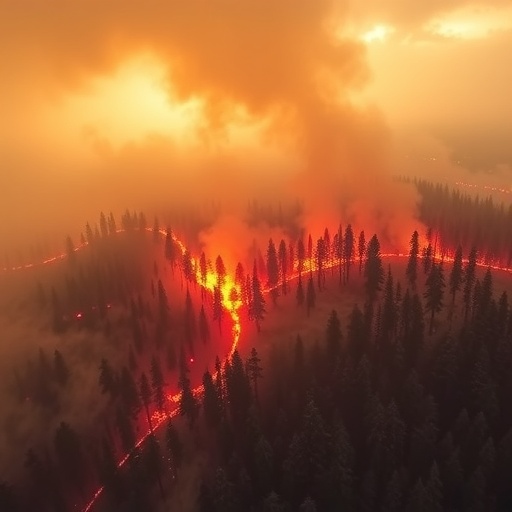
In a groundbreaking advancement in the study of wildfire carbon emissions, researchers at Lund University have unveiled the most comprehensive and precise map of carbon output from forest fires in Sweden. This innovative research fundamentally alters our understanding of where the most significant emissions originate, highlighting the critical role of subterranean peat and organic soil layers in exacerbating climate change. Contrary to previous assumptions that prioritized visible, above-ground fire intensity, this study reveals the silent yet substantial carbon release occurring deep beneath the forest floor.
The summer of 2018 was marked by an unprecedented and extreme heatwave in Sweden, resulting in the outbreak of 324 distinct forest fires. Leveraging an integrative approach that combined extensive field measurements with sophisticated modeling techniques and comprehensive data from several authoritative bodies—the Swedish Forest Agency, the Swedish Environmental Protection Agency, and the Swedish Meteorological and Hydrological Institute—the research team meticulously charted carbon emissions during this critical period. Their findings compel a dramatic reassessment of conventional wildfire carbon accounting methods and their implications for climate models globally.
Traditional fire emission databases have long focused on observable parameters such as the size of burning areas, smoke plumes, and the intensity of flames above the ground. This new study challenges those paradigms by demonstrating a pronounced underestimation of emissions from smoldering fires occurring in peatlands and organic soils. These below-ground combustion events, often invisible to satellite surveillance, intermittently release vast quantities of carbon that contribute significantly to atmospheric greenhouse gases, with emissions underestimated by as much as 50 percent during the 2018 fire season.
Johan A. Eckdahl, a leading forest fire researcher affiliated with Lund University and the University of California, Berkeley, emphasized this paradigm shift by noting that the intense and visibly dramatic above-ground fires do not necessarily correspond to the largest carbon releases. Instead, it is the persistent, low-visibility underground fires that present a more insidious threat to climate stability. These smoldering peat fires can persist for extended periods after surface flames have been extinguished, underscoring their outsized role in carbon dynamics.
The research further elucidates the remarkable carbon-storage capacity of boreal forests, a vital biome encircling the Northern Hemisphere, characterized predominantly by coniferous species. Peat soils in these regions have accumulated carbon over millennia, forming extensive organic layers with immense carbon stocks surpassing the current atmospheric carbon load. The drying and combustion of these soils, therefore, represent a significant release vector but one that has been largely overlooked due to the technical challenges in detection and quantification.
To exemplify the disproportionate impact of location over fire extent, the researchers compared the 2018 wildfire season with the 2014 Sala forest fire. Despite the larger burned surface area in 2018, the singular Sala fire emitted roughly equivalent amounts of carbon as the cumulative 324 fires in 2018. This striking disparity underscores that fire impact assessment must go beyond spatial metrics and incorporate detailed soil and ecosystem characteristics to accurately capture climate ramifications.
Eckdahl succinctly articulated the critical insight derived from these findings: the environmental consequence of a wildfire is profoundly influenced by the substrate it consumes. Fires that penetrate deep peat layers unleash more carbon than hundreds of fires confined to thin soil profiles or recently disturbed land. This understanding necessitates revised fire management strategies and climate models that integrate below-ground carbon emissions explicitly.
Moreover, the research provides compelling evidence regarding the role of forest management and land-use practices in shaping fire dynamics. High-resolution emission maps revealed that recently clear-felled forests may unintentionally facilitate fire propagation into older, more carbon-rich forest stands and wetlands, thereby intensifying emission risks. The study also highlighted the influence of human settlement density on fire suppression efficacy, with higher population areas enabling more rapid containment and reduced fire severity.
The findings have profound global implications, raising urgent questions about the accuracy of emissions estimates from recent large-scale wildfires in North America and Siberia, especially in light of the 2021 fire events in these regions. These areas lack sufficiently detailed baseline data, hindering calibration of satellite observations and predictive models for underground combustion emissions. Consequently, current climate impact assessments may significantly underestimate wildfire contributions to atmospheric greenhouse gases.
This research advocates a multifaceted approach to wildfire monitoring, combining satellite imaging of above-ground fires with extensive in situ investigations to more accurately quantify total carbon emissions. It highlights the essential need for integrating various observational methods to reveal the full scope of fire emissions, especially those hidden beneath the surface, to develop effective mitigation and adaptation strategies.
In a warming world where wildfires are increasing in frequency and intensity, understanding these hidden combustion processes is crucial for climate adaptation policies. Protecting vulnerable subterranean carbon stores through informed forest management and early intervention measures emerges as a key strategy to mitigate the climate impact of boreal wildfires.
In conclusion, the meticulous work by Lund University researchers marks a pivotal advancement in climate science by exposing significant underestimations in wildfire carbon emissions due to overlooked underground peat fires. This landmark study invites a re-examination of wildfire carbon budgets worldwide, bolstering our capacity to address climate change through informed and precise scientific knowledge.
News Publication Date: 27-Feb-2026
Web References: DOI: 10.1126/sciadv.adw5226
Cite Scienmag News
Sloane Callahan. (March 2, 2026). Massive Forest Fire Emissions Concealed Beneath the Earth. Scienmag. https://scienmag.com/massive-forest-fire-emissions-concealed-beneath-the-earth/
Sloane Callahan. "Massive Forest Fire Emissions Concealed Beneath the Earth." Scienmag, 2 March 2026, https://scienmag.com/massive-forest-fire-emissions-concealed-beneath-the-earth/. Accessed 4 September 2026.
Sloane Callahan. "Massive Forest Fire Emissions Concealed Beneath the Earth." Scienmag. March 2, 2026. https://scienmag.com/massive-forest-fire-emissions-concealed-beneath-the-earth/


