


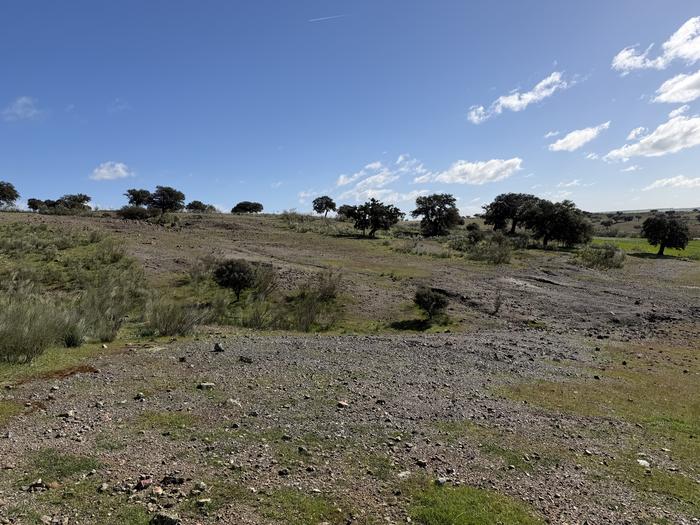
A recent archaeological survey conducted in the region around Cabeza del Buey, located within the province of Badajoz in southwestern Spain, has unveiled significant insights into Bronze Age mining activities. This meticulous survey, carried out over the course of one week in early February, sheds new light on the scale and sophistication of ancient metallurgical operations that shaped prehistoric European economies. Experts collaborating from the University of Gothenburg, the Universidad de Sevilla, and the Museo Arqueológico Provincial de Badajoz meticulously documented six previously unregistered mining sites dating back to the Bronze Age, revealing not only the expanse but also the complexity involved in the organized extraction of metals.
Among the most remarkable findings was the identification of one extensive mining complex, measuring approximately 200 meters by 50 meters, which underscores the intensive and coordinated nature of ancient metal extraction efforts. This site stands among the largest known mining areas from that era in the Iberian Peninsula, a testament to the advanced level of industrial activity that took place over 3,000 years ago. Such expansive mining infrastructure challenges previous assumptions regarding the geographical scope and economic importance of Bronze Age metallurgy in southwestern Europe.
The array of materials extracted from these mines primarily includes copper, lead, and silver—vital metals that underpinned Bronze Age metallurgy and long-distance trade. Copper, as the fundamental component of bronze, combined with tin to create the critical alloy, was indispensable for tool and weapon fabrication. The presence of lead and silver alongside copper points to a multifaceted resource extraction strategy, where multiple valuable metals were exploited concurrently, enhancing the economic and strategic significance of these mining hubs.
Integral to the survey’s findings was the discovery of approximately 80 grooved stone axes within the mining environment. These artifacts served as essential tools for ore processing, specifically for crushing and pulverizing raw mineral deposits before smelting. The sheer number of these axes underscores not only the scale of extraction but also implies a well-established technological tradition and workforce dedicated to sustained mining activities. Their design reflects sophisticated understanding of tool-making tailored to metallurgical requirements.
The context of this discovery interlocks with broader research programs focusing on the connectivity and economic landscapes of Bronze Age Europe. Previous isotopic and chemical analyses performed on Scandinavian Bronze Age artifacts have traced the provenance of their metallic components to southwestern Spain. Such evidence indicates that the metals mined in the region were extensively traded across vast distances, integrating this part of Iberia into a network of maritime and overland exchanges. These networks significantly contributed to cultural and technological dissemination throughout the European continent.
Professor Johan Ling, a leading archaeologist at the University of Gothenburg and principal investigator of the related Maritime Encounters project, emphasized the transformative impact of these findings on our understanding of prehistoric Europe. He noted that over the last decade, an increasing number of mining sites have been identified, revealing systematic metal extraction activities that were far more widespread and organized than previously assumed. The current survey adds to this corpus by documenting six new sites, augmenting the archaeological record and corroborating isotopic data with tangible excavation evidence.
Notably, these discoveries herald a paradigm shift, as they present concrete archaeological contexts that corroborate chemical and isotope analyses. These analytical methods have consistently suggested extensive interregional metal circulation, but physical evidence of the source mines had remained scarce. By mapping and documenting such extensive mining complexes, the research team provides material confirmation of the economic and social mechanisms underpinning Bronze Age connectivity across Europe.
The geographic and stratigraphic information collected during the survey also offers insights into mining techniques and environmental adaptations of the time. The extensive excavated areas demonstrate the use of coordinated labor groups capable of operating at significant scales, employing durable stone tools tailored to the process of ore extraction. Mining activities would have entailed excavation and surface-level extraction methods, likely supplemented by knowledge of ore vein locations and geological formations conducive to metal richness.
Furthermore, the presence of multiple metals including silver highlights the multifaceted value chains operating within Bronze Age communities. Silver’s inclusion points to early forms of wealth accumulation and possibly emergent social hierarchies based on control of precious metals. These aspects parallel developments seen in other parts of Europe and the Mediterranean, where metal production was closely tied to social stratification and political power.
The collaboration between the University of Gothenburg, Universidad de Sevilla, and the Museo Arqueológico Provincial de Badajoz reflects a multidisciplinary approach that integrates archaeological fieldwork, geochemical analyses, and historical contextualization. This comprehensive methodology enhances the reliability of the conclusions drawn and positions the region as a pivotal site in the study of European prehistory and early metallurgical economies.
This survey’s timing, conducted in February 2024, is strategic, capitalizing on favorable weather conditions and facilitating detailed site examination. The systematic recording of mining infrastructures combined with the recovery of associated artifacts fosters a robust database for ongoing comparative studies across Europe. As more sites are uncovered, the interconnected web of Bronze Age metallurgy and trade will become increasingly apparent.
In sum, the extraordinary scale of these recently documented mining sites, alongside the discovery of specialized tools and the identification of key metals, opens new avenues for understanding technological innovation and socio-economic networks in prehistoric Europe. This research not only enriches the archaeological narrative of southwestern Spain but also substantiates critical hypotheses about the extent of long-distance economic exchanges during the Bronze Age.
News Publication Date:
February 2024.
Web References:
https://www.eurekalert.org/multimedia/1116830
Cite Scienmag News
Courtney Benton. (February 24, 2026). Newly Discovered Bronze Age Mines in Spain Could Unlock the Origins of Scandinavian Bronze. Scienmag. https://scienmag.com/newly-discovered-bronze-age-mines-in-spain-could-unlock-the-origins-of-scandinavian-bronze/
Courtney Benton. "Newly Discovered Bronze Age Mines in Spain Could Unlock the Origins of Scandinavian Bronze." Scienmag, 24 February 2026, https://scienmag.com/newly-discovered-bronze-age-mines-in-spain-could-unlock-the-origins-of-scandinavian-bronze/. Accessed 4 September 2026.
Courtney Benton. "Newly Discovered Bronze Age Mines in Spain Could Unlock the Origins of Scandinavian Bronze." Scienmag. February 24, 2026. https://scienmag.com/newly-discovered-bronze-age-mines-in-spain-could-unlock-the-origins-of-scandinavian-bronze/


