


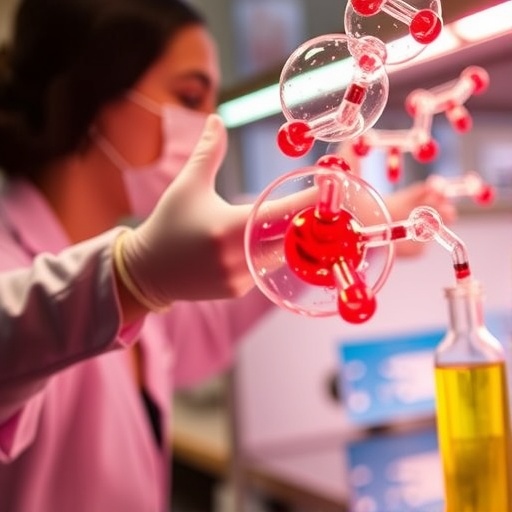
In the evolving landscape of sustainable chemical production, the ETOS (Electrifying Technical Organic Syntheses) Future Cluster emerges as a beacon of innovation, leveraging the power of electroorganic synthesis to transform traditional methods. The initiative, spanning from April 1, 2026, to March 31, 2029, marks the second phase of funding aimed at intensifying efforts to optimize electrochemical processes through industrial-scale piloting and process engineering. This shift underscores a crucial transition from theoretical and laboratory-based developments to practical applications, with the goal of synthesizing a broader range of chemicals in a more efficient and environmentally responsible manner.
Electroorganic synthesis represents a paradigm shift in chemical manufacturing, wherein organic compounds are generated or modified via electrolysis. Unlike conventional synthesis techniques requiring harsh chemicals and generating significant waste, electroorganic synthesis employs electricity as the primary driving force behind reactions. This substitution not only reduces dependency on aggressive reagents but also minimizes waste production by enabling highly selective chemical transformations. According to Ulrike Krewer, head of the Institute for Applied Materials — Electrochemical Technologies (IAM-ET) at the Karlsruhe Institute of Technology (KIT), the use of electricity sourced from renewables makes the process distinctly sustainable, aligning with global efforts to decarbonize industries.
The technological advancements made possible by innovative electrode materials and novel approaches to reaction engineering allow for previously unattainable efficiencies in electrochemical synthesis. Cutting-edge electrodes, tailored for enhanced conductivity and catalytic activity, facilitate new pathways for organic transformations that were once deemed impractical or inefficient. These breakthroughs represent critical steps toward integrating electroorganic synthesis into mainstream chemical manufacturing, providing a versatile platform capable of rapid adaptation to diverse chemical targets while maintaining environmental stewardship.
During its initial funding phase, the ETOS cluster achieved remarkable milestones, including the publication of over 20 scholarly articles that advanced the scientific understanding of electroorganic synthesis. The consortium also secured eight patents, reflecting the cluster’s pioneering innovations in both materials science and reaction engineering. Furthermore, industry collaboration facilitated the commercialization of two novel products, signaling the translation of fundamental research into real-world applications and market-ready solutions.
The engineering insights provided by the KIT team, under Krewer’s leadership, form a foundational pillar for ETOS’s ongoing success. Their focus now intensifies on system-level optimization — streamlining electrolyzer operation, automating production processes, and refining economic feasibility. This comprehensive approach addresses the critical challenges of scaling electroorganic synthesis from bench-top experiments to continuous industrial processes, ensuring that sustainability gains are coupled with viable commercial outcomes.
Integral to these advancements are the multi-institutional collaborations within KIT, encompassing the Institute of Catalysis Research and Technology, the Institute for Technology Assessment and Systems Analysis, the Institute for Control Systems, the Institute for Micro Process Engineering, and the Institute for Biological and Chemical Systems. The interdisciplinary synergy harnessed among these entities bolsters the development of robust methodologies to control reaction parameters precisely, enhance process adaptability, and evaluate techno-economic impacts comprehensively.
The scientific leadership of Professor Siegfried Waldvogel from the Max Planck Institute for Chemical Energy Conversion remains pivotal, with his expertise centered on employing state-of-the-art algorithms to refine electrosynthesis reactions. Through modern computational techniques, the ETOS cluster advances towards predictive reaction models and automated optimization protocols, enabling rapid identification of ideal operational conditions that maximize yield and selectivity while minimizing energy consumption.
As an integral member of the Clusters4Future initiative funded by the German Federal Ministry for Education and Research (BMBF), ETOS unites a formidable array of academic and industrial partners across the Rhine region from Freiburg to the Ruhr area. Institutions including the University of Kaiserslautern-Landau, Ruhr University Bochum, Johannes Gutenberg University Mainz, and the Fraunhofer Institute for Microengineering and Microsystems collaborate with leading chemical corporations such as BASF, Boehringer Ingelheim, Evonik, and ABB. This alliance not only fosters knowledge exchange but also accelerates technology transfer, enabling swift implementation of breakthroughs within industrial settings.
The financial framework underpinning ETOS’s ambitious agenda includes EUR 12.1 million from federal funding supplemented by an additional EUR 6 million from industrial partners, underscoring the commitment of both public and private sectors to sustainable chemical innovation. The collaborative model exemplifies the synergy required to tackle complex challenges in chemical manufacturing, integrating scientific discovery, engineering development, and market-oriented strategies.
The potential of electroorganic synthesis to revolutionize chemical production cannot be overstated. By harnessing electricity—preferably generated from renewable sources—to mediate chemical reactions, this approach aligns perfectly with the pressing demands of climate change mitigation and resource conservation. Through the ETOS initiative, advances in electrochemical technologies are poised to deliver scalable, cost-effective, and ecologically sensitive production methods that will redefine how chemicals are synthesized on a global scale.
KIT’s broader mission complements these technological strides by fostering research that addresses urgent societal challenges including climate change, energy transition, sustainable resource utilization, and artificial intelligence. As a University of Excellence within the Helmholtz Association, KIT cultivates an environment where interdisciplinary research thrives, creating pathways from fundamental science to pragmatic industrial application. The ETOS cluster embodies this ethos, driving science for societal impact through focused innovation in electroorganic synthesis.
In conclusion, the second funding period of the ETOS Future Cluster heralds a significant leap forward in sustainable chemical synthesis. By bridging scientific discovery with industrial application, leveraging novel electrode materials, sophisticated algorithms, and comprehensive systems engineering, ETOS is poised to transform the chemical industry’s environmental footprint profoundly. With continued collaboration between academia and industry, and unwavering commitment to sustainability, the cluster sets a new standard for green chemical manufacturing in the 21st century.
News Publication Date: Not specified (content based on upcoming funding period 2026-2029)
Web References:
Keywords
Electroorganic synthesis, sustainable chemistry, renewable energy, electrolysis, chemical industry decarbonization, electrode materials, Karlsruhe Institute of Technology, ETOS cluster, green manufacturing, process engineering, catalysis, industrial scale-up
Cite Scienmag News
Denise Maddox. (February 24, 2026). Ongoing Breakthroughs Propel Research on Clean Chemicals Forward. Scienmag. https://scienmag.com/ongoing-breakthroughs-propel-research-on-clean-chemicals-forward/
Denise Maddox. "Ongoing Breakthroughs Propel Research on Clean Chemicals Forward." Scienmag, 24 February 2026, https://scienmag.com/ongoing-breakthroughs-propel-research-on-clean-chemicals-forward/. Accessed 1 September 2026.
Denise Maddox. "Ongoing Breakthroughs Propel Research on Clean Chemicals Forward." Scienmag. February 24, 2026. https://scienmag.com/ongoing-breakthroughs-propel-research-on-clean-chemicals-forward/


