


What is the structure of a particular molecule? And how do molecules interact with each other? Researchers interested in those questions frequently use nuclear magnetic resonance (NMR) spectroscopy to find answers. In NMR, a powerful external magnetic field is employed to align the spins of atomic nuclei, which are then induced to rotate by an oscillating weak magnetic field generated by coils. A change in voltage as a result can be converted to measurable frequencies. Based on this, researchers can identify the molecular structures while also revealing certain information about the nuclear spin interactions. However, this type of investigation requires very strong magnetic fields generated by massive devices, which are themselves difficult to install and to maintain. At the same time, even with such elaborate equipment it is still difficult to analyze quadrupolar nuclei, which are the most abundant type of nuclei in nature.

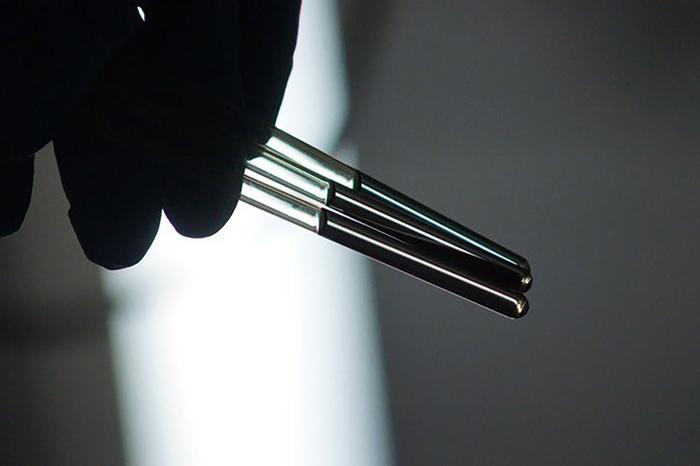
Credit: photo/©: Oleg Tretiak
What is the structure of a particular molecule? And how do molecules interact with each other? Researchers interested in those questions frequently use nuclear magnetic resonance (NMR) spectroscopy to find answers. In NMR, a powerful external magnetic field is employed to align the spins of atomic nuclei, which are then induced to rotate by an oscillating weak magnetic field generated by coils. A change in voltage as a result can be converted to measurable frequencies. Based on this, researchers can identify the molecular structures while also revealing certain information about the nuclear spin interactions. However, this type of investigation requires very strong magnetic fields generated by massive devices, which are themselves difficult to install and to maintain. At the same time, even with such elaborate equipment it is still difficult to analyze quadrupolar nuclei, which are the most abundant type of nuclei in nature.
In the case of zero-field nuclear magnetic resonance (zero-field NMR), there is no need for a powerful external magnetic field. Here, the intramolecular couplings between the spins of magnetically active nuclei are the predominant quantum mechanical interaction. The spectral lines are thus narrower and sharper, and samples can even be investigated in containers made of metal or other materials. Zero-field NMR spectroscopy is now used to monitor reactions in metal containers or for the analysis of plants; it also has promising applications in medicine. However, to be able to measure the small interactions between the spins, it is necessary to provide shielding against the Earth’s magnetic field, which is a complex undertaking in itself.
Simple yet more precise experimental setup
Researchers at Johannes Gutenberg University Mainz (JGU) and the Helmholtz Institute Mainz (HIM), collaborating with colleagues at the University of California, Berkeley, have recently managed to measure quadrupolar nuclei using zero-field NMR. “We analyzed an ammonium molecule, NH4+, a cation that plays an important role in various applications,” said Dr. Danila Barskiy, head of the JGU team. “We hope that in future we will be able to detect these molecules even in complex environments, such as reactors and metal containers.” The researchers were able to devise a system which simply involves mixing ammonium salts with water and adding various amounts of deuterium. The individual spectra were then recorded and analyzed. For this analysis, the scientists used a commercially available magnetometer – not bigger than a fingernail – in a home-built compact analytical system with magnetic shielding.
Precision measurements to test existing theories
The researchers also examined another interesting question: To what extent does the number of deuterium atoms in an ammonium molecule influence the spectrum and the relaxation characteristics of spins? As Román Picazo-Frutos, a student at the JGU Institute of Physics and lead author of the corresponding publication, pointed out: “Using our method, it is possible to determine resonance frequencies with a very high level of precision. Because the results produced by this technique can be compared with other experimental data, it can be used for benchmarking quantum chemistry calculations. We hope that our system will become standard practice in the near future.” Although predictions based on current theories correlate closely with the results obtained by the team, there are small deviations. “The work undertaken by the team has considerably extended the range of molecules that can be analyzed by means of zero- to ultralow-field NMR techniques. It may even contribute to the development of innovative applications that could be used to investigate the nuclei of atoms with small atomic numbers by means of their radioactive gamma decay,” concluded Professor Dmitry Budker of JGU.
The research results have been published in Nature Communications.
Related links:
- – Budker Lab at the JGU Institute of Physics
- – Helmholtz Institute Mainz (HIM)
- – GSI Helmholtzzentrum für Schwerionenforschung
- – Innovative Training Network “Zero to Ultra-low Field NMR”
- – ZULF NMR Blog
Read more:
- – press release “Erwin Schrödinger Prize for international research team at the Helmholtz Institute Mainz” (4 Oct. 2022)
- – press release “Less risk, less costs: Portable spectroscopy devices could soon become real” (1 Sept. 2022)
- – press release “Danila Barskiy receives Sofja Kovalevskaja Award to develop low-cost portable spectroscopic devices” (22 Sept. 2020)
Journal
Nature Communications
Article Title
Zero-field J-spectroscopy of quadrupolar nuclei
Article Publication Date
27-May-2024
Cite Scienmag News
Reid Dalton. (July 11, 2024). Quadrupolar nuclei measured for the first time by zero-field NMR. Scienmag. https://scienmag.com/quadrupolar-nuclei-measured-for-the-first-time-by-zero-field-nmr/
Reid Dalton. "Quadrupolar nuclei measured for the first time by zero-field NMR." Scienmag, 11 July 2024, https://scienmag.com/quadrupolar-nuclei-measured-for-the-first-time-by-zero-field-nmr/. Accessed 4 September 2026.
Reid Dalton. "Quadrupolar nuclei measured for the first time by zero-field NMR." Scienmag. July 11, 2024. https://scienmag.com/quadrupolar-nuclei-measured-for-the-first-time-by-zero-field-nmr/

