


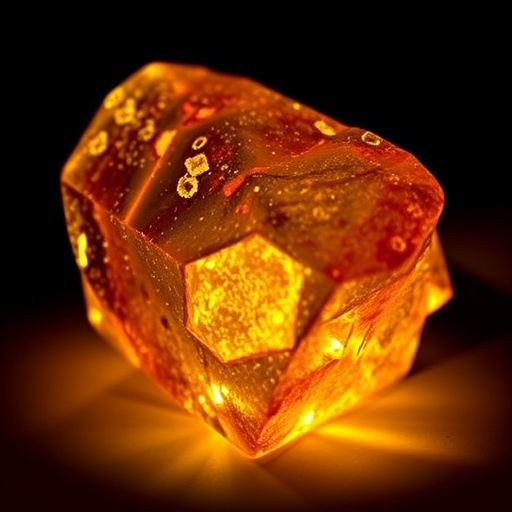
For the first time, Brazilian scientists have uncovered a remarkable natural phenomenon: a field of tektites, a form of natural glass born from the violent impact of extraterrestrial objects on Earth’s surface. These newly identified tektites have been named “geraisites,” in homage to Minas Gerais, the Brazilian state where their discovery was first documented. This striking addition to the global catalog of tektite strewn fields not only fills a geological void in South America but also offers an unprecedented window into Earth’s cosmic history, revealing a previously uncharted impact event dated to roughly 6.3 million years ago.
Prior to this groundbreaking discovery, only five major tektite fields had been officially recognized worldwide, scattered across Australasia, Central Europe, the Ivory Coast, North America, and Belize. The Brazilian geraisite field now joins this exclusive group, significantly expanding the known distribution of impact-formed natural glasses. The initial discovery sites spanned three municipalities in northern Minas Gerais—Taiobeiras, Curral de Dentro, and São João do Paraíso—forming an elongated strike about 90 kilometers in length. Additional specimens later extended the known field’s longitudinal range to over 900 kilometers, stretching into the neighboring states of Bahia and Piauí. Such an extensive strewn field dimension corroborates the hypothesis of a high-energy impact comparable in magnitude to other recognized tektite provinces.
Geraisites exhibit a fascinating variety of morphologies typical of tektitic forms that solidify mid-flight in Earth’s atmosphere. These include spheres, ellipsoids, drops, discoids, dumbbells, and twisted shapes, ranging in size from sub-gram fragments up to pieces weighing 85.4 grams with lengths around five centimeters. Their initial appearance is predominantly black and opaque; however, under intense illumination, they reveal a translucent quality tinged with a subtle grayish-green hue. This coloration distinguishes them from European moldavites, which are renowned for their vivid green tones and have even found historical use in jewelry since medieval times.
Detailed geochemical analyses have uncovered that geraisites possess a notably high silica (SiO2) content varying between 70.3% and 73.7%, marking them as rich in glassy silicate material. The oxides of sodium (Na2O) and potassium (K2O) range from 5.86% to 8.01%, values moderately elevated relative to other tektite fields. Trace element studies detect the presence of chromium and nickel at parts-per-million levels, suggesting the source materials were geochemically heterogeneous rather than uniform. Furthermore, rare inclusions of lechatelierite—a glassy silica phase formed only under extreme impact-induced temperatures—serve as unequivocal evidence of their cosmic impact origin.
One essential diagnostic feature confirming their classification as tektites is the exceptionally low water content measured via infrared spectroscopy, falling between 71 and 107 parts per million. This stark dryness sharply contrasts with volcanic glasses such as obsidian, which typically contain water contents an order of magnitude higher, ranging from hundreds of ppm to several percent. The dehydration results from rapid melting and cooling processes as molten ejecta traverse the atmosphere, a phenomenon characteristic of impact-generated glasses but absent in volcanic counterparts.
Argon isotope geochronology employing the ⁴⁰Ar/³⁹Ar dating technique has precisely constrained the impact event creating the geraisites to the late Miocene epoch, approximately 6.3 million years ago. Multiple age clusters—6.78 ± 0.02 Ma, 6.40 ± 0.02 Ma, and 6.33 ± 0.02 Ma—point to a singular depositional event rather than multiple distinct impacts. Researchers caution that this 6.3-million-year figure represents a maximum age, due to possible argon inheritance from the ancient continental crust material initially struck by the extraterrestrial impactor.
Remarkably, no definitive crater associated with the geraisite strewn field has yet been identified, a circumstance not uncommon in terrestrial tektite fields. Of the six established major tektite provinces worldwide, only half have corresponding known impact craters. For instance, the massive Australasian strewn field’s crater remains elusive but is hypothesized to lie beneath oceanic sediments. Brazilian geochemists suggest that the natural glass originated from Archean continental crust rocks dating between 3.0 and 3.3 billion years ago, implicating the São Francisco craton—a geologically stable and one of the oldest South American cratonic blocks—as the likely target area. The ancient granitic source is evident from isotopic signatures, narrowing the search for a potentially buried or eroded impact structure.
To uncover potential crater remnants, scientists propose employing aerogeophysical surveying methods such as magnetic and gravimetric anomaly detection. These techniques could reveal circular geophysical signatures consistent with impact structures, whether buried beneath younger sedimentary layers or heavily eroded beyond surface recognition. Until then, the energetic magnitude and spatial extent of the geraisite field continue to hint at a sizable cosmic collision, far exceeding minor meteoritic falls but likely less immense than the cataclysm responsible for Australasia’s extensive impact field.
Ongoing interdisciplinary research endeavors include the development of sophisticated computational models simulating impact scenarios. These models aim to estimate critical parameters such as kinetic energy release, impact velocity, entry angle, and melt volume produced during the event. Each new spatial distribution data point of geraisite occurrences integrates into these analytical frameworks, enhancing predictive accuracy. Together, these efforts significantly advance our understanding of impact processes and the geological aftermath they provoke on continental crusts.
The discovery of the geraisite strewn field in Brazil fills an important lacuna in South America’s impact record. Currently, only around nine large impact structures have been cataloged across the continent, predominantly ancient, and mostly concentrated within Brazil. The identification of these tektites also challenges the prevailing assumption that tektites are rare. Instead, it suggests that similar glassy impact materials may be more widespread, often overlooked or misclassified as common volcanic or anthropogenic glasses, especially in underexplored regions with sparse geoscientific coverage.
In addition to advancing the scientific knowledge of planetary impact phenomena, efforts led by geologist Álvaro Penteado Crósta emphasize responsible science communication. To counter sensationalism surrounding asteroid impacts, Crósta and his students maintain the Instagram account @defesaplanetaria, delivering accurate and nuanced information about meteorites, asteroid risks, and impact history. They stress that while cosmic collisions were frequent during the chaotic formative epochs of the Solar System, the current relatively stable planetary configuration results in far fewer impact events. Such public outreach fosters a science literacy that differentiates established data from speculative fearmongering.
Having devoted over four decades to the study of impact-related structures, Crósta’s work represents a significant milestone in the geological and planetary sciences community. Supported by the São Paulo Research Foundation (FAPESP), his research combines fieldwork, laboratory geochemistry, isotopic dating, and numerical modeling. The discovery of the geraisite tektite field underscores the dynamic and interconnected nature of Earth’s geological record with cosmic events, broadening our grasp of the destructive yet enlightening forces shaping planetary surfaces.
News Publication Date: 2-Dec-2025
Web References:
- Journal article DOI: 10.1130/G53805.1
- Researcher profile: Álvaro Penteado Crósta
- FAPESP website: www.fapesp.br/en
- FAPESP news agency subscription: http://agencia.fapesp.br/subscribe
References:
- Crósta, Á. P., et al. (2025). “Geraisite: The first tektite occurrence in Brazil.” Geology. DOI: 10.1130/G53805.1
Cite Scienmag News
Eleanor Cresswell. (February 20, 2026). Glass Created by Cosmic Impact in Brazil Reveals Collision Event from 6 Million Years Ago. Scienmag. https://scienmag.com/glass-created-by-cosmic-impact-in-brazil-reveals-collision-event-from-6-million-years-ago/
Eleanor Cresswell. "Glass Created by Cosmic Impact in Brazil Reveals Collision Event from 6 Million Years Ago." Scienmag, 20 February 2026, https://scienmag.com/glass-created-by-cosmic-impact-in-brazil-reveals-collision-event-from-6-million-years-ago/. Accessed 28 August 2026.
Eleanor Cresswell. "Glass Created by Cosmic Impact in Brazil Reveals Collision Event from 6 Million Years Ago." Scienmag. February 20, 2026. https://scienmag.com/glass-created-by-cosmic-impact-in-brazil-reveals-collision-event-from-6-million-years-ago/


