


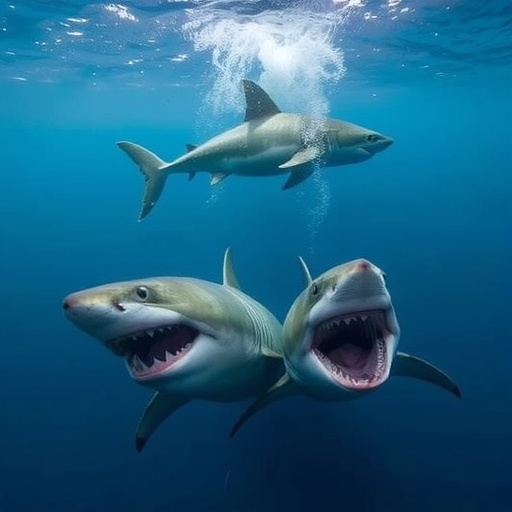
In the intricate dynamics of marine ecosystems, apex predators often engage in complex interactions that shape the behavior and distribution of species within their habitats. A groundbreaking study led by Flinders University has shed new light on the relationship between white sharks (Carcharodon carcharias) and killer whales (Orcinus orca) in South Australia’s Neptune Islands, challenging long-held assumptions about predator-prey responses and the factors influencing shark residency.
Historically, killer whales have been documented preying on a variety of shark species worldwide, including instances involving white sharks observed in Australia, Mexico, California, and South Africa. These predation events have been widely regarded as catalysts for abrupt behavioral changes in white sharks, often precipitating their sudden and prolonged absence from coastal aggregation sites. One of the most striking recorded interactions occurred on February 2, 2015, when a pod of approximately six killer whales attacked and killed a white shark near a cage-diving vessel within the Neptune Islands Group Marine Park.
During this predation event, three killer whales were seen corralling the white shark to restrict its mobility, while others delivered forceful head rams. Following the attack, the emergence of an oil slick on the water’s surface indicated a successful predation, and this dramatic encounter quickly garnered widespread media attention. In the immediate aftermath, white sharks vanished from the area for nearly two months, a disappearance initially attributed mainly to the influence of killer whale predation—a pattern thought to mirror similar phenomena observed off the coasts of South Africa.
Despite the prevalent belief that killer whale presence directly induces extended white shark absences, the Flinders University-led study provides nuanced insights that challenge this narrative. Utilizing an extensive dataset comprising 12 years of acoustic telemetry records combined with wildlife tourism sighting data, researchers were able to track and analyze long-term residency patterns of white sharks at the Neptune Islands with unprecedented precision.
The study’s lead researcher, Dr. Isabella Reeves, highlighted that while killer whales can indeed provoke an immediate flight response in white sharks, they do not necessarily account for all long-term shifts in shark presence. Over the course of more than a decade of data collection, the team observed six prolonged absences exceeding 42 days, of which only one coincided temporally with killer whale activity. Intriguingly, the lengthiest recorded absence surpassed the duration of the 2015 event and occurred without any detected involvement of killer whales.
These findings underscore the need to consider other ecological and biological factors that might influence white shark residency at aggregation sites beyond predation pressure alone. For instance, environmental variability, prey availability, reproductive cycles, and social behaviors could all potentially contribute to the complex dynamics governing shark movements and site fidelity. The study’s revelations call for a more holistic understanding of predator-prey relationships and the natural rhythms underlying marine species’ presence.
Further complexities emerged from the observation that not all killer whale encounters or shark mortalities result in extended shark disappearances. An encounter with killer whales in October 2024, for example, triggered only a brief five-day retreat for the white sharks, while the death of a tagged individual—possibly releasing chemical signals known as necromones that can induce avoidance behavior—prompted just a four-day absence. These shorter responses suggest that white sharks might calibrate their risk assessment and residency decisions based on the immediacy and context of the threat rather than reacting uniformly to every predator encounter.
Professor Charlie Huveneers, a senior author on the study and leader of the Southern Shark Ecology Group, emphasized that residency patterns exhibit high variability and that extended absences might often reflect intrinsic patterns rather than a direct response to predation risk. Such variability means that long-term absence at a known aggregation site does not inevitably signal a destabilizing factor like intense predation pressure but might instead be part of the sharks’ natural ecological behavior.
This research contributes significantly to the field of marine ecology by highlighting the importance of integrating long-term monitoring tools, such as acoustic telemetry, with observational data to unravel the subtleties of species interactions over extended temporal scales. The combination of quantitative tracking methodologies with real-world sighting data has allowed the research team to differentiate between immediate behavioral reactions and broader patterns of habitat use, thereby fostering a more comprehensive understanding of white shark ecology.
Beyond enhancing scientific knowledge, these insights carry broad implications for marine conservation and management strategies. Effective protection of apex predators hinges not only on recognizing the immediate threats they face but also on appreciating their ecological roles within complex environmental matrices. Misattributing prolonged shark absences solely to killer whale predation could lead to oversimplified conservation approaches that overlook other critical factors influencing shark populations.
Moreover, this work challenges sensationalized narratives that often portray killer whales as omnipotent agents driving shark populations from their habitats indefinitely. Instead, the study reveals a more nuanced ecosystem balance where predator-prey interactions are dynamic and modulated by multiple, sometimes subtle, environmental and biological influences.
The article, titled “Absence or Avoidance? White shark response to killer whale predation risk,” was published in the journal Wildlife Research in February 2026. It represents a collaborative effort among researchers Isabella M. Reeves, Adam Barnett, David M. Donnelly, Lauren Meyer, and Charlie Huveneers. The investigation invites marine scientists, conservationists, and the public alike to rethink perceptions of predator impacts in oceanic systems and to value the complexity embedded within natural animal behaviors.
In conclusion, the relationship between white sharks and killer whales in the Neptune Islands is far more intricate than a straightforward prey-predator avoidance scenario. While killer whale presence can prompt immediate shark flight, long-term white shark absences are often independent of killer whale predation events, reflecting inherent ecological variability. This revelation exemplifies how comprehensive, long-term research can overturn assumptions and deepen our understanding of marine predator dynamics, a vital step toward ensuring the effective stewardship of oceanic apex predators and their environments.
News Publication Date: 9-Feb-2026
Web References:
https://doi.org/10.1071/WR25088
References:
Reeves, I. M., Barnett, A., Donnelly, D. M., Meyer, L., & Huveneers, C. (2026). Absence or Avoidance? White shark response to killer whale predation risk. Wildlife Research. https://doi.org/10.1071/WR25088
Cite Scienmag News
Violet Maxwell. (February 18, 2026). White Sharks and Killer Whales: White Sharks Sometimes Show Boldness Rather Than Fear. Scienmag. https://scienmag.com/white-sharks-and-killer-whales-white-sharks-sometimes-show-boldness-rather-than-fear/
Violet Maxwell. "White Sharks and Killer Whales: White Sharks Sometimes Show Boldness Rather Than Fear." Scienmag, 18 February 2026, https://scienmag.com/white-sharks-and-killer-whales-white-sharks-sometimes-show-boldness-rather-than-fear/. Accessed 5 September 2026.
Violet Maxwell. "White Sharks and Killer Whales: White Sharks Sometimes Show Boldness Rather Than Fear." Scienmag. February 18, 2026. https://scienmag.com/white-sharks-and-killer-whales-white-sharks-sometimes-show-boldness-rather-than-fear/


