

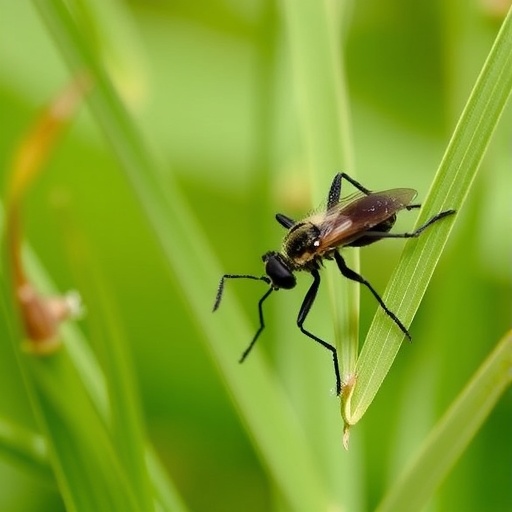
In the vast and intricate tapestry of ecosystems, the microscopic and often overlooked forms of life play critical roles that are essential to ecological balance. A groundbreaking study conducted by researchers at the University of Göttingen and the Hungarian HUN-REN Centre for Ecological Research has illuminated a hidden world of specialized insect biodiversity thriving within grass shoots. By meticulously examining over 23,000 grass shoots across multiple perennial and annual species, the team uncovered an astonishing richness of insect species, shedding new light on the delicate multitrophic interactions that sustain grassland ecosystems.
Traditional biodiversity studies tend to spotlight conspicuous fauna and flora, inadvertently neglecting the diminutive and cryptic insect communities residing within plant tissues. This research dispels such oversight by revealing that tiny herbivorous insects, alongside their parasitic wasp predators, compose a complex and dynamic food web nested inside perennial grasses. Employing a combination of extensive field sampling and laboratory rearing, the investigators differentiated 255 insect species inhabiting ten perennial grass species, in stark contrast to none found in five short-lived annual species. This finding highlights the critical role of plant longevity and shoot architecture in supporting insect diversity.
Perennial grasses, characterized by their persistence across seasons, appear to offer a stable and productive habitat that fosters insect colonization and specialization. The longer and more robust shoots of these grasses enhance visibility and resource availability, attracting a diverse assemblage of phytophagous insects such as gall midges and grass flies. These herbivores, which extract nutrients directly from plant tissues, are in turn targeted by an elaborate array of parasitic wasps. These wasps, often diminutive yet ecologically potent, deposit their eggs within or on the larvae of herbivores, with their offspring developing inside the host and frequently resulting in its demise.
The complexity uncovered by this study reflects a multitrophic network whereby the grasses serve as foundational producers, furnishing sustenance and shelter to herbivorous insects which themselves become hosts for an extensive guild of parasitoid wasps. On average, each perennial grass species supports approximately 12 herbivore species, which are parasitized by about 30 species of wasps. Such intricate interactions underscore the evolutionary specialization and interdependence that have developed among these tiny organisms within the confined spatial niche of grass shoots.
Interestingly, the annual grass species, which have shorter life spans and more ephemeral shoots, exhibited a complete absence of these specialized insect communities. This suggests that the unpredictable phenology and transient nature of annual grasses do not provide a reliable habitat for insect specialization, limiting the evolution of herbivore and parasitoid lineages adapted to these plants. Consequently, the diversity of grass-shoot insects is closely tied to the life history traits of their host plants, particularly shoot longevity and stability.
These findings carry profound implications for grassland management and biodiversity conservation. Common agricultural and landscape practices, such as regular mowing and grazing, disrupt the continuity of grass shoots and thus the survival of these specialized insect communities. Frequent disturbance eradicates the overwintering shoots and interrupts the life cycles of dependent insects, ultimately leading to declines in insect diversity and ecological resilience. The study advocates for the establishment of unmown refuges within grasslands to preserve intact perennial shoots, thereby safeguarding these hidden but vital insect populations.
Professor Teja Tscharntke, the study’s lead author, emphasizes that the undervalued community of grass-shoot insects warrants greater scientific and conservation attention. He argues that sustainable grassland management must incorporate strategies that recognize and ameliorate the habitat needs of these specialized insects. Maintaining insect diversity within grass shoots is not only key to conserving ecosystem complexity but also essential for supporting ecological processes such as nutrient cycling, pest regulation, and pollination services.
In their methodological approach, the researchers conducted comprehensive sampling through autumn and winter, seasons critical for observing overwintering insect larval stages. They meticulously collected insects from grass shoots, followed by laboratory rearing to facilitate accurate species identification and elucidation of trophic relationships. By reconstructing the food web interactions, they demonstrated the pivotal role perennial grasses play in supporting multitrophic insect communities.
This research challenges prevailing assumptions in grassland ecology by revealing the intricate, multilayered biodiversity that exists beneath the surface of common plant species. The study not only identifies a considerable number of species previously unknown or overlooked but also provides a conceptual framework for understanding host plant-insect specialization dynamics in grasslands. The long-term ecological consequences of diminishing these communities could ripple through food webs, affecting higher trophic levels and ecosystem services.
Beyond the ecological insights, the study holds significant implications for policy and land-use planning. It calls for a reevaluation of mowing schedules and grassland practices that prioritize short-term aesthetic or agricultural outcomes over ecological sustainability. Implementing management practices that allow perennial grasses to develop undisturbed for extended periods could foster the conservation of intricate insect assemblages and bolster overall biodiversity in grassland biomes.
In conclusion, the hidden diversity within grass shoots constitutes a vital component of grassland ecosystems that has been neglected by both science and management. The intricate relationships between perennial grasses, herbivorous insects, and parasitoid wasps exemplify the complexity of natural multitrophic networks. Protecting and promoting these specialized insect communities requires an integrated approach that combines ecological research with adaptive land management. This study stands as a compelling testament to the ecological wealth concealed within the unassuming blades of grass and the urgent need to conserve it.
Subject of Research: Not applicable
Article Title: The hidden multitrophic diversity of specialized grass-shoot insects – neglected by grassland management.
News Publication Date: 16-Feb-2026
Web References: https://doi.org/10.1016/j.baae.2026.01.004
References: Teja Tscharntke, Péter Batáry, Stefan Vidal. “The hidden multitrophic diversity of specialized grass-shoot insects – neglected by grassland management.” Basic and Applied Ecology (2026). DOI: 10.1016/j.baae.2026.01.004
Image Credits: Credit: Tscharntke, T. et al., Basic and Applied Ecology, DOI: 10.1016/j.baae.2026.01.004, licensed under CC BY 4.0
Keywords: Insects, Arthropods, Beetles, Grasses, Ecosystems, Grasslands, Grassland ecosystems, Environmental sciences, Applied ecology, Ecological processes, Ecology, Ecological diversity, Species diversity, Species richness, Biodiversity conservation, Biodiversity indicators, Biodiversity loss, Biodiversity threats, Habitat diversity, Biodiversity, Farming, Sustainable agriculture, Agricultural policy, Agriculture


