


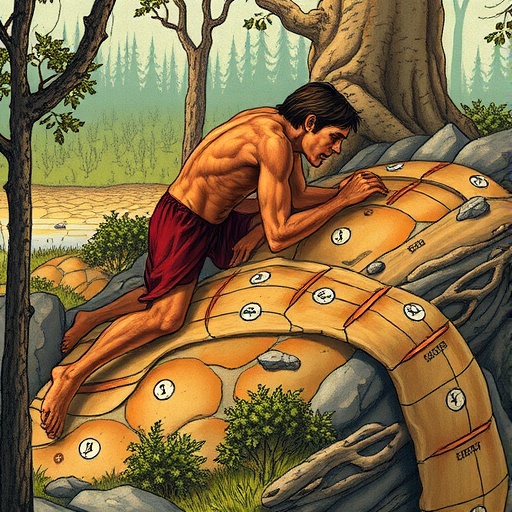
For decades, one of the most persistent explanations for the disappearance of Neanderthals has been that climate change broke their world apart. As temperatures shifted rapidly across Ice Age Europe, the argument goes, the forests, grasslands and river valleys that sustained Neanderthal communities may have shrunk into isolated pockets. Cut off from one another, populations would have become smaller, less resilient and increasingly vulnerable to extinction. A new study now challenges that influential scenario, reporting no evidence that climate-driven fragmentation of suitable habitat occurred before Neanderthals vanished.
The research, published in Communications Earth & Environment, re-examines the environmental conditions surrounding the final chapter of Neanderthal history. Led by M. Yousefi, M. Grünig and J. C. Svenning, the study addresses a key question in human evolution: did abrupt climate change transform Neanderthal territory into a scattered archipelago of ecological refuges, or did suitable landscapes remain sufficiently connected for populations to move and interact? The answer matters because habitat fragmentation is more than simple habitat loss. When a continuous environment is divided into isolated patches, animals may face reduced access to food, fewer opportunities to find mates and a higher risk that local populations will disappear independently.
Neanderthals occupied much of Europe and parts of western Asia for hundreds of thousands of years, surviving repeated glacial advances, warmer interglacial periods and dramatic ecological rearrangements. Their final disappearance, roughly 40,000 years ago, occurred during a period of climatic instability, making environmental explanations especially attractive. Ice sheets expanded and retreated, temperatures swung sharply, and vegetation zones moved across the continent. In principle, such changes could have compressed Neanderthal-friendly environments and severed connections between regional groups. The new analysis, however, indicates that the available evidence does not show a clear, continent-wide pattern of climate-induced isolation immediately before extinction.
To test the fragmentation hypothesis, the researchers reconstructed how climatically suitable Neanderthal environments may have been distributed through time. Such reconstructions typically combine paleoclimate simulations with information about the ecological conditions associated with archaeological Neanderthal sites. Instead of treating climate as a single temperature curve, the approach considers several interacting variables, including temperature, precipitation and seasonal conditions. These data can be used to estimate the distribution of “climatically suitable habitat”—areas where environmental conditions would have fallen within a range potentially tolerable for Neanderthal populations. By comparing these modeled landscapes across successive periods, scientists can identify whether suitable areas contracted, shifted or became divided into isolated clusters.
The distinction between movement and fragmentation is crucial. A habitat can move geographically without becoming disconnected. For example, a belt of suitable conditions may shift northward or southward as temperatures change while remaining continuous enough for animals to track it. Fragmentation requires something more specific: formerly connected areas must be separated by zones that are unsuitable or effectively impassable. The study’s central finding is that, although climate altered the location and extent of suitable environments, the patterns do not support a major increase in fragmentation before the Neanderthals’ extinction. In other words, climate change may have forced populations to adjust their ranges, but it did not demonstrably split their remaining habitat into isolated islands.
That result weakens a simple version of the climate-collapse theory, but it does not make climate irrelevant. Environmental change can affect a species without fragmenting its habitat. Rapid fluctuations may disrupt prey populations, alter water availability, change the balance between open and wooded landscapes or create conditions that are difficult to track across generations. Neanderthals were also not uniformly dependent on one ecosystem. Their archaeological record shows flexibility across different environments, from temperate woodland settings to colder, more open landscapes. A habitat that appears suitable in a broad climate model may still offer poor access to prey, fuel, shelter or raw materials at a local scale. The researchers’ conclusion therefore addresses a specific mechanism—climate-driven fragmentation—rather than ruling out every possible ecological effect.
The findings also sharpen the debate over why Neanderthals disappeared while Homo sapiens expanded across Eurasia. If their habitat remained broadly connected, then explanations focused on demographic fragility, competition, disease, social networks or interactions with incoming modern human populations may deserve greater attention. Small populations can remain geographically widespread yet still be vulnerable if their numbers are low, their communities are sparsely connected or their recovery from local losses is slow. In such cases, a connected landscape does not guarantee survival. It may simply provide routes through which population decline spreads. Genetic evidence has already suggested that Neanderthals experienced low population sizes and limited genetic diversity in some regions, conditions that could have amplified the effects of even modest ecological or social pressures.
The study also illustrates why extinction research increasingly depends on combining climate models, archaeology and spatial ecology rather than relying on a single dramatic event. Fossil sites are unevenly distributed, and the absence of evidence at one location does not necessarily indicate the absence of Neanderthals or suitable habitat. Climate simulations likewise operate at resolutions that may miss local refuges, mountain valleys and coastal environments. The researchers’ conclusion is therefore best understood as a test of what current data can support: there is no clear evidence that climate fragmented Neanderthal habitat immediately before extinction. Future work using higher-resolution environmental reconstructions, improved dating and more detailed archaeological records may reveal regional patterns hidden by continent-wide models.
The new result is likely to fuel a broader reassessment of the final Neanderthals—not as a population trapped in a climate-shattered Europe, but as a human group facing a complex and changing competitive landscape. Their disappearance may have resulted from several pressures acting together: demographic instability, ecological disruption, interactions with Homo sapiens and chance events that affected already vulnerable communities. By removing one of the most visually compelling versions of the climate narrative, the study leaves researchers with a more complicated but potentially more accurate picture. Neanderthal habitats changed, sometimes dramatically, yet the evidence does not show that climate tore those habitats into disconnected fragments before the species vanished. The mystery of their extinction remains, but the search is now moving away from a single environmental catastrophe and toward the combined biology, behavior and history of two human lineages sharing the same continent.
Cite Scienmag News
Gavin Prescott. (August 25, 2026). Study finds no climate-driven Neanderthal habitat fragmentation before extinction. Scienmag. https://scienmag.com/study-finds-no-climate-driven-neanderthal-habitat-fragmentation-before-extinction/
Gavin Prescott. "Study finds no climate-driven Neanderthal habitat fragmentation before extinction." Scienmag, 25 August 2026, https://scienmag.com/study-finds-no-climate-driven-neanderthal-habitat-fragmentation-before-extinction/. Accessed 3 September 2026.
Gavin Prescott. "Study finds no climate-driven Neanderthal habitat fragmentation before extinction." Scienmag. August 25, 2026. https://scienmag.com/study-finds-no-climate-driven-neanderthal-habitat-fragmentation-before-extinction/


