


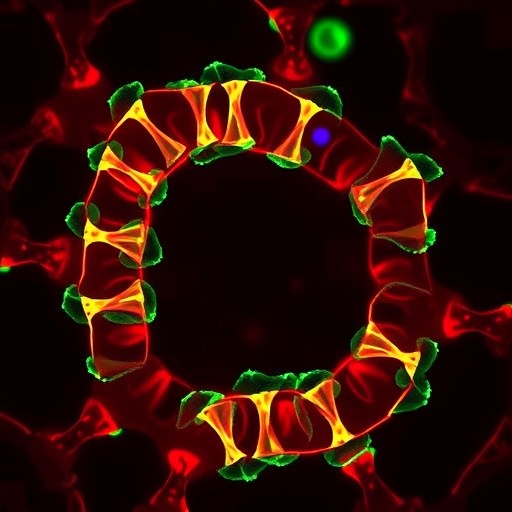
In a groundbreaking study that could reshape the therapeutic landscape of colorectal cancer, researchers have unveiled a novel approach that targets the tumor microenvironment with unprecedented precision. The study, led by Wang, S., Wang, Z., Wu, C., and their colleagues, introduces a ferroptosis-based nanotherapy that specifically ameliorates colorectal cancer-associated fibroblasts (CAFs), known architects of the immunosuppressive tumor milieu. This advance published in Nature Communications in 2026, signals a pivotal shift from conventional cancer therapies focused solely on tumor cells to strategies that modulate the supportive stroma, which often dictates disease progression and therapy resistance.
Colorectal cancer remains a formidable challenge, ranking among the leading causes of cancer mortality worldwide. Despite advances in immunotherapy and targeted treatments, the tumor microenvironment continues to thwart effective immune responses. Central to this hostile microenvironment are CAFs, a heterogeneous population of stromal cells that foster immune evasion, promote tumor growth, and contribute to therapeutic refractory states. These fibroblasts secrete immunosuppressive cytokines and extracellular matrix components that not only physically shield cancer cells but also alter the immune landscape, creating a sanctuary for tumor survival.
Traditional approaches to dismantle this tumor stroma have met with limited success due to the complexity and plasticity of CAFs. However, the current research takes advantage of a novel cellular vulnerability—ferroptosis, an iron-dependent form of regulated cell death distinguished by lipid peroxidation. Unlike apoptosis or necrosis, ferroptosis triggers a lethal accumulation of oxidative damage to membrane lipids, offering a unique pathway to eradicate malignant and supportive cells that are otherwise resistant to cell death.
The innovative aspect of this study lies in harnessing nanotechnology to deliver ferroptosis inducers selectively to CAFs within the colorectal tumor microenvironment. By engineering nanocarriers that can navigate and penetrate the dense stromal architecture, the researchers ensured that the ferroptosis-inducing compounds reached their cellular targets effectively, minimizing off-target effects and systemic toxicity. This nano-enabled precision therapy epitomizes the convergence of molecular oncology and materials science, opening new therapeutic avenues that were previously inaccessible.
Mechanistically, the nanotherapy disrupts the metabolic and redox homeostasis in CAFs, precipitating an iron-catalyzed cascade of lipid peroxide accumulation. This not only induces ferroptotic cell death in the fibroblasts but also reverses the immunosuppressive landscape they maintain. The ablation of CAFs alleviates dense extracellular matrix deposition and diminishes inhibitory cytokines, thereby reawakening anti-tumor immune surveillance and enhancing the infiltration and activity of cytotoxic T cells within the tumor bed.
The study leverages advanced molecular profiling to characterize the phenotypic changes in CAFs following ferroptosis induction. Detailed transcriptomic and proteomic analyses reveal downregulation of key fibroblast activation markers and immunomodulatory factors, underscoring the efficacy of this approach in remodeling the tumor microenvironment. This comprehensive molecular insight is critical, as it confirms that the therapy does not merely kill CAFs but fundamentally reprograms the stromal niche towards an immune-permissive state.
Furthermore, preclinical models of colorectal cancer demonstrated remarkable therapeutic outcomes when treated with the ferroptosis-based nanotherapy. Tumor burden was significantly reduced, accompanied by prolonged survival and enhanced response to checkpoint blockade immunotherapies. These results indicate a promising synergistic potential, wherein the nanotherapy primes the tumor microenvironment to become more amenable to existing immunotherapeutic interventions, paving the way for combinatorial clinical strategies.
The safety profile of the nanotherapy was rigorously assessed, revealing minimal systemic toxicity and negligible adverse effects on normal tissue fibroblasts. This selectivity is attributed to the unique microenvironmental conditions within the cancerous stroma—such as elevated iron levels and oxidative stress—that sensitize CAFs to ferroptotic triggers. The targeted nature of this approach highlights its translational promise, potentially overcoming one of the major hurdles in stroma-directed cancer therapies: collateral damage to healthy tissue.
The implications of this research extend beyond colorectal cancer. Given the pervasive role of CAFs in various solid tumors, the principles of ferroptosis-induced stromal modulation could inspire broad applications across oncology. Tumors characterized by dense fibrotic stroma, including pancreatic and breast cancers, may particularly benefit from analogous nanotherapeutic strategies, transforming how clinicians confront tumor heterogeneity and microenvironmental resistance mechanisms.
Critically, this study also challenges the current paradigms of tumor biology and treatment. It compels the scientific community to reconsider the tumor microenvironment not merely as a passive scaffold but as an active determinant of cancer evolution and therapy resistance. Therapeutic designs that integrate stroma-targeting with immune modulation, as exemplified by this ferroptosis nanotherapy, underscore a new era of precision oncology tailored to dismantle the multifaceted tumor ecosystem.
Ongoing research aims to optimize the nanocarrier design further, enhancing targeting efficiency and payload stability, while clinical translation efforts are being initiated to evaluate safety and efficacy in human patients. The interdisciplinary collaboration between oncologists, nanotechnologists, and immunologists exemplified by this accomplishment illustrates the dynamic integration of diverse scientific domains necessary to conquer cancer’s complexities.
In sum, the ferroptosis-based nanotherapy developed by Wang and colleagues marks a transformative leap in colorectal cancer treatment, illuminating a path where manipulating the tumor microenvironment via regulated cell death pathways can synergize with immune activation. This pioneering work enriches the arsenal against colorectal cancer and renews hope for durable therapeutic responses in malignancies historically resistant to conventional interventions.
Cite Scienmag News
Nathaniel Bowman. (February 14, 2026). Ferroptosis Nanotherapy Reverses Colorectal Cancer Fibroblasts. Scienmag. https://scienmag.com/ferroptosis-nanotherapy-reverses-colorectal-cancer-fibroblasts/
Nathaniel Bowman. "Ferroptosis Nanotherapy Reverses Colorectal Cancer Fibroblasts." Scienmag, 14 February 2026, https://scienmag.com/ferroptosis-nanotherapy-reverses-colorectal-cancer-fibroblasts/. Accessed 3 September 2026.
Nathaniel Bowman. "Ferroptosis Nanotherapy Reverses Colorectal Cancer Fibroblasts." Scienmag. February 14, 2026. https://scienmag.com/ferroptosis-nanotherapy-reverses-colorectal-cancer-fibroblasts/


