


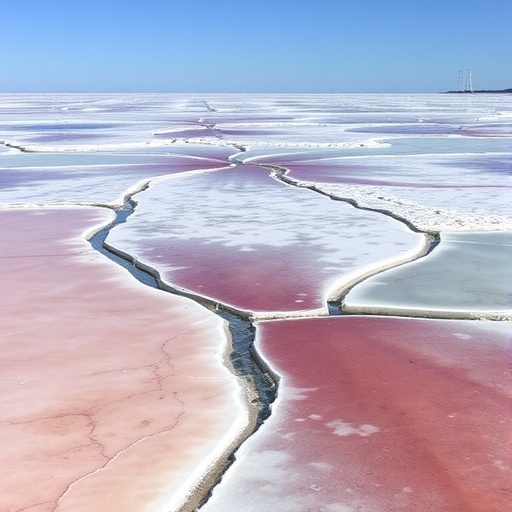
In a striking revelation that underscores the profound impacts of climate change on oceanic systems, new research from the University of Colorado Boulder reveals that the Southern Indian Ocean, off the western coast of Australia, is experiencing a dramatic decrease in salinity at an unprecedented rate. This alarming trend, observed over the past six decades, is intricately tied to shifting global wind patterns and ocean currents influenced by rising global temperatures. The consequences of this shift extend far beyond regional boundaries, with potential ramifications for global climate regulation and marine ecosystems.
The research, recently published in Nature Climate Change, elucidates how climate change is actively reshaping the intricate balance of salt and freshwater in one of the planet’s critical oceanic regions. The study highlights that this decrease in salinity is not a local anomaly but part of a larger-scale redistribution of freshwater within the world’s oceans, primarily driven by altered wind circulations over the Indian and tropical Pacific Oceans. These atmospheric modifications are funneling more freshwater into the Southern Indian Ocean, a process that could reverberate through planetary climate systems.
Typically, seawater maintains an average salinity near 3.5%, a balance achieved through the continuous interplay of evaporation and precipitation. However, within the expansive Indo-Pacific freshwater pool, spanning the eastern Indian Ocean to the western Pacific in the Northern Hemisphere tropics, surface waters are characteristically less salty. This is largely due to persistent tropical rainfall and comparatively subdued evaporation rates, forming a massive repository of fresher water that critically influences global ocean circulation patterns.
This Indo-Pacific freshwater pool is a vital component of the thermohaline circulation—a complex global conveyor belt that moves heat, salt, and freshwater across the world’s oceans. Surface currents transport warm, less saline waters from the Indo-Pacific region towards the Atlantic, contributing to the temperate climate experienced in parts of Western Europe. Upon reaching the North Atlantic, this water cools, increases in salinity and density, then sinks, driving the deep ocean return currents back to the Indian and Pacific Oceans.
However, observational data collected over the last sixty years expose that the salty seawater region off the southwest coast of Australia, historically dry with extensive evaporation, is becoming unusually fresher. The area has seen a staggering 30% contraction in its salty water mass, signaling an extraordinary influx of freshwater. According to Dr. Weiqing Han, a professor in the Department of Atmospheric and Oceanic Sciences and lead investigator, this represents the most rapid freshening trend recorded in the Southern Hemisphere, marking a profound shift in oceanic freshwater distribution patterns.
The magnitude of this freshwater influx is staggering—the equivalent of adding approximately 60% of Lake Tahoe’s volume yearly into this ocean segment. To put this into perspective, Dr. Gengxin Chen, a senior scientist at the Chinese Academy of Sciences and lead author, illustrates that this amount of freshwater could hypothetically supply the entire United States population with drinking water for over 380 years. This comparison not only emphasizes the scale but highlights the significant alteration in the regional water cycle driven by climatic changes.
Significantly, this freshening is not attributable to local precipitation fluctuations. Instead, it represents a notable consequence of global warming’s influence on atmospheric circulation. Enhanced surface wind shifts over the Indian and tropical Pacific Oceans are rerouting ocean currents, effectively shuttling more freshwater from the Indo-Pacific freshwater pool into the Southern Indian Ocean. This complex interplay between the atmosphere and ocean currents illustrates the far-reaching effects of anthropogenic climate change on marine hydrodynamics.
Salinity profoundly affects seawater density, and the influx of fresher water reduces the density of surface waters in the Southern Indian Ocean. Because fresher water is lighter and tends to remain atop denser, saltier layers, this stratification intensifies the vertical separation between surface and deep ocean waters. The increased salinity gradient diminishes the vertical mixing crucial for nutrient recycling and heat redistribution between ocean layers, processes essential for sustaining ocean health and biological productivity.
The disruption of vertical mixing caused by enhanced freshwater stratification can have serious ecological repercussions. Normally, nutrient-rich deep waters ascend to the sunlit surface layers, supporting phytoplankton growth and maintaining the marine food web’s foundation. With reduced mixing, nutrient transport declines, jeopardizing plankton populations and, subsequently, the diverse marine life that relies on this primary productivity. Furthermore, the impaired heat transfer from surface to deeper layers could exacerbate warming in the upper ocean, amplifying thermal stress for marine organisms already vulnerable due to climate change.
These findings add a new dimension to concerns surrounding the thermohaline circulation. Prior studies have indicated that the addition of freshwater from melting Arctic and Greenland ice disrupts the salinity gradient in the North Atlantic, potentially slowing this critical circulation system. The observed expansion of the freshwater pool in the Indo-Pacific and its movement into the Southern Indian Ocean could compound this effect, as an increased volume of fresher water eventually makes its way into the Atlantic through global ocean connectivity. Such disruptions risk altering heat distribution on a planetary scale, with implications for weather patterns, sea level rise, and climate variability.
The emerging scenario portrays the Southern Indian Ocean as a dynamically changing system whose salinity patterns are increasingly dominated by human-driven climatic alterations. The impacts on marine ecosystems highlight an urgent need to integrate ocean salinity monitoring into global climate models to better predict and manage the consequences of ongoing freshwater redistribution. Researchers emphasize the critical role of ocean-atmosphere coupling in these processes, noting that understanding these feedbacks is essential to preparing for future environmental conditions.
Looking ahead, sustained observation and sophisticated modeling are vital to unraveling the complex mechanisms underlying these salinity changes. Multidisciplinary efforts that link atmospheric science, oceanography, and marine ecology will be key to addressing the cascading effects of freshwater shifts on biodiversity, fisheries, and global climate resilience. This study serves as a clarion call to scientists and policymakers alike, underscoring that ocean salinity is not a static parameter but a sensitive indicator of planetary health in a warming world.
The Southern Indian Ocean’s freshening phenomenon exemplifies the profound interconnectedness inherent in Earth’s systems—how atmospheric changes, driven by anthropogenic emissions, propagate through ocean currents, reshape marine environments, and ultimately influence global climate stability. As climate change continues its relentless progression, unraveling such changes is imperative for anticipating the future trajectory of the planet’s oceans and the life they sustain.
News Publication Date: February 3, 2026
Web References:
- Research article in Nature Climate Change: https://www.nature.com/articles/s41558-025-02553-1
References:
- Han, W., Chen, G., et al. (2026). Climate-driven shifts in ocean salinity and their implications for global thermohaline circulation. Nature Climate Change. DOI: 10.1038/s41558-025-02553-1
Cite Scienmag News
Violet Maxwell. (February 12, 2026). One of the Ocean’s Saltiest Regions Is Becoming Fresher. Scienmag. https://scienmag.com/one-of-the-oceans-saltiest-regions-is-becoming-fresher/
Violet Maxwell. "One of the Ocean’s Saltiest Regions Is Becoming Fresher." Scienmag, 12 February 2026, https://scienmag.com/one-of-the-oceans-saltiest-regions-is-becoming-fresher/. Accessed 3 September 2026.
Violet Maxwell. "One of the Ocean’s Saltiest Regions Is Becoming Fresher." Scienmag. February 12, 2026. https://scienmag.com/one-of-the-oceans-saltiest-regions-is-becoming-fresher/


