


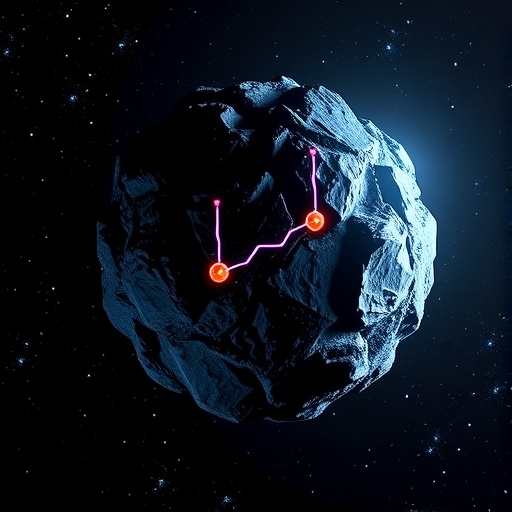
UNIVERSITY PARK, Pa. — The origins of amino acids, fundamental components necessary for life, have always been a subject of profound scientific inquiry. Previously, amino acids were detected in ancient samples hailing from a 4.6-billion-year-old asteroid named Bennu, which was brought back to Earth in 2023 by NASA’s OSIRIS-REx mission. However, the precise mechanisms by which these crucial molecules formed in the hostile environment of space remained a tantalizing enigma. Recent investigations, spearheaded by a team of scientists from Penn State, unveil a groundbreaking narrative suggesting that these essential building blocks may have emerged in a frigid, radioactive environment during the formative years of our solar system.
Published on February 9 in the Proceedings of the National Academy of Sciences, this research significantly alters the previously held beliefs regarding the formation of amino acids in celestial bodies. The findings suggest that the building blocks of life in asteroids like Bennu may not have originated solely in environments rich in warm liquid water—a significant departure from traditional theories that primarily emphasized the necessity of aqueous environments for the synthesis of organic compounds. According to the researchers, the diverse conditions of the early solar system facilitated multiple pathways for amino acid formation, vastly expanding our understanding of prebiotic chemistry.
Leading the research initiative, Allison Baczynski, an assistant research professor in geosciences at Penn State, expressed intrigue at the study’s revelations. The scope of the research indicated that various conditions beyond the conventional milieu of warm, liquid water could yield vital biochemical compounds essential for life. The isotopic analysis revealed that amino acids found within the asteroid Bennu could have formed through unique processes previously unconsidered, pointing toward the vast assortment of environments in which these fundamental molecules can emerge.
The Penn State team focused their analysis on glycine, which is regarded as the simplest amino acid and possesses a two-carbon molecular structure. Glycine plays an integral role in forming proteins, which are pivotal for nearly every biological function within living organisms, functioning to build cells and facilitate chemical reactions. The potential presences of glycine in cosmic bodies, such as asteroids and comets, imply that some of life’s core ingredients may have synthesized in space—later delivered to the nascent Earth, fostering the conditions necessary for life to flourish.
Historically, the prominent theoretical pathway for glycine synthesis has been through a process known as Strecker synthesis, which necessitates the interaction of hydrogen cyanide, ammonia, and aldehydes or ketones—coupled with the presence of liquid water. However, the new findings challenge this paradigm, proposing instead that glycine on Bennu may have developed in a radically different context, potentially synthesizing within frozen ice that was bombarded by radiation in the outer reaches of the early solar system.
Advanced technology played a pivotal role in this groundbreaking discovery. The team employed specialized instrumentation capable of conducting isotopic measurements on minuscule amounts of organic compounds, like glycine. Without substantial advancements in analytical equipment, this study’s revelations may have remained undiscovered. Baczynski emphasized how the investment in modern science and technology has yielded fresh insights into the origins of amino acids and their potential to elucidate the genesis of life itself.
Comparisons drawn between amino acids retrieved from Bennu and those present in the famous Murchison meteorite, which fell in Australia in 1969, offer intriguing revelations. While Murchison’s amino acids appear to have formed under conditions requiring liquid water, the isotopic data suggest that Bennu’s glycine could have originated from colder, more extreme environments. This disparity indicates not just different processes of amino acid synthesis but also hints at the chemically distinct regions of the solar system from which these parent bodies emerged.
As the researchers delve deeper into the implications of their findings, many exciting questions arise. Amino acids, for example, can exist in two mirror-image forms, akin to left and right hands. Previous assumptions held that these enantiomers should exhibit similar isotopic signatures. Yet the analysis of glumatic acid from Bennu reveals drastically different nitrogen isotopic values for each form. This perplexity opens further avenues of investigation, compelling scientists to discern the reasons behind such striking differences within closely related organic compounds.
The Penn State research team, including co-authors Mila Matney, Christopher House, and Katherine Freeman, envisions a path forward paved with continued exploration. They aim to scrutinize additional meteorites, hoping to discern whether their amino acids align with those observed in either Murchison or Bennu. The quest for understanding the cosmic origins of life’s foundational building blocks remains full of questions, emphasizing a need for continued research into the pathways that could have facilitated the emergence of life.
In a broader context, the study holds significant implications for our understanding of abiogenesis and how life could emerge in diverse environments across the universe. The findings compel scientists to reconsider long-held beliefs about where and how the basic components of life can appear in extraterrestrial settings. By studying meteoric samples and conducting further isotopic analyses, researchers hope to uncover yet more layers to the complex tapestry of origins that life might have shared with the cosmos.
The reception of these exciting findings is further underscored by the financial backing provided through multiple NASA programs, highlighting the collective efforts aimed at unraveling the mysteries of the early solar system. Such inquiries are critical, as they not only deepen our understanding of life on Earth but also pave the way for astrobiological explorations into other celestial bodies. The secrets that lie within the universe’s vast regions continue to captivate humanity’s imagination, reinforcing the notion that curiosity and scientific inquiry are imperative for unveiling the destinies of both life on Earth and potentially elsewhere in the cosmos.
As the pursuit of knowledge in planetary science continues, the overarching quest remains clear: to unearth further evidence regarding the origins of amino acids and their eventual role in the formation of life on our home planet. Only through rigorous investigation and an openness to revising existing theories can the scientific community hope to advance its comprehension of the intricate dance between chemistry and biology that ultimately birthed life as we know it.
The implications of this research extend beyond understanding our own origins, offering glimpses into the broader mechanics of life’s emergence throughout the universe. As questions continue to arise from these findings, one thing is evident—our quest to unravel the cosmic underpinnings of life’s genesis is as infinite as space itself, inviting generations of scientists to participate in an ongoing dialogue about the origins of life in the cosmos.
Keywords
Origin of life, amino acids, early solar system, asteroid Bennu, isotopic analysis, prebiotic chemistry, extraterrestrial life, hydrological hypothesis, Strecker synthesis, astrochemistry, space exploration, Penn State research.
Cite Scienmag News
Grant Pearson. (February 9, 2026). Essential Building Blocks of Life Unveiled in Asteroid Bennu. Scienmag. https://scienmag.com/essential-building-blocks-of-life-unveiled-in-asteroid-bennu/
Grant Pearson. "Essential Building Blocks of Life Unveiled in Asteroid Bennu." Scienmag, 9 February 2026, https://scienmag.com/essential-building-blocks-of-life-unveiled-in-asteroid-bennu/. Accessed 3 September 2026.
Grant Pearson. "Essential Building Blocks of Life Unveiled in Asteroid Bennu." Scienmag. February 9, 2026. https://scienmag.com/essential-building-blocks-of-life-unveiled-in-asteroid-bennu/


