


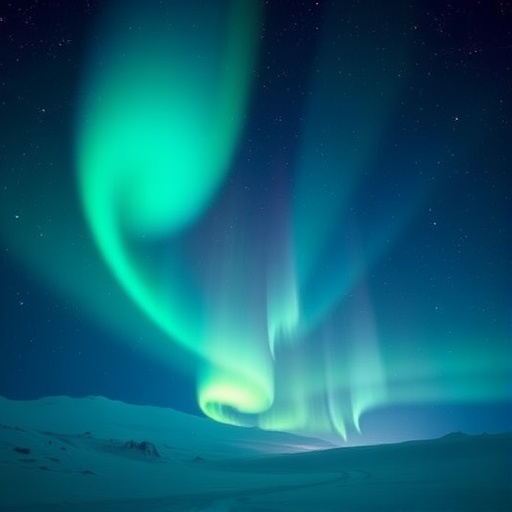
Natural phenomena often captivate the human imagination, and few sights are as mesmerizing as the ethereal glow of auroras. These natural light displays, particularly visible near the poles, owe their spectacular colors to the interaction of high-energy particles from solar winds with Earth’s atmosphere. While the fundamental mechanics of auroras have been somewhat understood, a pivotal question has lingered: how are these energetic particles accelerated before colliding with the atmosphere? Recent research elucidates this mystery, revealing that Alfvén waves situated in Earth’s magnetic field may serve as the driving force behind these stunning atmospheric displays.
A team of researchers, including leading physicists from The University of Hong Kong (HKU) and the University of California, Los Angeles (UCLA), has documented groundbreaking insights into the processes powering auroras. Their findings, published in the esteemed journal Nature Communications, demonstrate that Alfvén waves—plasma waves that travel along magnetic field lines—play a critical role in energizing charged particles. This discovery not only enhances our understanding of auroral mechanisms on Earth, but it also sets the groundwork for extrapolating these principles to other celestial bodies within our solar system.
The study meticulously analyzed the trajectory and energy gain of charged particles before their descent into the Earth’s atmosphere. The researchers posited that Alfvén waves act as a natural accelerator. These waves, moving along the magnetic field lines, continuously supply energy to charged particles, effectively driving them downwards where they incite breathtaking auroral displays. This cascading process results in the vivid lights that so many of us thrill to experience.
To substantiate their claims, the researchers evaluated data from a multitude of satellites that monitor Earth’s magnetic field and auroras. This impressive array of observational data included contributions from NASA’s Van Allen Probes and the multiple-satellite THEMIS mission. Through meticulous cross-referencing of satellite data, the researchers confirmed that Alfvén waves perpetually transfer energy to the auroral acceleration regions, sustaining the electric fields necessary for auroras to develop.
Professor Zhonghua Yao, who leads the HKU team, remarked that their breakthrough offers not merely an answer to the inner workings of Earth’s aurora, but a comprehensive model that is applicable to various other planets, both within our solar system and beyond. The research team combines extensive experience in planetary science with a focus on magnetospheric dynamics, particularly regarding larger planets like Jupiter and Saturn. This experience enriches any discussion about auroral processes, as understanding the magnetospheric conditions in these gas giants allows for a more informed analysis of Earth’s auroras.
Most notably, their approach highlights the importance of interdisciplinary collaboration. The UCLA team, led by Dr. Sheng Tian, contributed an extensive understanding of Earth’s auroral physics, while the HKU group’s expertise brought a broader perspective of planetary dynamics to the study. This duality in expertise proves vital; bridging Earth sciences and planetary exploration can yield insights that would otherwise remain elusive to researchers confined to a single, focused discipline.
The unique findings highlighted in this study position Alfvén waves not only as fundamental players in Earth’s auroral phenomena but also as universal elements in the study of planetary atmospheres. These waves, produced by various processes including interactions with the solar wind, appear to have similar effects on other planetary bodies where auroras are present. By elucidating the mechanisms behind such dramatic displays, the researchers provide a framework through which to analyze auroral phenomena across different planetary environments.
In addition to an enhanced understanding of auroras, this research opens doors to futuristic studies concerning how energy dynamics shape atmospheres on other planets. Investigating how other planetary bodies, such as those in the outer solar system, manage and utilize this energetic flow could offer further avenues of investigation. The allure of exponential developments in space sciences is tantalizing, as researchers may eventually derive predictive models to understand phenomena that at present seem completely foreign.
As this field of research continues to evolve, groundbreaking explorations of auroras are expected to become more frequent, especially with advanced observational technology at our disposal. Satellite technologies are continually refining our ability to monitor auroras and their underlying mechanics, allowing scientists to collect data that was previously unattainable. As these methods advance, the breadth of understanding regarding solar winds, Alfvén waves, and atmospheric interactions will likely expand, revealing further layers of complexity in the interplay between celestial bodies and their magnetospheres.
Furthermore, by understanding these natural processes, researchers can begin to consider implications for future space missions as humanity ventures beyond our own planet. Knowledge of auroras and their energetic sources could inform spacecraft design and crew safety protocols, particularly for missions exploring more distant realms of the solar system. As we strive towards more ambitious explorations, deciphering these atmospheric dynamics becomes increasingly critical.
This recent research emphasizes the interconnected nature of scientific inquiry—exploiting synergies between diverse fields enriches not just our understanding of specific phenomena, but also leads to broad advancements across domains. The profound implications of uncovering these auroral mechanics signify strides not merely confined to physics, but also extending into the realms of planetary science, environmental studies, and even forecasting solar weather events.
The study culminates in an exciting juncture in space science, holding promise for potential breakthroughs that could reshape our understanding of atmospheric behaviors both on Earth and across other celestial bodies. As researchers continue to delve deeper into the dynamics defining our solar system, the solutions to lingering mysteries—such as what energizes auroras—sustain our thirst for knowledge and discovery, echoing through not only scientific circles but also inspiring public interest in the celestial phenomena that adorn our night skies.
In summary, the revelation that Alfvén waves serve as a cornerstone of auroral dynamics on Earth reinforces our appreciation of the intricate actions unfolding within Earth’s atmosphere. As researchers refine their models and gather more data, we can anticipate thrilling developments in our comprehension of both terrestrial and extraterrestrial displays of energy from cosmic origins, proving that in the universe, there are always more mysteries to explore.
Keywords
Alfvén waves, auroras, magnetic fields, Earth science, planetary science, solar energy, charged particles, atmospheric physics, interdisciplinary collaboration.
Cite Scienmag News
Faith Mcneil. (February 5, 2026). HKU and UCLA Researchers Discover Mechanism Behind ‘Space Battery’ Functioning in Auroral Regions. Scienmag. https://scienmag.com/hku-and-ucla-researchers-discover-mechanism-behind-space-battery-functioning-in-auroral-regions/
Faith Mcneil. "HKU and UCLA Researchers Discover Mechanism Behind ‘Space Battery’ Functioning in Auroral Regions." Scienmag, 5 February 2026, https://scienmag.com/hku-and-ucla-researchers-discover-mechanism-behind-space-battery-functioning-in-auroral-regions/. Accessed 5 September 2026.
Faith Mcneil. "HKU and UCLA Researchers Discover Mechanism Behind ‘Space Battery’ Functioning in Auroral Regions." Scienmag. February 5, 2026. https://scienmag.com/hku-and-ucla-researchers-discover-mechanism-behind-space-battery-functioning-in-auroral-regions/


