


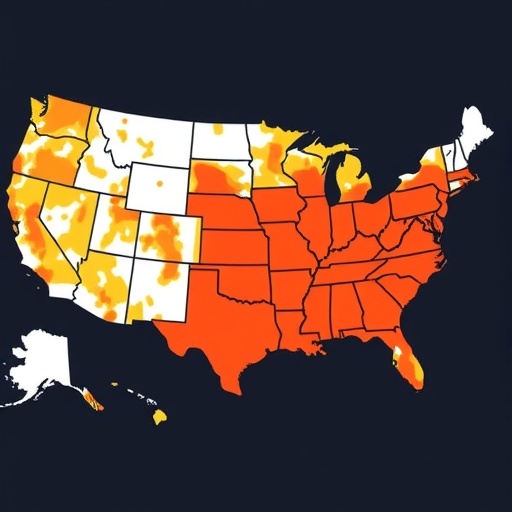
In a groundbreaking study published in PLOS Climate, researchers from Universidad Carlos III de Madrid (UC3M) and Universidad de Zaragoza (UNIZAR) have unveiled a novel framework for comprehending regional patterns of climate warming across the contiguous United States. Unlike traditional climate analyses that focus predominantly on mean temperature changes, this pioneering research delves into the full temperature distribution, exposing intricate nuances of how warming manifests differently within various parts of the temperature spectrum. This approach permits a more granular understanding of climate dynamics, revealing that many areas experience significant warming in either extreme high or low temperature ranges rather than through simple uniform increases.
Temperature plays a pivotal role in shaping ecological systems, human health, and economic activities. However, conventional metrics, which often rely solely on average annual temperatures, obscure the complexity embedded within climate variability. Conceptually, it is akin to evaluating economic inequality solely based on per capita GDP: such an approach blunts insight into conditions endured by the extremes of society. Similarly, by focusing only on mean temperatures, climate studies risk neglecting the frequency and intensity of temperature extremes that exert disproportionate impacts on both natural and human systems.
Employing an extensive dataset derived from the PRISM temperature database, the research covers daily temperature observations from 1950 through 2021, compiling over 26,000 data points per state. This wealth of data enabled the generation of full temperature distributions per state, encompassing minimum, mean, and maximum daily temperatures. Subsequently, the scientists introduced a novel metric known as “warming dominance,” designed to quantify whether increases are predominantly occurring in the higher or lower quantiles of temperature distributions, thereby capturing regional warming heterogeneities that conventional methods fail to identify.
The findings challenge widespread assumptions by demonstrating that only 55% of the 48 contiguous U.S. states exhibit statistically significant increases in their mean temperatures. However, a striking 84% show warming in at least one segment of their temperature distributions—whether at the highest or lowest extremes. This uncovering underscores the importance of examining comprehensive temperature profiles rather than aggregated means, highlighting regional disparities with profound implications for climate adaptation.
In particular, the West Coast states such as California, Oregon, Washington, and Nevada are experiencing pronounced increases in their annual peak temperatures. These elevated maxima indicate an exacerbation of extreme heat events, amplifying risks for heatwaves, wildfires, and associated public health crises. The widening thermal dispersion exhibited here reflects an alarming trend toward increasingly volatile and hazardous summer temperatures that demand urgent attention.
Conversely, states in northern parts of the country such as North Dakota, South Dakota, and Minnesota are witnessing rapid increases in minimum temperatures rather than their highs. This “softening” of winters suggests truncated cold spells and reduced thermal variability, potentially reshaping ecosystems sensitive to frost cycles, disrupting agricultural regimes dependent on chilling hours, and altering energy consumption patterns. Such subtle yet impactful warming can insidiously affect both natural and socioeconomic domains.
Meanwhile, the Southern United States, home to states like Alabama, Mississippi, and Texas, emerges as comparatively stable based on aggregated data, showing limited statistically significant temperature trends. Nevertheless, the research cautions that even in these seemingly stable regions, significant changes occur in specific portions of the temperature distribution. Hence, oversimplified assessments could underestimate potential climate risks lurking beneath surface-level stability, particularly in vulnerable subpopulations and ecosystems.
An intriguing dimension of the study is the correlation between warming dominance and political affiliation across states. Areas experiencing pronounced warming dominance, primarily in the Northeast and West Coast, predominantly align with Democratic voting patterns, while states in the South and parts of the interior with less evident warming trends tend to lean Republican. This geographical and political concordance raises compelling questions about the influence of localized climate experiences on public perception, political polarization, and the collective commitment to climate mitigation efforts.
The study’s ranking of states reveals Rhode Island, Arizona, Connecticut, Massachusetts, and California as “warming leaders,” exhibiting the most intense temperature increases across the entire distribution. These states confront amplified climate-related challenges demanding prioritized intervention. Understanding the heterogeneity of warming patterns within these frontline regions is vital for tailoring effective policies aimed at mitigating adverse impacts on public health, infrastructure, water resources, and agriculture.
By unveiling distinct patterns of warming dominance, this research extends beyond mere observation by suggesting strategic pathways for adaptation responses. For instance, regions with intensified high-temperature warming need to bolster heatwave preparedness, implement cooling infrastructure, and revise building codes to enhance thermal resilience. Conversely, areas experiencing diminishing cold extremes might reframe agricultural calendars or redesign energy usage patterns to accommodate altered seasonality.
The applied methodology and concept of warming dominance provide a versatile analytical toolkit that could extend beyond temperature metrics to other climate variables such as precipitation extremes, drought incidence, and sea-level rise. This promises broader applicability in enhancing climate risk assessments, guiding resource allocation, and informing multi-scale environmental policies that better reflect regional disparities induced by anthropogenic climate change.
Ultimately, the research illustrates a critical paradigm shift necessary for confronting climate change in the 21st century: moving from simplistic averages to richer, multidimensional assessments. This nuance illuminates inequalities in climate exposure and impact, enriching scientific understanding and elevating the granularity with which stakeholders can formulate nuanced, region-specific mitigation and adaptation interventions. Such advances are indispensable for achieving resilient societies in a rapidly warming world.
Backed by funding from Spain’s Ministry of Science and Innovation, the State Research Agency, and the European Regional Development Fund, this multi-institutional study represents a poignant contribution to the emerging field of regional climate heterogeneity. Its findings herald new directions for climatology, economics, public policy, and environmental justice as the global community seeks to equitably manage the escalating impacts of climate change.
News Publication Date: 4-Feb-2026
Web References: https://doi.org/10.1371/journal.pclm.0000808
References: Rivas MDG, Gonzalo J (2026) Regional heterogeneity and warming dominance in the United States. PLOS Clim 5(2): e0000808.
Cite Scienmag News
Russell Cooper. (February 6, 2026). 41 US States Experience Unique Patterns of Warming, Reveals UC3M and UNIZAR Study. Scienmag. https://scienmag.com/41-us-states-experience-unique-patterns-of-warming-reveals-uc3m-and-unizar-study/
Russell Cooper. "41 US States Experience Unique Patterns of Warming, Reveals UC3M and UNIZAR Study." Scienmag, 6 February 2026, https://scienmag.com/41-us-states-experience-unique-patterns-of-warming-reveals-uc3m-and-unizar-study/. Accessed 3 September 2026.
Russell Cooper. "41 US States Experience Unique Patterns of Warming, Reveals UC3M and UNIZAR Study." Scienmag. February 6, 2026. https://scienmag.com/41-us-states-experience-unique-patterns-of-warming-reveals-uc3m-and-unizar-study/


