


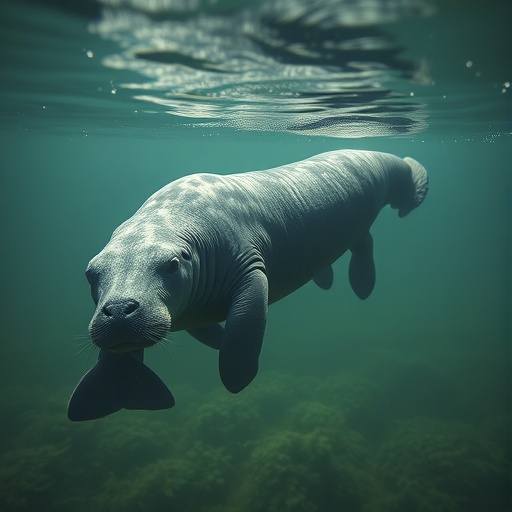
The Amazonian manatee, a vulnerable freshwater mammal native to the vast Amazon Basin, has long remained elusive to researchers aiming to understand its true population dynamics and distribution patterns. Traditional survey methods, often reliant on visual observation or capture techniques, have proven inadequate in the dense and expansive habitats where these gentle giants reside. A breakthrough study employing environmental DNA (eDNA) analysis offers a promising alternative to overcome these limitations and open new frontiers in the conservation of this endangered species.
Environmental DNA, a cutting-edge molecular approach, capitalizes on trace genetic material shed by organisms into their environment. Aquatic species, in particular, release DNA into water through skin cells, mucus, and excretions. By collecting and analyzing water samples, scientists can detect the presence of species without needing direct sightings, a game-changing capability especially in remote, inaccessible locations like the western Amazon. This method facilitates the surveying of elusive animals while minimizing disruption to their natural behavior and habitat.
In this pioneering research, investigators collected water samples in the vast and remote western Amazon—one of the few areas with limited human footprints, coinciding with known manatee habitats. The team strategically extracted eDNA from these samples, amplifying manatee-specific genetic markers to confirm their presence. This deployment showcased the superior sensitivity of eDNA, revealing occurrences of Amazonian manatees in stretches of river and floodplain environments previously undocumented by conventional techniques.
The implications of this advancement extend beyond mere detection. eDNA methodologies allow for continuous, non-invasive monitoring programs that can be adapted to varying logistic constraints. Remote areas, long considered enigmatic due to access difficulties, can now be surveyed with relative ease, making conservation efforts more dynamic and informed. By mapping the distribution accurately, wildlife managers can identify critical habitats, migration corridors, and possibly population bottlenecks, thus tailoring protection strategies with unprecedented precision.
Another crucial aspect addressed by the study is the impact of anthropogenic influence on manatee distribution. The data indicated a strong preference for regions with minimal human activity, underscoring the sensitivity of Amazonian manatees to disturbances. This insight, afforded through molecular surveillance, reinforces the urgency to minimize habitat degradation caused by deforestation, pollution, and unregulated development, which threaten the aquatic ecosystems that sustain these mammals.
The methodology behind the eDNA approach is both robust and innovative. Water samples undergo filtration to concentrate genetic material, followed by DNA extraction using specialized protocols to preserve tissue fragments. Polymerase Chain Reaction (PCR) amplification targets mitochondrial DNA sequences unique to the Amazonian manatee, ensuring specificity and reducing false positives. The results, validated through replicates and controls, provide reliable presence data while enabling future quantitative assessments as techniques evolve.
Furthermore, this technology aligns well with global conservation goals emphasizing biodiversity monitoring and species protection. The low-cost and minimal field infrastructure requirement makes it highly suitable for collaboration between international and local scientists, boosting capacity building in biodiversity-rich yet resource-limited regions like the Amazon. It promotes community involvement and environmental stewardship by demonstrating tangible benefits of molecular ecology.
The study’s findings were published in a leading open-access scientific journal, making this valuable information broadly available to the global research community. Dissemination of these results encourages replication of eDNA surveys for other threatened aquatic species, fostering a multidisciplinary approach that bridges molecular biology, ecology, and conservation policy. It catalyzes novel scientific inquiry into ecosystem health, species interactions, and environmental change impact assessments.
Importantly, the researchers declared no conflicts of interest, ensuring impartiality and credibility. The research received funding support from philanthropic donations and national science councils, demonstrating the vital role of diverse financial backing in pioneering ecological science. Such funding models support innovative methods that can reshape wildlife management practices worldwide.
Visual documentation included a compelling image of a researcher collecting a water sample adjacent to Ilhas das Onças near Belém city, symbolizing the blend of fieldwork and high-tech science. The photo highlights the practical field protocols that enable large-scale eDNA sampling, connecting molecular techniques with on-the-ground conservation actions. These images serve not only as scientific evidence but as powerful communication tools to raise awareness.
This novel application of eDNA technology in the Amazon basin is an exemplary case of how modern scientific tools can address longstanding conservation challenges. The precise and efficient detection of the vulnerable Amazonian manatee opens up new horizons for monitoring and protecting this iconic species. It also contributes to a broader understanding of freshwater ecosystems, reinforcing the importance of preserving biodiversity hotspots.
Overall, this research marks a pivotal step forward, offering a blueprint for future wildlife surveys in remote environments. Through integrating molecular innovation and ecological insights, it provides hope that the Amazonian manatee—and many other endangered species—can be studied more effectively and safeguarded for generations to come. The convergence of technology and environmental stewardship exemplified here is a beacon for conservation science globally.
Cite Scienmag News
Margaret Porter. (February 4, 2026). New eDNA Method Reveals Vulnerable Amazonian Manatees Thrive Mostly in Remote Western Amazon Areas with Low Human Activity. Scienmag. https://scienmag.com/new-edna-method-reveals-vulnerable-amazonian-manatees-thrive-mostly-in-remote-western-amazon-areas-with-low-human-activity/
Margaret Porter. "New eDNA Method Reveals Vulnerable Amazonian Manatees Thrive Mostly in Remote Western Amazon Areas with Low Human Activity." Scienmag, 4 February 2026, https://scienmag.com/new-edna-method-reveals-vulnerable-amazonian-manatees-thrive-mostly-in-remote-western-amazon-areas-with-low-human-activity/. Accessed 4 September 2026.
Margaret Porter. "New eDNA Method Reveals Vulnerable Amazonian Manatees Thrive Mostly in Remote Western Amazon Areas with Low Human Activity." Scienmag. February 4, 2026. https://scienmag.com/new-edna-method-reveals-vulnerable-amazonian-manatees-thrive-mostly-in-remote-western-amazon-areas-with-low-human-activity/


