


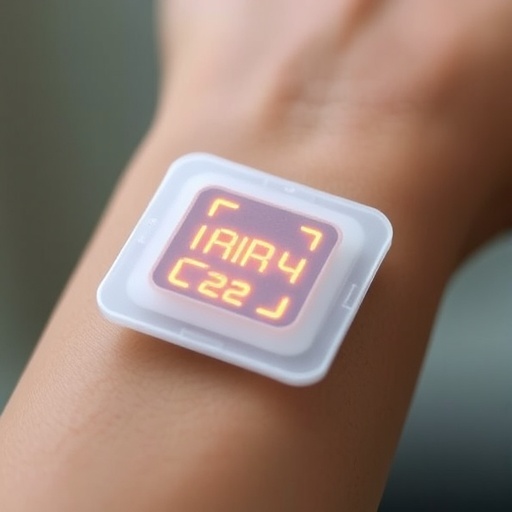
In a groundbreaking advancement destined to transform therapeutic drug monitoring, researchers have unveiled a wearable, electrochemical aptamer-based patch capable of continuous, real-time measurement of drug concentrations right from the dermal interstitial fluid. This new technology, recently tested in a pilot phase clinical trial involving healthy participants, holds immense promise, especially for drugs with narrow therapeutic windows and substantial patient-to-patient variability in drug exposure. The study’s findings reveal that such patches could revolutionize dosing paradigms by providing high-resolution pharmacokinetic data previously unobtainable through traditional blood sampling methods.
Drugs like vancomycin, a potent antibiotic commonly used to treat serious infections, often demand tight therapeutic control to avoid toxicity or suboptimal dosing. Conventional monitoring relies on sparse plasma sampling, leading to incomplete pharmacokinetic profiles and delayed dose adjustments. The wearable patches introduced in this trial incorporate electrochemical sensors built on solid microneedles that interface directly with interstitial fluid, capturing drug concentration changes at a temporal resolution of five minutes over extended periods up to 24 hours. This minimally invasive approach moves therapeutic drug monitoring out of the clinic and into continuous real-life monitoring.
The heart of the system is an electrochemical sensor based on aptamer technology. Aptamers are synthetic oligonucleotide molecules that bind selectively and reversibly to their target analytes—in this case, vancomycin molecules. By translating drug binding events to measurable electrical signals, these sensors simultaneously achieve high specificity and sensitivity. The sensor array embedded on microneedles penetrates the upper layers of the skin painlessly, confirming participant feedback that reported nearly imperceptible sensations during use.
Safety assessments were paramount to the pilot study. Six healthy individuals wore the patches at different bodily sites for up to 24 hours. Across participants, the patches exhibited excellent tolerability, with no significant adverse events reported. Additionally, the microneedles caused little to no discomfort, marking a substantial improvement over traditional blood draws. The minimally invasive nature of the patch, combined with its robust performance, highlights a key benefit for future outpatient or at-home monitoring applications.
Data retrieved from the patches revealed previously unobservable pharmacokinetic dynamics of vancomycin in the interstitial fluid compartment. High-frequency measurements captured nuanced fluctuations in drug distribution and clearance, illustrating complex compartmental characteristics that sparse plasma sampling misses. When modeled, the data offered refined insights into vancomycin kinetics, potentially enabling clinicians to optimize dosing strategies on an individual patient basis with unprecedented precision.
While the patches demonstrated stable operation over the initial 12-hour period post-insertion, sensor degradation became increasingly evident thereafter, constraining analysis primarily to this timeframe. Ongoing efforts to enhance sensor durability and longevity are underway, underscoring the evolving nature of this nascent technology. Nonetheless, even within the 12-hour window, the wealth of pharmacological data collected could inform dosing decisions far more dynamically than current clinical protocols allow.
A remarkable aspect of the wearable patches is the consistency of readings across different anatomical sites and participant populations. Concentration trends remained coherent within and between individuals, confirming the replicability and reliability of this approach. Such robustness is critical for future widespread adoption, reassuring clinicians that site of placement does not substantially bias pharmacokinetic interpretation.
Beyond vancomycin, the platform’s modular design holds vast potential for adaptation to a broad spectrum of therapeutics requiring close plasma concentration monitoring. Drugs with narrow therapeutic indices, like immunosuppressants, antiepileptics, and chemotherapeutics, could similarly benefit from continuous monitoring. Researchers anticipate that future versions of the patch will incorporate wireless data transmission and integrate with digital health ecosystems, facilitating telemedicine and real-time dosing adjustments.
The data-rich output of the electrochemical patch challenges the decades-old paradigm of intermittent blood draws, transforming it into a seamless stream of actionable information. Such innovation aligns with the broader movement toward precision medicine, which aims to tailor treatments not just based on genetics but dynamically according to pharmacokinetics and patient physiology. Integrating continuous drug concentration feedback could reduce adverse events, improve treatment efficacy, and ultimately personalize therapies with unparalleled accuracy.
This pioneering clinical trial represents the first human proof-of-concept that electrochemical aptamer-based microneedle patches can safely measure drug levels continuously in vivo with high temporal resolution. It bridges the gap between bench research and practical clinical deployment, pushing the frontiers of wearable biosensors. Future larger-scale trials will be essential to validate efficacy in diverse patient populations and real-world settings, as well as to establish cost-effectiveness and regulatory compliance.
Importantly, the trial was registered with the Australian New Zealand Clinical Trials Registry, emphasizing transparency and scientific rigor underpinning this translational research. Researchers invite collaboration across disciplines to optimize sensor chemistry, hardware miniaturization, and data analytics pipelines. Such multidisciplinary efforts will be crucial to overcome current technical limitations and help realize the full clinical utility of wearable drug monitoring devices.
As healthcare increasingly embraces digital tools, this wearable patch exemplifies how merging biology, chemistry, electronics, and informatics can yield transformative diagnostic solutions. Beyond drug monitoring, the same fundamental technology could be adapted to continuously track biomarkers relevant to metabolic diseases, infectious conditions, or even personalized fitness. The implications for patient empowerment and decentralized care models are profound.
The promise of electrochemical aptamer-based patches extends well beyond vancomycin or infectious disease applications. With advances in aptamer design, sensor sensitivity, and miniaturization, future generations could offer multiplexed monitoring of drugs and metabolites simultaneously, delivering holistic pharmacokinetic profiles. This capability would markedly improve clinical decision-making, therapeutic outcomes, and patient quality of life.
While challenges remain—such as sensor longevity, mass manufacturing, and integration into clinical workflows—the results of this early human study signal a paradigm shift. The era of “smart patches” that continuously monitor drugs from under the skin and wirelessly relay data in real-time is rapidly approaching. Such devices herald an exciting future of precision dosing made accessible and convenient for patients worldwide.
In conclusion, the novel wearable electrochemical patch technology has demonstrated safety, near-painless application, and unprecedented kinetic resolution in measuring vancomycin levels in interstitial fluid. The pilot phase clinical trial sets a robust foundation for future development and eventual clinical adoption, marking a pivotal advancement in therapeutic drug monitoring. The approach has the potential to fundamentally reshape how clinicians manage complex pharmacotherapies, ultimately fostering safer and more effective individualized medicine.
Cite Scienmag News
Ophelia Keating. (February 4, 2026). Wearable Electrochemical Patch Enables Continuous Drug Monitoring. Scienmag. https://scienmag.com/wearable-electrochemical-patch-enables-continuous-drug-monitoring/
Ophelia Keating. "Wearable Electrochemical Patch Enables Continuous Drug Monitoring." Scienmag, 4 February 2026, https://scienmag.com/wearable-electrochemical-patch-enables-continuous-drug-monitoring/. Accessed 4 September 2026.
Ophelia Keating. "Wearable Electrochemical Patch Enables Continuous Drug Monitoring." Scienmag. February 4, 2026. https://scienmag.com/wearable-electrochemical-patch-enables-continuous-drug-monitoring/


