


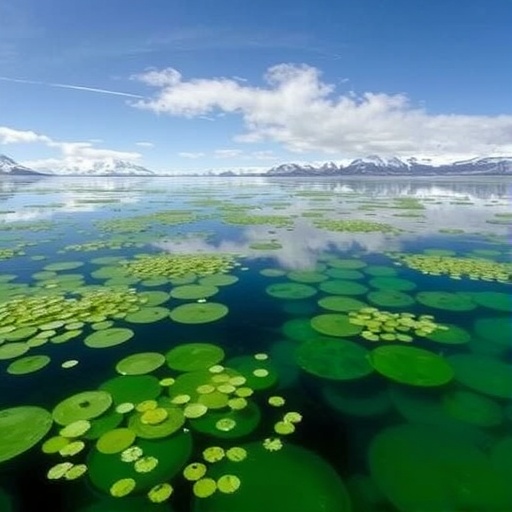
In the remote and frigid landscapes of northwest Greenland, a surprising ecological dynamic unfolds beneath the pristine ice sheets—one that challenges longstanding perceptions about nutrient availability and biological activity in glacier environments. Recent research conducted by Gill-Olivas, Forjanes, Turpin-Jelfs, and colleagues, published in Nature Communications, reveals that the process of ice ablation, far from being a mere physical melting event, plays an indispensable role in supplying vital macronutrients such as nitrogen and phosphorus to glacier ice algae. This discovery not only deepens our understanding of glacial ecosystems but also has profound implications for the carbon cycle and microbial life in polar regions.
Glacier ice algae, microscopic photosynthetic organisms thriving on glacier surfaces, contribute significantly to biological darkening of ice, affecting melt rates and, consequently, the global cryosphere’s stability. Despite their ecological importance, the pathways through which these algae obtain essential nutrients have remained enigmatic. Traditional paradigms posited that glaciers, often considered nutrient-poor, limited biological activity due to the scarcity of available nitrogen and phosphorus. The study spearheaded by Gill-Olivas et al. dismantles this assumption by elucidating how ablation processes facilitate the delivery of these macronutrients directly to glacier surfaces.
Ablation—the melting and sublimation-driven erosion of ice masses—is a fundamental aspect of glacier dynamics, especially pronounced during Arctic summer seasons. Traditionally viewed as a consequence of climate warming and a primary driver of glacial retreat, ablation has now been reframed as a critical ecological facilitator. The research team deployed cutting-edge isotopic tracing and nutrient flux measurements across multiple ablation zones in NW Greenland to quantify the contribution of melting ice to nutrient availability. Their findings indicate that ablation events release nutrient-rich brine and particulate matter accumulated within the glacier’s internal layers, effectively fertilizing the glacier’s surface microbiota.
Nitrogen, a key element required for amino acids and nucleic acids, was found in unexpectedly high concentrations within meltwater streams descending across ice surfaces, signifying active mobilization from ice reserves. Correspondingly, phosphorus, often a limiting nutrient in terrestrial and aquatic systems, was also detected in significant quantities, providing evidence that phosphorus limitation in glacier ecosystems may be alleviated seasonally during intense ablation periods. The coupling of nitrogen and phosphorus supply through ablation challenges the notion that glaciers are inert or nutrient-starved habitats, revealing instead a dynamic nutrient regime influenced directly by cryophysical processes.
Importantly, the study identifies that the timing and magnitude of nutrient release are intricately linked to ablation intensity, which fluctuates annually due to seasonal and climatic variability. In warmer months, accelerated melting liberates greater quantities of stored nutrients, enhancing glacier ice algae productivity. This seasonal nutrient pulsing creates a predictable rhythm that structures microbial life cycles on glacier surfaces. Moreover, the mechanisms of nutrient liberation and transportation are linked to the structural heterogeneity of ice, including crevasses and melt channels, which funnel nutrient-enriched waters and sediments towards algae colonies.
This biological fertilization via ablation has broader environmental ramifications. Glacier ice algae substantially influence surface albedo, the reflectivity of ice surfaces, by producing pigmented biomass that darkens ice, promoting localized warming and further melting—a positive feedback loop. The contribution of nutrients through ablation thus indirectly accelerates glacier melt by fostering algal blooms, potentially exacerbating sea-level rise. The study’s insights call for integrating biological and physical processes in models predicting glacier responses to climate change, as neglecting the nutrient-biological interactions risks underestimating melt dynamics.
Furthermore, these findings underline the resilience and adaptability of microbial life in extreme environments. Despite the harsh conditions characterized by low temperatures, high UV radiation, and nutrient scarcity, glacier ice algae exploit transient nutrient sources facilitated by ablation, sustaining primary productivity. This nutrient provisioning system indicates a complex cryosphere biosphere link, where abiotic ice dynamics regulate biological processes that, in return, impact the physical state of the ice itself.
From a biogeochemical perspective, the implications extend beyond microbial ecology into elemental cycling at the global scale. The mobilization of nitrogen and phosphorus from glaciers to downstream ecosystems through meltwater runoff may influence nutrient budgets in Arctic fjords and oceans, affecting biological productivity and carbon sequestration in these interconnected habitats. Such cross-ecosystem nutrient fluxes highlight the importance of glaciers not merely as inert reservoirs of fresh water but as active participants in regional nutrient cycling networks.
Technologically, the research employed innovative analytical approaches combining satellite remote sensing with in situ nutrient sampling and molecular biology techniques to characterize microbial community responses to nutrient pulses. This multidisciplinary methodology allowed the team to link nutrient release patterns causally with ice algal growth rates, pigment production, and genetic expression profiles, unveiling the finely tuned physiological responses of glacier algae to ablation-mediated nutrient supply.
Notably, this study paves the way for exploring nutrient dynamics in other cryospheric environments, including Antarctic ice sheets and high mountain glaciers, where similar processes may be operating but remain undocumented. Understanding whether ablation universally enhances nutrient availability and microbial productivity across polar and alpine systems is crucial for predicting how global climate shifts will influence cryosphere-associated biomes.
Climate change projections suggest increasing ablation intensities in Arctic regions, which, based on this study, could amplify nutrient delivery and biological activity on glacier surfaces in the near term. While this might temporarily boost photosynthetic carbon fixation by ice algae, the resultant enhanced surface darkening and melting could accelerate glacier mass loss, with cascading effects on sea-level rise and downstream ecosystems. Managing and mitigating these feedbacks requires integrating biological nutrient dynamics into climate models.
This research also raises intriguing questions about the potential for glacier microbial communities to serve as bioindicators of climate change, given their sensitivity to nutrient fluxes driven by ablation. Monitoring ice algal growth and nutrient concentrations over time could offer valuable insight into the pace and ecological consequences of polar warming. Moreover, understanding microbial adaptations to fluctuating nutrient landscapes could inform biotechnological applications, such as engineering cold-adapted enzymes or novel bioactive compounds.
In summary, the groundbreaking work by Gill-Olivas and colleagues transforms our comprehension of glacier ice algae ecology by demonstrating that ablation—the process by which glaciers lose mass—not only shapes physical landscape changes but also underpins critical nutrient supply mechanisms sustaining life on ice surfaces. This dual physical-biological influence underscores the complex, interconnected nature of cryosphere systems under climate stress and demands a multidisciplinary approach to unravel future trajectories.
As the Arctic continues to warm at rates exceeding global averages, unraveling the feedbacks between ice melt, nutrient cycling, and microbial life becomes ever more imperative. The evidence that ablation nourishes glacier ice algae with nitrogen and phosphorus reframes glaciers as dynamic ecosystems rather than barren ice blocks. This revelation prompts a rethinking of glacial contributions to biogeochemical cycles and carbon fluxes and highlights the intricate interplay between climate-driven physical processes and microbial ecology in shaping Earth’s frozen frontiers.
Cite Scienmag News
Violet Maxwell. (January 28, 2026). Ablation Supplies Key Nutrients to NW Greenland Algae. Scienmag. https://scienmag.com/ablation-supplies-key-nutrients-to-nw-greenland-algae/
Violet Maxwell. "Ablation Supplies Key Nutrients to NW Greenland Algae." Scienmag, 28 January 2026, https://scienmag.com/ablation-supplies-key-nutrients-to-nw-greenland-algae/. Accessed 4 September 2026.
Violet Maxwell. "Ablation Supplies Key Nutrients to NW Greenland Algae." Scienmag. January 28, 2026. https://scienmag.com/ablation-supplies-key-nutrients-to-nw-greenland-algae/


