


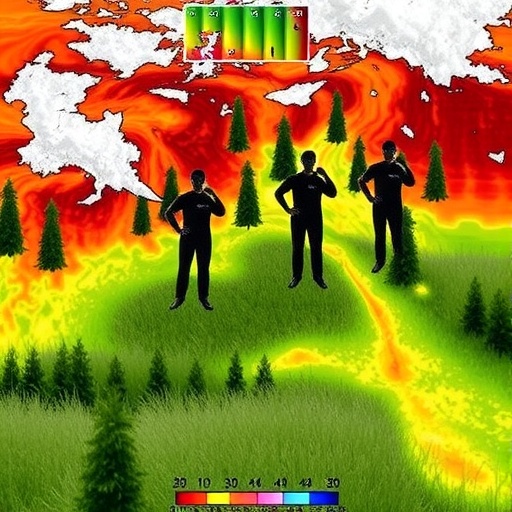
In a groundbreaking study published in Nature Communications, researchers have unveiled compelling evidence of human-induced changes in the patterns of evapotranspiration, a crucial process in the Earth’s water cycle. This research marks a significant advance in our understanding of how anthropogenic activities are reshaping the environment, particularly through alterations in extreme and seasonal evapotranspiration dynamics. The findings present not only a wake-up call about the escalating impacts of climate change but also a critical diagnostic tool for future climate adaptation and mitigation strategies.
Evapotranspiration, the combined process of water evaporation from land and transpiration from vegetation, is fundamental to the hydrological cycle. It regulates moisture transfer from terrestrial ecosystems back into the atmosphere, thus influencing weather patterns, agriculture, and water resource availability. Despite its central role, detecting human-driven changes in evapotranspiration has been notoriously difficult due to the complex interplay of natural variability and anthropogenic influences. This new research effectively disentangles these factors, providing robust observational evidence of changes tied to human activity.
The study leverages an unprecedented array of global evapotranspiration observations, combining satellite remote sensing data with ground-based measurements. By analyzing extreme and seasonal variations, the scientists could track shifts in evapotranspiration that coincide with increased greenhouse gas emissions and widespread land use changes. This methodological approach allows the quantification of human impacts with greater precision than previously possible, bridging a vital gap between climate models and actual measurements.
One of the notable revelations of the research is the pronounced increase in extreme evapotranspiration events. These are characterized by episodic surges in moisture release from the surface, which can lead to significantly altered local and regional climate conditions. The intensification of such events is linked to rising global temperatures and altered soil moisture dynamics under anthropogenic forcing. This shift has profound implications for droughts, heatwaves, and overall ecosystem resilience.
Seasonal evapotranspiration patterns have also undergone marked shifts, with observable changes in timing and magnitude. For instance, the onset of peak evapotranspiration periods has shifted earlier in some regions, correlating with earlier warming trends driven by human activities. Additionally, the peak values themselves have increased or decreased depending on the specific environmental context and the degree of land use modification. These alterations potentially disrupt established agricultural calendars and natural habitats, amplifying the challenges posed by climate variability.
The team’s use of advanced statistical techniques and climate attribution methods enabled them to isolate anthropogenic signals from natural climate variability, thus reinforcing the reliability of the results. By doing so, they provide clear attribution that these changes are not merely part of natural cycles but are significantly influenced by human-induced climate change. This capacity for attribution is critical for guiding policy and adaptation measures aimed at mitigating adverse outcomes.
Crucially, the research underscores the intimate link between land management practices and evapotranspiration responses. Deforestation, urban expansion, and agricultural intensification distinctly modify evapotranspiration patterns, sometimes exacerbating the effects of atmospheric warming. Understanding these linkages allows for more targeted interventions in land use policies to help moderate the climatic impacts of evapotranspiration changes.
Moreover, the implications of altered evapotranspiration extend beyond atmospheric moisture dynamics. They impact soil health by changing moisture availability, influence plant growth cycles, and affect water resource sustainability. As such, shifts in evapotranspiration patterns could cascade through ecosystems, disrupting food production, biodiversity, and human water security. The study’s insights offer a roadmap for integrated environmental management addressing these multifaceted challenges.
This research also prompts a reevaluation of climate models, which have historically struggled to replicate observed evapotranspiration extremes accurately. By incorporating the new observational data and findings into model development, scientists can enhance projection accuracy for future climate scenarios. This upgrade is vital for anticipating the trajectories of drought, flooding, and vegetation changes under ongoing climate change.
The timing of these findings is particularly salient as the world grapples with intensifying climate crises. Evapotranspiration changes serve as a sensitive barometer of environmental stress and human influence, suggesting the need for immediate attention in global climate policy frameworks. The evidence provides concrete grounds for strengthening commitments to emissions reductions and fostering sustainable land use approaches.
Adding to its significance, the study opens avenues for regional impact assessments. Because evapotranspiration patterns vary spatially, the ability to detect human-induced changes at fine scales enables localized climate risk evaluations. This granularity facilitates adaptive water management and agricultural planning that better reflect emerging climatic realities, thereby enhancing resilience.
Beyond the scientific community, the tangible signals of anthropogenic influences on evapotranspiration underscore wider societal responsibilities. Public awareness of such systemic environmental changes can drive grassroots climate action and support for policies aimed at curbing emissions and protecting ecosystems. The study thus serves as an important communication bridge, connecting scientific evidence with societal responses.
The researchers also draw attention to the need for continuous monitoring of evapotranspiration and related hydrological processes as climate change progresses. Sustained observational networks and enhanced remote sensing capabilities are essential to track evolving patterns and to validate mitigation efforts. Investment in these scientific infrastructures is paramount to inform adaptive strategies in a changing climate.
Furthermore, this investigation underscores the importance of interdisciplinary research. Combining expertise from climatology, hydrology, ecology, and data science has proven essential in resolving the complex picture of evapotranspiration changes. Such collaborative science is fundamental to confronting the multifaceted challenges posed by the Anthropocene era.
In conclusion, this compelling evidence of human-driven shifts in evapotranspiration highlights the profound and pervasive impacts of our activities on the planet’s water and climate systems. It calls for heightened vigilance, integrated management, and global cooperation to address the cascading effects on ecosystems and human societies. As one of the first studies to provide direct observational detection of these changes, it sets a powerful precedent for future climate science and policy innovation.
Cite Scienmag News
Sloane Callahan. (January 24, 2026). Tracking Human Impact on Extreme Seasonal Evapotranspiration. Scienmag. https://scienmag.com/tracking-human-impact-on-extreme-seasonal-evapotranspiration/
Sloane Callahan. "Tracking Human Impact on Extreme Seasonal Evapotranspiration." Scienmag, 24 January 2026, https://scienmag.com/tracking-human-impact-on-extreme-seasonal-evapotranspiration/. Accessed 5 September 2026.
Sloane Callahan. "Tracking Human Impact on Extreme Seasonal Evapotranspiration." Scienmag. January 24, 2026. https://scienmag.com/tracking-human-impact-on-extreme-seasonal-evapotranspiration/


