


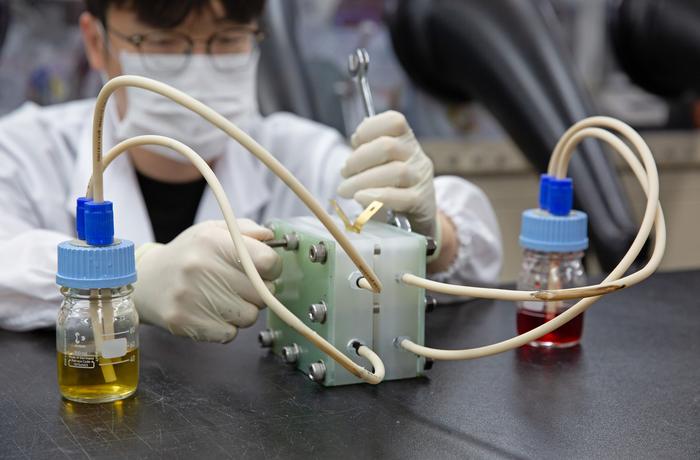
A technology has been developed to replace the active material in large-capacity ESS ‘redox flow batteries’ with a more affordable substance.
*Redox Flow Battery: A term synthesized from Reduction, Oxidation, and Flow. It is a battery that stores electrical energy as chemical energy through oxidation and reduction reactions of active materials in the electrolyte at the electrode surface and converts it back to electrical energy when needed. It is capable of large-scale storage, can be used long-term through periodic replacement of the electrolyte, and its major advantage is the absence of fire risk.

Credit: KOREA INSTITUTE OF ENERGY RESEARCH
A technology has been developed to replace the active material in large-capacity ESS ‘redox flow batteries’ with a more affordable substance.
*Redox Flow Battery: A term synthesized from Reduction, Oxidation, and Flow. It is a battery that stores electrical energy as chemical energy through oxidation and reduction reactions of active materials in the electrolyte at the electrode surface and converts it back to electrical energy when needed. It is capable of large-scale storage, can be used long-term through periodic replacement of the electrolyte, and its major advantage is the absence of fire risk.
Dr. Seunghae Hwang’s research team from the Energy Storage Research Department at the Korea Institute of Energy Research has successfully enhanced the performance and cycle life of redox flow batteries, a prominent large-capacity energy storage device, by introducing functional groups* that replace the active materials and improve solubility and stability.
*Functional group: A group of atoms within an organic compound that determines the properties of the compound and plays a role in defining its characteristics.
To expand the use of renewable energies such as solar and wind power, a long-term energy storage system is needed that can store electricity generated during favorable weather conditions for more than 8 hours and reuse it when necessary. Among these, redox flow batteries, which have a lower fire risk and a long cycle life of over 20 years compared to commonly used lithium-ion batteries, are being actively researched globally. The Republic of Korea is also focusing on developing* low-cost, high-efficiency technologies for widespread adoption around 2030.
*Energy Storage Industry Development Strategy (October 2023), Ministry of Trade, Industry and Energy
Although vanadium is currently commercialized as the active material in redox flow batteries, its limited reserves have spurred recent research into alternatives. Organic compounds such as viologens, made from naturally occurring elements like carbon and oxygen, are particularly notable for their affordability and potential to replace vanadium. However, viologens have the disadvantage of low solubility, which reduces the overall energy density, and their instability when they repeat charging and discharging, necessitating the development of technologies to overcome these issues.
To address these issues, researchers have introduced functional groups into viologens. These functional groups fit into the viologens like assembly blocks, enhancing their solubility and stability.
To increase the solubility of viologens, researchers introduced sulfonate and ester functional groups, which have water-friendly properties. These two functional groups generate attractive forces between molecules through interactions with water (electrolyte) molecules on the surface of the viologens, facilitating the dispersion of viologens in water.
Viologens are structured like a sandwich, consisting of two molecular layers. During charging, these layers frequently combine, changing into a structure that can no longer store energy. To address this, researchers introduced alpha-methyl functional groups that act as obstacles. These functional groups introduce a twist into the layered structure and generate repulsion between molecules, suppressing side-reactions and thereby enhancing the efficiency and stability of energy storage.
As a result of applying the active material developed by the researchers to redox flow batteries, it was confirmed that the energy density improved by more than twice compared to vanadium redox flow batteries. Additionally, after 200 cycles of charging and discharging, the batteries demonstrated 99.4% coulombic efficiency (discharge capacity relative to charge capacity) and 92.4% capacity retention, indicating enhanced performance and stability.
Dr. Seunghae Hwang, the first author of the paper containing the research results, stated, ‘In response to climate change and to expand the use of renewable energy, it is necessary to facilitate energy storage through the development of redox flow batteries that have both price competitiveness and long cycle life.’ She added, ‘This research enables the design of active materials that achieve both affordability and longevity, contributing to the early commercialization of redox flow batteries.
The research results were published in the prestigious materials science journal ‘ACS Applied Materials and Interfaces (IF 9.5)’, and the study was conducted with the support from the KIER.
Journal
ACS Applied Materials & Interfaces
Article Title
Integration of Functional Groups to Enhance the Solubility and Stability of Viologen in Aqueous Organic Redox Flow Batteries
Article Publication Date
24-May-2024
Cite Scienmag News
Faith Mcneil. (July 3, 2024). KIER develops ‘viologen redox flow battery’ to replace vanadium’. Scienmag. https://scienmag.com/kier-develops-viologen-redox-flow-battery-to-replace-vanadium/
Faith Mcneil. "KIER develops ‘viologen redox flow battery’ to replace vanadium’." Scienmag, 3 July 2024, https://scienmag.com/kier-develops-viologen-redox-flow-battery-to-replace-vanadium/. Accessed 3 September 2026.
Faith Mcneil. "KIER develops ‘viologen redox flow battery’ to replace vanadium’." Scienmag. July 3, 2024. https://scienmag.com/kier-develops-viologen-redox-flow-battery-to-replace-vanadium/

