


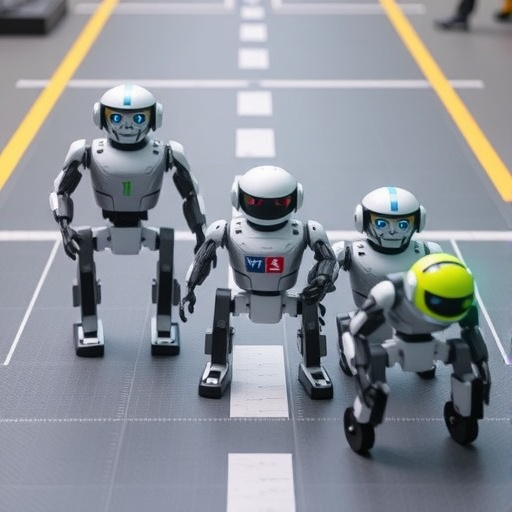
In the constantly evolving field of robotics, researchers are grappling with the complex challenge of enabling multiple robots to navigate autonomously in shared spaces. This is particularly crucial in scenarios reminiscent of social mini-games where robots must operate without causing disruption or harm. A recent study by Chandra, Zinage, and Bakolas delves deep into this issue, presenting innovative methods aimed at achieving deadlock-free, safe, and decentralized multi-robot navigation. This approach hinges on the application of discrete-time control barrier functions, a delicate interplay of mathematical frameworks designed to ensure safety and efficacy in control systems.
The motivation behind this research stems from the increasingly prevalent need for robots to perform collaboratively in environments that are not strictly structured. Traditional methods often require central coordination, creating potential bottlenecks and the risk of deadlock situations when robots attempt to share the same space. This new framework seeks to address those limitations by fostering a decentralized approach. By utilizing discrete-time control barrier functions, the research team provides a foundation for robots to make real-time decisions while ensuring they avoid collisions and conflicts with other agents in their vicinity.
Control barrier functions serve as a mathematical mechanism that defines safe regions of operation for robots. In essence, they delineate the boundaries within which a robot can maneuver without infringing on the safe zones of others in the environment. This approach not only guarantees safety but also affords each robot the autonomy to navigate within defined constraints, making independent decisions based on local information. The implications of this can be profound, particularly in scenarios where robots must interact or coexist within dynamic environments.
Deep in the technicalities, the researchers proposed a discrete-time model, which is crucial for implementing control barrier functions accurately. The study adopts a piecewise approach to control, allowing robots to assess their surroundings and their movements in discrete time intervals. This framework proves especially beneficial in real-time applications, where decisions need to be made quickly based on changing conditions. These discrete time steps can be adjusted dynamically, facilitating a more responsive and adaptable robotic behavior.
Safety is paramount in multi-robot systems, especially in settings where human interaction might occur. The research team meticulously crafted algorithms that ensure safety constraints are met at all times. This means that as robots navigate through their environments, they consistently assess potential threats and modify their trajectories accordingly. The ability to predict and adapt swiftly can greatly reduce the chances of accidents, enhancing user trust and acceptance of robotic systems in public and semi-public spaces.
Decentralization plays a pivotal role in this new navigation paradigm. In contrast to conventional centralized systems, which risk overwhelming single points of control, this decentralized approach empowers individual robots to operate independently yet coherently within their ecological niche. Each robot is endowed with the capability to process its observations and make autonomous navigation decisions, thus improving overall robustness against failures that might occur in central coordination systems.
The research illustrates the potential effectiveness of their approach through simulations and performance evaluations, providing a glimpse into future applications. The results demonstrate not only the feasibility of achieving safe multi-robot navigation in social mini-games but also the efficiency gains associated with decentralized systems. The robots adapt their movements without a central authority overseeing their actions, achieving remarkable coordination and flow in their navigational patterns.
Moreover, the practical applications of such systems stretch across various sectors. Industries such as entertainment, service delivery, and logistics could benefit immensely from the advancements this research champions. Consider the scenario of robotic waitstaff in a restaurant, adeptly navigating between tables while avoiding collisions with customers and other staff. Such systems could greatly enhance operational efficiency and customer experience, paving the way for smarter, more interactive service-driven robotics.
One of the broader implications of this study lies in the integration of social contexts within robotic interactions. By framing navigation within social mini-games, the researchers highlight the importance of understanding human-robot interaction dynamics. Future robots capable of participating effectively in social environments can potentially foster deeper engagement between humans and machines, transforming how we perceive and utilize robotic assistance in everyday life.
Furthermore, this research contributes significantly to the body of knowledge regarding robot autonomy. As robots become increasingly commonplace, advancing their capability to function independently while ensuring safety and cooperation becomes essential. The frameworks discussed in this study provide a vital reference point for future innovations in robotic navigation and collaboration, setting a high bar for ensuing research efforts.
In conclusion, the findings of Chandra and his colleagues represent a significant leap forward in the quest for safe, decentralized multi-robot navigation in quasi-social environments. The application of discrete-time control barrier functions offers a novel and effective pathway to mitigate deadlock issues while ensuring the safety of all agents involved. As robotic systems continue to evolve, embracing such interdisciplinary approaches will be crucial in realizing the full potential of autonomous technology in our daily lives.
As we continue to explore the integration of these systems in increasingly complex environments, the groundwork laid by this study signifies a pivotal advancement. The future of robotics, replete with autonomous agents capable of seamlessly cohabitating alongside humans, is just beyond the horizon, offering unprecedented opportunities for collaboration and interaction. Thus, as we march towards an era where robots are an inherent part of our societal fabric, the research findings being celebrated today will serve as both a beacon and a building block for the innovations of tomorrow.
Chandra, R., Zinage, V., Bakolas, E. et al. Deadlock-free, safe, and decentralized multi-robot navigation in social mini-games via discrete-time control barrier functions.
Auton Robot 49, 12 (2025). https://doi.org/10.1007/s10514-025-10194-8
Cite Scienmag News
Denise Maddox. (January 22, 2026). Decentralized Collision-Free Navigation for Multi-Robots. Scienmag. https://scienmag.com/decentralized-collision-free-navigation-for-multi-robots/
Denise Maddox. "Decentralized Collision-Free Navigation for Multi-Robots." Scienmag, 22 January 2026, https://scienmag.com/decentralized-collision-free-navigation-for-multi-robots/. Accessed 1 September 2026.
Denise Maddox. "Decentralized Collision-Free Navigation for Multi-Robots." Scienmag. January 22, 2026. https://scienmag.com/decentralized-collision-free-navigation-for-multi-robots/


