


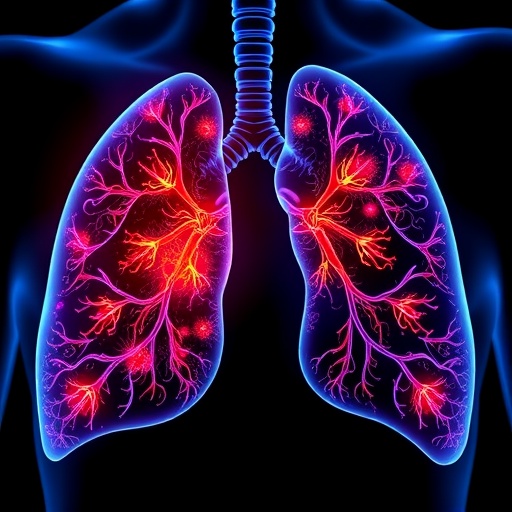
In a groundbreaking study, researchers led by Li, S., Weng, K., and Yan, L., have made significant strides in understanding the complex interplay within the tumor microenvironment, particularly focusing on lung adenocarcinoma. The study meticulously explored the role of CLEC3B-positive inflammatory cancer-associated fibroblasts (iCAFs) and how these cells alter the tumor landscape, facilitating an array of challenges and opportunities regarding immunotherapeutic strategies. Utilizing advanced techniques, the authors decoded the spatially resolved single-cell transcriptomic data across multiple cancer types, drawing vital connections that could potentially transform how therapies are designed.
At the core of this research lies the recognition that the tumor microenvironment is not merely a passive backdrop to cancer progression but a dynamic entity that significantly influences tumor behavior and treatment response. In lung adenocarcinoma, the infiltration of immune cells often reflects a war between tumor evasion tactics and the patient’s immune response. The pivotal question that emerged was how certain fibroblast populations, particularly those expressing the CLEC3B marker, play a role in reprogramming the immune microenvironment. The study provided insights into how these fibroblasts contribute to an immunosuppressive niche that promotes tumor growth while concurrently influencing therapeutic efficacy.
The methodology employed in this research is noteworthy. By integrating single-cell transcriptomics with spatial profiling techniques, the researchers created a robust framework for characterizing the tumor microenvironment at an unprecedented resolution. This approach allowed them to isolate distinct populations of cells within the tumor stroma and assess their functional states in relation to various tumor and immune cells. The ability to visualize these interactions in situ represents a significant advancement in cancer biology, enabling researchers to track changes in cellular interactions and molecular signaling pathways over time.
The findings underscore the importance of CLEC3B-positive iCAFs in lung adenocarcinoma. These fibroblasts are implicated in the secretion of cytokines and growth factors that profoundly affect immune cell behavior. Instead of merely supporting tumor structure, these cells can actively modulate the immune response, promoting an environment conducive to tumor survival and growth. The researchers highlighted that understanding these mechanisms is crucial for enhancing the response to current immunotherapies, particularly in cases where patients exhibit limited clinical benefits from existing treatment protocols.
Furthermore, the research examined how the presence of these iCAFs correlates with patient outcomes. By analyzing comprehensive datasets from multiple cancer types, they found a consistent pattern where high levels of CLEC3B expression correlated with poor prognosis. These results suggest that targeting these specific fibroblast populations might not only improve patient outcomes but could also provide a novel therapeutic avenue, redirecting the focus of immunotherapy from solely attacking tumor cells to also dismantling the supportive infrastructure that aids their survival.
The implications of this study extend beyond lung adenocarcinoma. By employing a pan-cancer perspective, the researchers have laid the groundwork for exploring similar fibroblast populations in other malignancies. This broad approach allows for a deeper understanding of the tumor-associated microenvironment across various cancer types, promoting the potential for discovering universal biomarkers that could enhance the predictive capability of oncologists when devising treatment plans. The shared mechanisms across different tumors could illuminate new therapeutic strategies that leverage the tumor stroma rather than solely targeting the cancer cells themselves.
In addition to enhancing immunotherapy effectiveness, the study raises critical questions regarding the timing and combination of therapeutic interventions. Understanding the dynamics of CLEC3B-positive iCAFs and their interactions with other immune cells and tumor cells may guide the design of sequential or combinatorial therapy regimens. For instance, introducing agents that target these fibroblasts ahead of conventional therapy could sensitize tumors to immunotherapeutic agents, potentially overcoming resistance mechanisms that lead to treatment failure.
The researchers acknowledge the complexity inherent in targeting the tumor microenvironment. Unlike traditional cancer therapies that focus solely on the cancer cell, targeting stromal components requires a nuanced understanding of cellular interactions and signaling pathways. Future clinical trials will need to carefully evaluate the impact of fibroblast-targeting therapeutics on the broader immune context, ensuring that we do not inadvertently induce adverse effects that could compromise patient safety.
Despite the promising nature of this study, the authors also noted the considerable obstacles that remain. Translating the insights gained from spatially resolved transcriptomics into clinical practice demands extensive further research. There is a need to verify the results in larger cohorts and to investigate longitudinal changes that occur within the tumor microenvironment in response to treatment. Additionally, the development of specific inhibitors or modulators of CLEC3B+ iCAFs must be a priority, followed by rigorous preclinical and clinical testing to ensure their efficacy and safety.
As we step into an era defined by personalized medicine, the findings from this research play a pivotal role in shaping the future of cancer therapy. The integration of advanced molecular techniques and the focus on the tumor microenvironment could redefine our understanding of cancer biology and treatment. With ongoing advancements and collaborations in biomedical research, the community is closer than ever to unraveling the complexities of tumors and their microenvironments.
In summary, the exploration of CLEC3B+ iCAFs provides critical insights into the tumor microenvironment’s role in lung adenocarcinoma and highlights the need for innovative strategies that target both tumors and their accompanying fibroblast populations. As researchers continue to decode the intricate relationships within the tumor stroma, targeted therapies holding the promise of improved therapeutic responses may soon emerge, making the dream of effective cancer treatment a reality for many patients.
The future of lung adenocarcinoma therapy may very well hinge on these findings. As the research community rallies around this new understanding of fibroblast biology, we anticipate that their work will not only impact lung cancer treatment but will stimulate new scientific inquiries across various cancer types. This knowledge may ultimately pave the way for next-generation therapies that take advantage of the complex interactions within the tumor microenvironment, redefining how we approach cancer in the 21st century.
In conclusion, the work done by Li, S., Weng, K., and Yan, L. broadens our understanding of the tumor microenvironment, particularly in the context of lung adenocarcinoma. Their meticulous research offers a new perspective on fibroblast biology, particularly CLEC3B-positive inflammatory cancer-associated fibroblasts, illuminating pathways that could significantly enhance the efficacy of current treatments and open up avenues for novel therapies. This study is a testament to the potential that lies within the intersection of cancer research and immunotherapy, heralding a new chapter in the journey toward effective cancer management.
Li, S., Weng, K., Yan, L. et al. Decoding the tumor microenvironment remodeling orchestrated by CLEC3B+ inflammatory cancer-associated fibroblasts in lung adenocarcinoma immunotherapy: elucidation from pan-cancer spatially single-cell transcriptomics landscape.
J Transl Med (2026). https://doi.org/10.1186/s12967-026-07677-2
Cite Scienmag News
Nathaniel Bowman. (January 12, 2026). Unraveling Tumor Microenvironment in Lung Cancer Immunotherapy. Scienmag. https://scienmag.com/unraveling-tumor-microenvironment-in-lung-cancer-immunotherapy/
Nathaniel Bowman. "Unraveling Tumor Microenvironment in Lung Cancer Immunotherapy." Scienmag, 12 January 2026, https://scienmag.com/unraveling-tumor-microenvironment-in-lung-cancer-immunotherapy/. Accessed 4 September 2026.
Nathaniel Bowman. "Unraveling Tumor Microenvironment in Lung Cancer Immunotherapy." Scienmag. January 12, 2026. https://scienmag.com/unraveling-tumor-microenvironment-in-lung-cancer-immunotherapy/


