


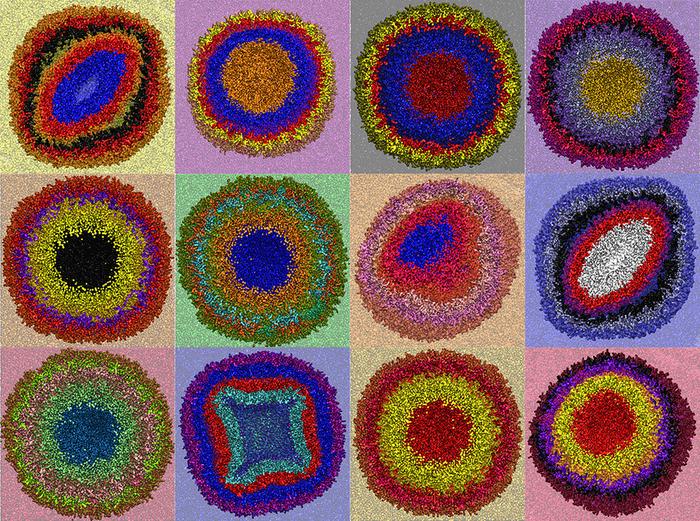
Our cells and the machinery inside them are engaged in a constant dance. This dance involves some surprisingly complicated choreography within the lipid bilayers that comprise cell membranes and vesicles — structures that transport waste or food within cells. In a recent ACS Nano paper, Luis Mayorga and Diego Masone shed some light on how these vesicles self-assemble, knowledge that could help scientists design bio-inspired vesicles for drug-delivery or inspire them to create life-like synthetic materials.

Credit: ACS Nano 2024, DOI: 10.1021/acsnano.4c01590
Our cells and the machinery inside them are engaged in a constant dance. This dance involves some surprisingly complicated choreography within the lipid bilayers that comprise cell membranes and vesicles — structures that transport waste or food within cells. In a recent ACS Nano paper, Luis Mayorga and Diego Masone shed some light on how these vesicles self-assemble, knowledge that could help scientists design bio-inspired vesicles for drug-delivery or inspire them to create life-like synthetic materials.
Double-membrane vesicles have inner and outer lipid bilayers. While scientists previously predicted that these membranes fold and warp themselves into a variety of shapes, researchers could not observe the rearrangement experimentally. So, Mayorga and Masone used molecular dynamics calculations together with an algorithm developed by Bart Bruininks and colleagues to virtually “segment” the layers so they can be seen separately. After running dozens of simulations with different vesicle sizes and lipid compositions, five common shapes were identified: oblates and prolates (elongated or flattened blobs), toroids (doughnuts), stomatocytes (cup shapes) and spheroids. This work, say the researchers, offers insight into the “unexpected inner intricacies” of how lipid bodies spontaneously self-organize.
The authors acknowledge funding from National Scientific and Technical Research Council (CONICET) and National Agency for the Promotion of Science and Technology (ANPCyT).
For more of the latest research news, register for our upcoming meeting, ACS Fall 2024. Journalists and public information officers are encouraged to apply for complimentary press registration by completing this form.
###
The American Chemical Society (ACS) is a nonprofit organization chartered by the U.S. Congress. ACS’ mission is to advance the broader chemistry enterprise and its practitioners for the benefit of Earth and all its people. The Society is a global leader in promoting excellence in science education and providing access to chemistry-related information and research through its multiple research solutions, peer-reviewed journals, scientific conferences, eBooks and weekly news periodical Chemical & Engineering News. ACS journals are among the most cited, most trusted and most read within the scientific literature; however, ACS itself does not conduct chemical research. As a leader in scientific information solutions, its CAS division partners with global innovators to accelerate breakthroughs by curating, connecting and analyzing the world’s scientific knowledge. ACS’ main offices are in Washington, D.C., and Columbus, Ohio.
To automatically receive news releases from the American Chemical Society, contact newsroom@acs.org.
Note: ACS does not conduct research, but publishes and publicizes peer-reviewed scientific studies.
Follow us: X, formerly Twitter | Facebook | LinkedIn | Instagram
Journal
ACS Nano
Article Title
“The Secret Ballet Inside Multivesicular Bodies”
Article Publication Date
3-Jun-2024
Cite Scienmag News
Bethany Barker. (June 26, 2024). Revealing the dynamic choreography inside multilayer vesicles. Scienmag. https://scienmag.com/revealing-the-dynamic-choreography-inside-multilayer-vesicles/
Bethany Barker. "Revealing the dynamic choreography inside multilayer vesicles." Scienmag, 26 June 2024, https://scienmag.com/revealing-the-dynamic-choreography-inside-multilayer-vesicles/. Accessed 4 September 2026.
Bethany Barker. "Revealing the dynamic choreography inside multilayer vesicles." Scienmag. June 26, 2024. https://scienmag.com/revealing-the-dynamic-choreography-inside-multilayer-vesicles/

