


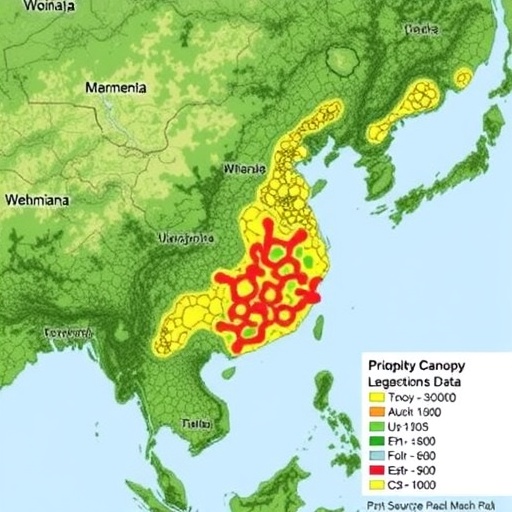
In a groundbreaking study that pushes the boundaries of ecological research, a team led by renowned scholars P. Donev, H. Wang, and S. Qin has made significant strides in enhancing our understanding of mixed forest ecosystems through innovative techniques for canopy gap detection and distribution modeling. Their research adeptly integrates multi-source data, merging remote sensing technology with field observations to create a comprehensive framework for studying ecological dynamics within forest environments. The implications of their findings hold promise not only for ecological monitoring but also for guiding sustainable forest management practices globally.
The significance of canopy gaps in forest ecosystems cannot be overstated. These gaps play a pivotal role in influencing biodiversity, light availability, and nutrient cycling. In mixed forests, where a diverse array of species coexists, understanding the spatial distribution and dynamics of these gaps becomes essential. The methodologies employed in this research allow for unprecedented insights into how canopy gaps form, persist, and affect the surrounding ecosystem, enabling scientists to draw connections between these gaps and broader ecological processes.
Utilizing advanced remote sensing techniques, the researchers were able to gather extensive data on canopy structure and composition across various forest types. This approach is particularly important in mixed forests, where variations in species composition can lead to differing canopy structures that influence light penetration and microclimate conditions. Leveraging satellite imagery, LiDAR data, and ground-level assessments, the team orchestrated a robust analysis that highlights the intricate relationships between canopy gaps and species diversity within these ecosystems.
One of the standout features of this research is the integration of multi-source data, which enhances the resolution and reliability of the findings. By combining data from various platforms, including drones and ground sensors, the research team achieved a comprehensive view of the forest landscape. This holistic perspective is particularly valuable in identifying patterns that may be overlooked when relying on a singular source of information. The cross-verification of data not only increases the accuracy of the canopy gap models but also reinforces the credibility of the ecological interpretations derived from the analysis.
The study’s findings revealing the distribution of canopy gaps within the mixed forest ecosystem carry profound implications for biodiversity conservation strategies. Increased awareness of the locations and ecological roles of these gaps can assist in developing targeted forest management plans that prioritize habitat preservation. The research highlights the necessity for a tailored approach to forest management—one that acknowledges the specific ecological needs of diverse species and their interactions with canopy structures.
Moreover, the implications extend to climate change research as well. Understanding how canopy gaps are affected by climate variability could provide insights into how forest ecosystems adapt to changing environmental conditions. The data produced from this research can serve as a baseline for future studies, allowing ecologists to monitor changes over time and assess the resilience of forests against climate-induced disruptions. Such insights are essential not only for the ecological community but also for policymakers and environmental managers tasked with creating effective conservation strategies in the face of climate change.
The multi-disciplinary approach adopted by the researchers emphasizes the collaborative nature of modern ecological science. By bringing together expertise from remote sensing, forest ecology, and environmental modeling, the researchers exemplify the importance of cross-disciplinary collaboration in addressing complex ecological challenges. This integrative methodology enhances not only the scientific validity of their findings but also opens doors to future research initiatives that can build upon this foundational work.
This study underscores the importance of technological advancements in environmental monitoring. The use of remote sensing technology in ecology has seen exponential growth in recent years, facilitating comprehensive data collection that was previously unattainable. The researchers’ proficiency in blending cutting-edge technology with field-based research exemplifies a forward-thinking approach to scientific inquiry, allowing for more efficient data collection and analysis processes that can adapt to various ecological contexts.
Looking ahead, the researchers encourage further investigation into the dynamics of canopy gaps within different ecological frameworks. Given the evidence of complex interactions between canopy structures and ecosystem processes, future studies could expand beyond mixed forests to encompass other types of woodland ecosystems. By doing so, scientists can build a more nuanced understanding of global forest dynamics, fostering ongoing dialogue about conservation and sustainable management practices.
Additionally, the study presents an important case for the role of technology in enhancing educational initiatives related to ecology. By demonstrating the efficacy of advanced data collection techniques, the research serves as a valuable teaching tool for aspiring ecologists and environmental scientists. The knowledge gained from this study represents not just empirical findings but also a pedagogical opportunity to inspire future generations to explore the intricate relationships present in natural ecosystems.
Ultimately, the research conducted by Donev and colleagues stands as a testament to the power of innovative methodologies in enhancing our understanding of forest ecology. Their pioneering work in integrating multi-source data for canopy gap detection and distribution modeling represents a significant leap forward in ecological research. As the scientific community reflects on these findings, it is clear that the research contributes to a vital dialogue about the essential role that forests play in our planetary health and the urgent need to protect these irreplaceable ecosystems.
Through their rigorous investigation, the authors pave the way for future inquiries into the complexities of forest ecosystems while advocating for informed management practices that prioritize ecological integrity. The insights delivered in this study possess the potential to reshape how we view and interact with mixed forests, ultimately fostering a deeper appreciation for the intricate web of life that exists within these vibrant environments.
In summary, Donev, Wang, and Qin have successfully illuminated critical aspects of mixed forest ecosystems by focusing on the detection and modeling of canopy gaps. Their research not only enriches our scientific understanding but also poses essential questions for ongoing dialogue about the conservation and management of forest resources. As we step forward into a future marked by ecological uncertainty, the contributions of this study will undoubtedly resonate throughout the realms of ecology, conservation, and environmental science.
Cite Scienmag News
Gavin Prescott. (December 20, 2025). Mapping Canopy Gaps with Multi-Source Data Integration. Scienmag. https://scienmag.com/mapping-canopy-gaps-with-multi-source-data-integration/
Gavin Prescott. "Mapping Canopy Gaps with Multi-Source Data Integration." Scienmag, 20 December 2025, https://scienmag.com/mapping-canopy-gaps-with-multi-source-data-integration/. Accessed 4 September 2026.
Gavin Prescott. "Mapping Canopy Gaps with Multi-Source Data Integration." Scienmag. December 20, 2025. https://scienmag.com/mapping-canopy-gaps-with-multi-source-data-integration/


