


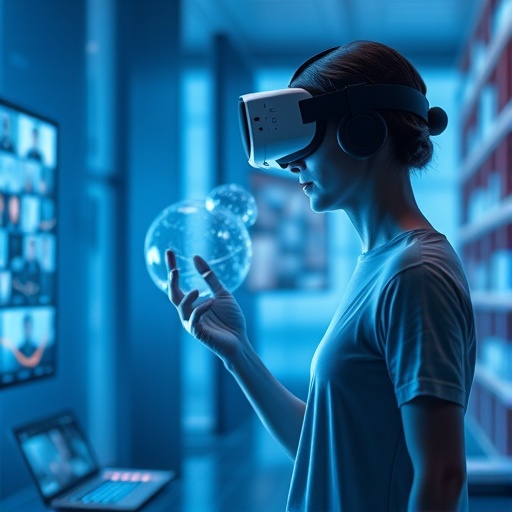
In recent years, virtual reality (VR) has emerged as a revolutionary tool in educational settings, transforming how learners engage with complex concepts. The application of VR technologies offers immersive environments that facilitate experiential learning, allowing students to dive deeply into subject matter in ways that traditional classroom settings cannot match. This evolution in educational methodologies has prompted researchers to investigate the dynamics of how learners interact with these tools. A pivotal study titled “Re-Experiencing vs. Self-Explaining: Comparing Generative Learning Activities in VR” explores this very interaction by delving into generative learning activities within virtual environments.
This research, conducted by an esteemed trio of scholars, sheds light on two distinct approaches to learning through VR: re-experiencing, where learners immerse themselves in a simulated environment, and self-explaining, which prompts learners to articulate their understanding of the concepts at play. By analyzing the differences between these methodologies, the researchers aim to identify which approach may yield better educational outcomes and how that knowledge could be applied to enhance the development of VR educational programs.
Investigating the impact of these generative activities on learning processes is crucial in today’s fast-paced educational landscape. The researchers employed rigorous methodologies, including empirical studies with diverse participant groups, to thoroughly assess how each approach influences cognitive load, retention rates, and engagement levels among learners. Their findings offer significant implications for educators and instructional designers who wish to optimize learning experiences through VR technology.
The study’s focus on cognitive load is particularly noteworthy, as it examines how the immersive nature of VR can either enhance or obstruct learning processes. When students engage in re-experiencing activities, they can inherently relate their prior knowledge to new experiences, potentially mitigating cognitive overload. Conversely, self-explaining activities push students to construct their understanding, which can lead to better retention of information but also demands higher cognitive resources.
Moreover, the article provides insights into the framing of generative learning tasks within VR settings. It suggests that the design of VR experiences should strategically incorporate elements that facilitate both re-experience and self-explanation, to foster a more holistic learning environment. This dual approach could cater to diverse learning preferences, thus broadening the accessibility of VR education.
An essential aspect of the research is its implication for the future development of educational content in VR. The findings suggest that designing environments that engage learners actively—not just as passive observers—can significantly enhance the efficacy of VR as an educational tool. The researchers advocate for an integration of these two methods within virtual learning environments, allowing educators to harness the strengths of both techniques while mitigating their weaknesses.
Beyond the immediate implications for VR education, this research reminds us of the broader potential of merging technology with pedagogy. As educational paradigms shift toward more experiential forms of learning, understanding the nuances of how technology alters cognitive processes remains pivotal. This research enriches the conversation by providing a framework to discuss the relationship between technology use and learning outcomes, essential for educators and policymakers alike.
In conclusion, the study “Re-Experiencing vs. Self-Explaining” offers a compelling examination of how various learning approaches manifest in virtual reality environments. By investigating generative activities in detail, it lays the foundation for further exploration into the intricacies of learner engagement and cognitive processing within VR. Essentially, this research illuminates a path forward for the effective implementation of VR in educational contexts, addressing not just what students learn but also how they learn.
As we move further into the digital age, the importance of research that explores the intersection of technology and education cannot be overstated. This study is a step toward unraveling the complexities of immersive learning experiences and ensuring that learners are equipped with the skills necessary to thrive in an increasingly interactive world. The insights derived from this research will undoubtedly guide future endeavors in enhancing educational experiences through innovative technologies.
The implications of this research extend into multiple fields, including instructional design, cognitive sciences, and educational technology. By grasping the intricacies of generative learning activities in immersive settings, educators can create more tailored and effective pedagogical strategies. Ultimately, the ongoing evolution of VR technology promises exciting possibilities for revolutionary educational experiences, making this research a crucial point of reference for future investigations into the effectiveness of virtual learning environments.
As the educational landscape continues to incorporate advanced technologies, the outcomes of studies like this will shape how we understand the potential of immersive learning tools. The understanding of cognitive processes in learning will evolve, driven by ongoing research and technological improvements, ensuring that learners can benefit from the most effective educational strategies available.
Lastly, the excitement surrounding VR in education continues to grow, with this research standing at the forefront of a vital discussion on how to harness emerging technologies responsibly and effectively. As educators and learners alike navigate this new terrain, the insights gathered from such rigorous examinations are invaluable for driving future developments in educational methodologies.
Cite Scienmag News
Courtney Benton. (December 12, 2025). Re-Experiencing vs. Self-Explaining: VR Learning Compared. Scienmag. https://scienmag.com/re-experiencing-vs-self-explaining-vr-learning-compared/
Courtney Benton. "Re-Experiencing vs. Self-Explaining: VR Learning Compared." Scienmag, 12 December 2025, https://scienmag.com/re-experiencing-vs-self-explaining-vr-learning-compared/. Accessed 4 September 2026.
Courtney Benton. "Re-Experiencing vs. Self-Explaining: VR Learning Compared." Scienmag. December 12, 2025. https://scienmag.com/re-experiencing-vs-self-explaining-vr-learning-compared/


