


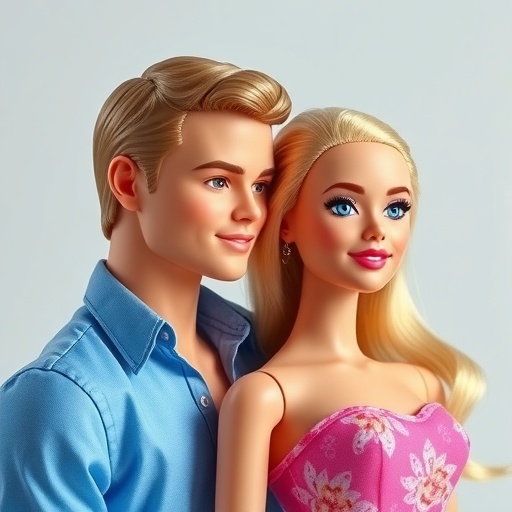
Barbie and Ken, long-standing symbols of idealized beauty, may be edging closer to the proportions of real human bodies. A new study by researchers at Adelaide University and UNSW Sydney has found that contemporary dolls in Mattel’s Barbie Fashionistas range have substantially more realistic body dimensions than the original figures examined in a landmark Australian study three decades ago. The findings suggest that one of the world’s most recognizable toy brands has made measurable progress toward representing body diversity, although the dolls remain deliberately stylized and do not fully mirror average human anatomy.
The research revisits a 1996 investigation that famously calculated the physical proportions of Barbie and Ken after scaling the dolls to adult human height. That earlier analysis concluded that the original Barbie’s narrow waist, elongated limbs, and highly specific chest-to-hip proportions were statistically improbable in real populations. The researchers estimated that fewer than one in 10 million people could naturally match the doll’s combination of measurements. Ken, although less extreme in some respects, also displayed a physique that was difficult to reconcile with typical male body proportions.
For the new study, researchers applied the same scientific approach to current dolls, including Curvy, Tall, Petite, and Standard Barbie models, as well as the latest Ken figure. They recorded dimensions from multiple regions of the body, including the head, neck, chest, waist, hips, thighs, calves, ankles, upper arms, forearms, and wrists. These measurements were then converted into ratios and compared with data collected from young adult men and women between 18 and 35 years of age. By using standardized proportional measures rather than relying only on visual impressions, the study was able to assess how closely the dolls’ physical configurations correspond to human variation.
The analysis focused on ratios commonly used in anthropometry, the scientific measurement of the human body. These included waist-to-hip, chest-to-waist, chest-to-hip, and waist-to-height ratios. Such measures help researchers compare body shape independently of absolute height or scale. A person’s waist circumference, for example, can be interpreted differently depending on overall stature, while a waist-to-height ratio provides a normalized indicator of body proportions. The researchers also compared the doll measurements with changing population trends, recognizing that average body dimensions are not fixed and can vary across generations and demographic groups.
Among the Barbie figures tested, Curvy Barbie most closely approximated the average female proportions represented in the contemporary comparison data. The results indicated that the newer models’ waist-to-hip and chest-to-waist ratios were far less extreme than those of traditional Barbie. They now fall within the broad range observed in real populations, although several measurements remain below typical female averages. This distinction is important: a proportion can be statistically plausible without being representative of the most common body shape. The modern dolls therefore appear more realistic in a technical sense, but they continue to present an idealized version of the human form.
Ken’s body has also changed, becoming more anatomically credible than earlier versions. However, the study found that some of his proportions, particularly the relationship between chest and waist circumference, remain less representative of the average adult male body. This means that Ken’s overall silhouette may be closer to reality, while still emphasizing a muscular, V-shaped physique associated with cultural ideals of male attractiveness. The result highlights that increasing realism is not necessarily the same as eliminating appearance-based expectations.
The researchers say the changes matter because toys can function as early visual lessons about bodies. Children encounter dolls before they have the vocabulary or critical perspective to evaluate how bodies are represented, and repeated exposure to highly narrow ideals may influence expectations about appearance, health, and identity. Previous research has linked unrealistic body images with body dissatisfaction, distorted perceptions of normal anatomy, and unhealthy behaviors, particularly among children and adolescents. The new study does not establish that playing with a particular doll directly causes these outcomes, but it supports the argument that representation in children’s products forms part of a wider social environment surrounding body image.
Associate Professor Sara Grafenauer of UNSW Medicine & Health said Barbie and Ken remain influential cultural figures because they are presented not merely as toys but as aspirational adult characters. Their physical design can therefore carry symbolic meaning beyond the plastic figures themselves. Professor Kevin Norton of Adelaide University, who co-authored the original 1996 study, described the newer proportions as a reflection of changing community expectations. The inclusion of Curvy, Tall, and Petite versions, alongside different facial features, skin tones, hairstyles, and physical characteristics, represents a broader attempt to show that there is no single template for an adult body.
Belinda Durey, a co-researcher from Adelaide University, said the next step should be continued diversification in body size, shape, and proportion, combined with positive messages about health and inclusion. The researchers emphasize that body diversity should not be reduced to a marketing category or treated as a substitute for accurate health information. Nevertheless, the findings suggest that today’s Barbie and Ken are substantially closer to average human proportions than their predecessors. In a culture where a small plastic figure can become a global symbol within a single generation, that shift may be more than cosmetic: it could signal a growing recognition that children’s toys are most powerful when the people they represent look less like impossible ideals and more like the diverse populations children see around them.
News Publication Date: 16-Jun-2026
Web References: https://journals.plos.org/plosone/article?id=10.1371/journal.pone.0351794; https://adelaide.edu.au/about/news/2026/swipe-right–dating-apps-linked-to-body-image-pressures/; https://shop.mattel.com/collections/barbie-fashionistas
References: PLOS One, DOI: 10.1371/journal.pone.0351794; Original 1996 study: https://link.springer.com/article/10.1007/BF01544300
Cite Scienmag News
Courtney Benton. (August 7, 2026). Scientists give Barbie and Ken a reality check after 30 years. Scienmag. https://scienmag.com/scientists-give-barbie-and-ken-a-reality-check-after-30-years/
Courtney Benton. "Scientists give Barbie and Ken a reality check after 30 years." Scienmag, 7 August 2026, https://scienmag.com/scientists-give-barbie-and-ken-a-reality-check-after-30-years/. Accessed 4 September 2026.
Courtney Benton. "Scientists give Barbie and Ken a reality check after 30 years." Scienmag. August 7, 2026. https://scienmag.com/scientists-give-barbie-and-ken-a-reality-check-after-30-years/


