


FROSTBURG, MD (June 20, 2024)—The impacts of climate change are being felt all over the world, but how will it impact how your hometown feels? An interactive web application from the University of Maryland Center for Environmental Science allows users to search 40,581 places and 5,323 metro areas around the globe to match the expected future climate in each city with the current climate of another location, providing a relatable picture of what is likely in store.

Credit: University of Maryland Center for Environmental Science/Matthew Fitzpatrick
Changing climate will make home feel like somewhere else
Interactive app shows how climate change will make places around the world feel like they are closer to the equator
FROSTBURG, MD (June 20, 2024)—The impacts of climate change are being felt all over the world, but how will it impact how your hometown feels? An interactive web application from the University of Maryland Center for Environmental Science allows users to search 40,581 places and 5,323 metro areas around the globe to match the expected future climate in each city with the current climate of another location, providing a relatable picture of what is likely in store.
You may have already experienced these changes where you live and may be wondering: What will climate of the future be like where I live? How hot will summers be? Will it still snow in winter? And perhaps How might things change course if we act to reduce emissions? This web application helps to provide answers to these questions.
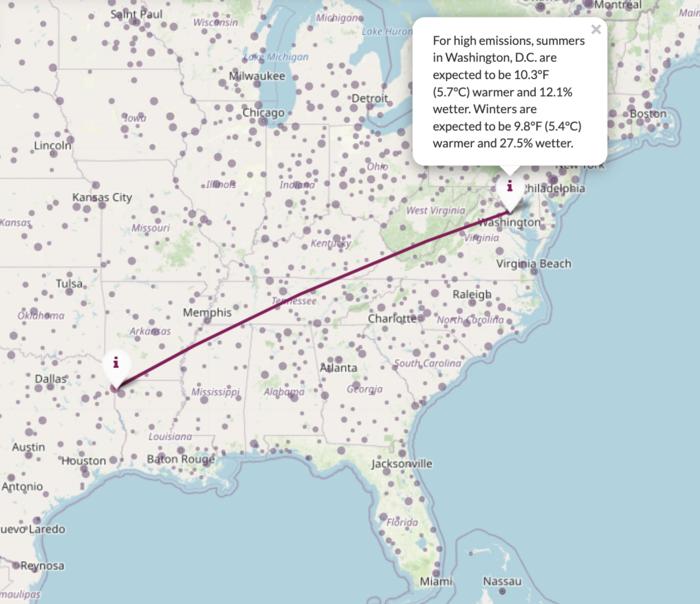
For example, if you live in Washington, D.C., you would need to travel to northern Louisiana to experience what Washington, D.C., will feel like by 2080, where summers are expected to be 11.5°F warmer in 50 years. If you live in Shanghai, China, you would need to travel to northern Pakistan to experience what Shanghai’s climate could be like in 2080.
“In 50 years, the northern hemisphere cities to the north are going to become much more like cities to the south. Everything is moving towards the equator in terms of the climate that’s coming for you,” said Professor Matthew Fitzpatrick. “And the closer you get to the equator there are fewer and fewer good matches for climates in places like Central America, south Florida, and northern Africa. There is no place on earth representative of what those places they will be like in the future.”
A spatial ecologist, Fitzpatrick used climate-analog mapping, a statistical technique that matches the expected future climate at one location—your city of residence, for instance—with the current climate of another familiar location, to provide a place-based understanding of climate change. He used the most recent available data from the Intergovernmental Panel on Climate Change (IPCC), the United Nations body for assessing the science related to climate change, to illustrate anticipated temperature changes over 30 years under two different scenarios.
Because the answer to these questions depends on how climate is expected to change and the specific nature of those changes is uncertain, the app provides results for both high and reduced emissions scenarios, as well as for several different climate forecast models. You can map the best matches for your city for these different scenarios and models as well as map the similarity between your city’s future climate and present climates everywhere (based on the average of the five forecasts for each emission scenario).
The first scenario that users can search is similar to our current trajectory and assumes very high greenhouse gas emissions, in which the planet is on track to warm around 9 degrees F by the end of this century. This scenario would make the earth warmer than it likely has been in millions of years. The second scenario is similar to what the planet would feel like if nations pursue Paris Climate Accord goals. Under that scenario, the planet warms by about 3 degrees F by immediately and drastically reducing human-caused greenhouse gases emissions.
“I hope that it continues to inform the conversation about climate change. I hope it helps people better understand the magnitude of the impacts and why scientists are so concerned,” said Fitzpatrick.
Search the interactive climate map for your city at www.umces.edu/futureurbanclimates
UNIVERSITY OF MARYLAND CENTER FOR ENVIRONMENTAL SCIENCE
The University of Maryland Center for Environmental Science leads the way toward better management of Maryland’s natural resources and the protection and restoration of the Chesapeake Bay. From a network of laboratories located across the state, UMCES scientists provide sound evidence and advice to help state and national leaders manage the environment, and prepare future scientists to meet the global challenges of the 21st century. www.umces.edu
# # #
Cite Scienmag News
Violet Maxwell. (June 23, 2024). Changing climate will make home feel like somewhere else. Scienmag. https://scienmag.com/changing-climate-will-make-home-feel-like-somewhere-else/
Violet Maxwell. "Changing climate will make home feel like somewhere else." Scienmag, 23 June 2024, https://scienmag.com/changing-climate-will-make-home-feel-like-somewhere-else/. Accessed 3 September 2026.
Violet Maxwell. "Changing climate will make home feel like somewhere else." Scienmag. June 23, 2024. https://scienmag.com/changing-climate-will-make-home-feel-like-somewhere-else/

