


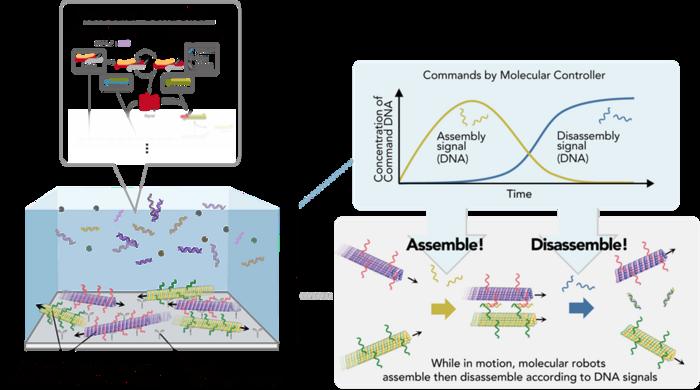
Researchers from Tohoku University and Kyoto University have successfully developed a DNA-based molecular controller that autonomously directs the assembly and disassembly of molecular robots. This pioneering technology marks a significant step towards advanced autonomous molecular systems with potential applications in medicine and nanotechnology.

Credit: Tohoku University
Researchers from Tohoku University and Kyoto University have successfully developed a DNA-based molecular controller that autonomously directs the assembly and disassembly of molecular robots. This pioneering technology marks a significant step towards advanced autonomous molecular systems with potential applications in medicine and nanotechnology.
“Our newly developed molecular controller, composed of artificially designed DNA molecules and enzymes, coexists with molecular robots and controls them by outputting specific DNA molecules,” points out Shin-ichiro M. Nomura, an associate professor at Tohoku University’s Graduate School of Engineering and co-author of the study. “This allows the molecular robots to self-assemble and disassemble automatically, without the need for external manipulation.”
Such autonomous operation is a crucial advancement, as it enables the molecular robots to perform tasks in environments where external signals cannot reach.
In addition to Nomura, the research team included Ibuki Kawamata (an associate professor at Kyoto University’s Graduate School of Science), Kohei Nishiyama (a graduate student at Johannes Gutenberg University Mainz), and Akira Kakugo (a professor at Kyoto University’s Graduate School of Science).
Research on molecular robots, which are designed to aid in disease treatment and diagnosis by functioning both inside and outside the body, is gaining significant attention. Previous research by Kakugo and colleagues had developed swarm-type molecular robots that move individually. These robots could be assembled and disassembled as a group through external manipulation. But thanks to the constructed molecular controller, the robots can self-assemble and disassemble according to a programmed sequence.
The molecular controller initiates the process by outputting a specific DNA signal equivalent to the “assemble” command. The microtubules in the same solution, modified with DNA and propelled by kinesin molecular motors, receive the DNA signal, align their movement direction, and automatically assemble into a bundled structure. Subsequently, the controller outputs a “disassemble” signal, causing the microtubule bundles to disassemble automatically. This dynamic change was achieved through precise control by the molecular circuit, which functions like a highly sophisticated signal processor. Moreover, the molecular controller coexists with molecular robots, eliminating the need for external manipulation.
Advancing this technology is expected to contribute to the development of more complex and advanced autonomous molecular systems. As a result, molecular robots might perform tasks that cannot be accomplished alone by assembling according to commands and then dispersing to explore targets. Additionally, this research expanded the activity conditions of molecular robots by integrating different molecular groups, such as the DNA circuit system and the motor protein operating system.
“By developing the molecular controller and combining it with increasingly sophisticated and precise DNA circuits, molecular information amplification devices, and biomolecular design technologies, we expect swarm molecular robots to process a more diverse range of biomolecular information automatically,” adds Nomura. ” This advancement may lead to the realization of innovative technologies in nanotechnology and the medical field, such as nanomachines for in-situ molecular recognition and diagnosis or smart drug delivery systems.”
Details of the breakthrough were published in the journal Science Advances on May 31, 2024.
Journal
Science Advances
Article Title
Autonomous assembly and disassembly of gliding molecular robots regulated by a DNA-based molecular controller
Article Publication Date
31-May-2024
Cite Scienmag News
Denise Maddox. (June 14, 2024). Self-assembling and disassembling swarm molecular robots via DNA molecular controller. Scienmag. https://scienmag.com/self-assembling-and-disassembling-swarm-molecular-robots-via-dna-molecular-controller/
Denise Maddox. "Self-assembling and disassembling swarm molecular robots via DNA molecular controller." Scienmag, 14 June 2024, https://scienmag.com/self-assembling-and-disassembling-swarm-molecular-robots-via-dna-molecular-controller/. Accessed 3 September 2026.
Denise Maddox. "Self-assembling and disassembling swarm molecular robots via DNA molecular controller." Scienmag. June 14, 2024. https://scienmag.com/self-assembling-and-disassembling-swarm-molecular-robots-via-dna-molecular-controller/

