

Tuesday, May 5, 2026
Science
No Result
View All Result
  • Login
  • HOME
  • SCIENCE NEWS
  • CONTACT US
  • HOME
  • SCIENCE NEWS
  • CONTACT US
No Result
View All Result
Scienmag
No Result
View All Result
Home Science News Chemistry

A liquid crystal source of photon pairs

June 14, 2024
in Chemistry
Reading Time: 3 mins read
0
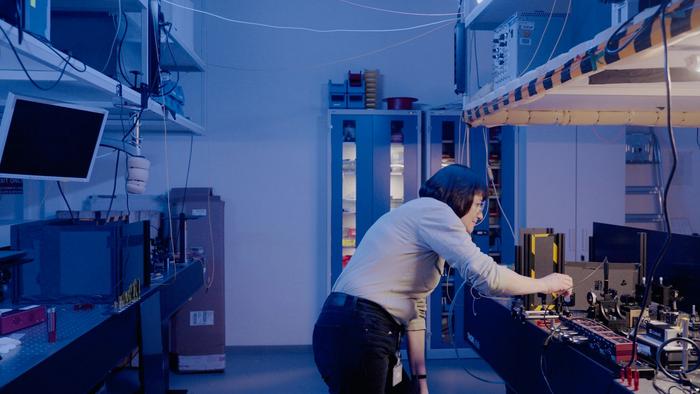
›Quantum Radiation‹ Research Group Maria Chekhova, Max Planck Institute for the Science of Light
67
SHARES
609
VIEWS
Share on FacebookShare on Twitter
ADVERTISEMENT

Spontaneous parametric down-conversion (SPDC), as a source of entangled photons, is of great interest for quantum physics and quantum technology, but so far it could be only implemented in solids. Researchers at the Max Planck Institute for the Science of Light (MPL) and Jozef Stefan Institute in Ljubljana, Slovenia, have demonstrated, for the first time, SPDC in a liquid crystal. The results, recently published in Nature, open a path to a new generation of quantum sources: efficient and electric-field tunable.

›Quantum Radiation‹ Research Group Maria Chekhova, Max Planck Institute for the Science of Light

Credit: © Tanya Chekhova

Spontaneous parametric down-conversion (SPDC), as a source of entangled photons, is of great interest for quantum physics and quantum technology, but so far it could be only implemented in solids. Researchers at the Max Planck Institute for the Science of Light (MPL) and Jozef Stefan Institute in Ljubljana, Slovenia, have demonstrated, for the first time, SPDC in a liquid crystal. The results, recently published in Nature, open a path to a new generation of quantum sources: efficient and electric-field tunable.

The splitting of a single photon in two is one of the most useful tools in quantum photonics. It can create entangled photon pairs, single photons, squeezed light, and even more complicated states of light which are essential for optical quantum technologies. This process is known as spontaneous parametric down-conversion (SPDC).

SPDC is deeply linked to central symmetry. This is the symmetry with respect to a point – for instance, a square is centrally symmetric but a triangle is not. In its very essence – a splitting of one photon in two – SPDC breaks the central symmetry. Therefore, it is only possible in crystals whose elementary cell is centrally asymmetric. SPDC cannot happen in ordinary liquids or gases, because these materials are isotropic.

Recently, however, researchers have discovered liquid crystals that have a different structure, the so-called ferroelectric nematic liquid crystals. Despite being fluidic, these materials feature strong central symmetry breaking. Their molecules are elongated, asymmetric and, most importantly, they can be re-oriented by external electric field. Re-orientation of molecules changes the polarization of the generated photon pairs, as well as the generation rate. Given a proper packaging, a sample of such material can be a very useful device because it produces photon pairs efficiently, can be easily tuned with electric field, and can be integrated into more complex devices.

Using the samples prepared in Jozef Stefan Institute (Ljubljana, Slovenia) from a ferroelectric nematic liquid crystal synthesized by Merck Electronics KGaA, researchers at the Max-Planck Institute for the Science of Light have implemented SPDC, for the first time, in a liquid crystal. The efficiency of entangled photons generation is as high as in the best nonlinear crystals, such as lithium niobate, of similar thickness. By applying an electric field of just a few Volts, they were able to switch the generation of photon pairs on and off, as well as to change the polarization properties of these pairs. This discovery starts a new generation of quantum light sources: flexible, tunable, and efficient.


Journal

Nature

DOI

10.1038/s41586-024-07543-5

Method of Research

Experimental study

Subject of Research

Not applicable

Article Title

Tunable entangled photon-pair generation in a liquid crystal

Article Publication Date

12-Jun-2024

Share27Tweet17
Previous Post

Concrete-nitrogen mix may provide major health and environment benefits

Next Post

Self-assembling and disassembling swarm molecular robots via DNA molecular controller

Related Posts

Here’s a rewritten version of the headline for a science magazine post: “A Simple Model Explaining How AI Learns” Or, if you want it a bit more engaging: “Understanding AI Learning Through a Toy Model” Let me know if you want it shorter, more technical, or more casual! — Chemistry
Chemistry

Here’s a rewritten version of the headline for a science magazine post:

“A Simple Model Explaining How AI Learns”

Or, if you want it a bit more engaging:

“Understanding AI Learning Through a Toy Model”

Let me know if you want it shorter, more technical, or more casual!

May 5, 2026
From Generalist to Specialist: Protein Binding Evolution — Chemistry
Chemistry

From Generalist to Specialist: Protein Binding Evolution

May 5, 2026
Alkali-Ion Enhanced Zeolitic Imidazolate Glasses — Chemistry
Chemistry

Alkali-Ion Enhanced Zeolitic Imidazolate Glasses

May 4, 2026
Exotic Quantum Phase Dynamically Links Vibrations Separated by Symmetry — Chemistry
Chemistry

Exotic Quantum Phase Dynamically Links Vibrations Separated by Symmetry

May 4, 2026
Revolutionary Magnon Discovery Opens Doors to Mini Quantum Computers — Chemistry
Chemistry

Revolutionary Magnon Discovery Opens Doors to Mini Quantum Computers

May 4, 2026
Unraveling the Origins of Hydrogen Cyanide on Early Earth — Chemistry
Chemistry

Unraveling the Origins of Hydrogen Cyanide on Early Earth

May 4, 2026
Next Post
Figure 1

Self-assembling and disassembling swarm molecular robots via DNA molecular controller

  • Mothers who receive childcare support from maternal grandparents show more parental warmth, finds NTU Singapore study

    Mothers who receive childcare support from maternal grandparents show more parental warmth, finds NTU Singapore study

    27640 shares
    Share 11052 Tweet 6908
  • University of Seville Breaks 120-Year-Old Mystery, Revises a Key Einstein Concept

    1043 shares
    Share 417 Tweet 261
  • Bee body mass, pathogens and local climate influence heat tolerance

    677 shares
    Share 271 Tweet 169
  • Researchers record first-ever images and data of a shark experiencing a boat strike

    540 shares
    Share 216 Tweet 135
  • Groundbreaking Clinical Trial Reveals Lubiprostone Enhances Kidney Function

    527 shares
    Share 211 Tweet 132
Science

Embark on a thrilling journey of discovery with Scienmag.com—your ultimate source for cutting-edge breakthroughs. Immerse yourself in a world where curiosity knows no limits and tomorrow’s possibilities become today’s reality!

RECENT NEWS

  • Blood Lipidome Predicts Alzheimer’s Risk, Phenotypes
  • Life’s Use of Molybdenum, Tungsten Dates 3.4 Billion Years
  • BRD4’s Novel Role Unveiled in X-linked Dystonia-Parkinsonism
  • Measuring Animal Welfare Effects of Biological Invasions

Categories

  • Agriculture
  • Anthropology
  • Archaeology
  • Athmospheric
  • Biology
  • Biotechnology
  • Blog
  • Bussines
  • Cancer
  • Chemistry
  • Climate
  • Earth Science
  • Editorial Policy
  • Marine
  • Mathematics
  • Medicine
  • Pediatry
  • Policy
  • Psychology & Psychiatry
  • Science Education
  • Social Science
  • Space
  • Technology and Engineering

Subscribe to Blog via Email

Enter your email address to subscribe to this blog and receive notifications of new posts by email.

Join 5,146 other subscribers

© 2025 Scienmag - Science Magazine

Welcome Back!

Login to your account below

Forgotten Password?

Retrieve your password

Please enter your username or email address to reset your password.

Log In
No Result
View All Result
  • HOME
  • SCIENCE NEWS
  • CONTACT US

© 2025 Scienmag - Science Magazine

Discover more from Science

Subscribe now to keep reading and get access to the full archive.

Continue reading
