

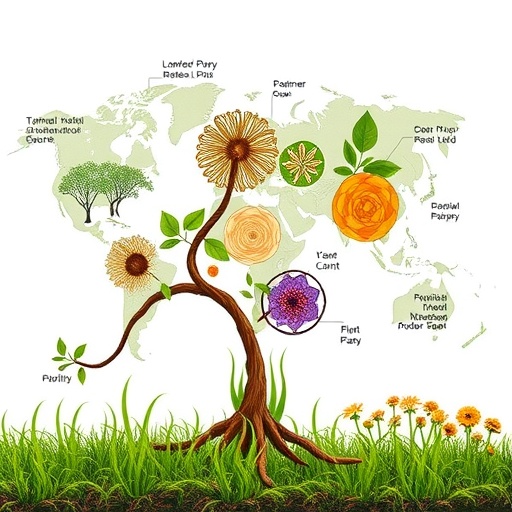
In the dynamic field of ecology, understanding the factors governing the successful naturalization of plant species worldwide has long been a subject of profound importance. A groundbreaking study by Fan, Fristoe, Li, and colleagues, published in Nature Communications, sheds new light on how the interplay between ecological similarities and dissimilarities between donor and recipient regions critically shapes patterns of global plant naturalizations. This fresh perspective not only refines our theoretical grasp of biogeographical processes but also carries significant implications for biodiversity conservation and the management of invasive species.
The crux of the research lies in unraveling how the ecological characteristics of a plant’s origin (donor region) and its new environment (recipient region) influence its ability to establish and thrive beyond its native habitat. Previous investigations often focused singularly on either the traits of invasive species or the ecological conditions of recipient sites. However, this study takes a more holistic approach by systematically comparing the ecological contexts of both regions, thereby revealing complex interactions that either facilitate or hinder plant naturalizations globally.
At the core of the methodology, the researchers compiled and analyzed extensive datasets encompassing numerous plant species and the environmental profiles of both their source and introduced locales. They meticulously quantified ecological similarities, such as climate parameters, soil types, and habitat characteristics, as well as differences in these variables, to create a comprehensive framework. Using advanced statistical models and machine learning techniques, they identified patterns linking these ecological factors with observed naturalization success rates across continents.
A remarkable finding from the study emphasizes that naturalization is not solely driven by the congruence of ecological variables. While high similarity between donor and recipient habitats certainly supports successful establishment by providing familiar conditions, substantial ecological dissimilarities can also foster naturalization by reducing competition with native flora and exposing invaders to fewer natural enemies. This dual role of both similarity and difference challenges conventional wisdom that favors uniformity between regions as the main predictor of invasion success.
Furthermore, the research uncovers that the relative importance of ecological similarities and dissimilarities varies by geographical locations and species traits. For example, temperate regions with relatively homogeneous climates tend to favor naturalizations where ecological similarity dominates, whereas tropical zones, characterized by high heterogeneity, often witness successful invasions in more ecologically distinct environments. This nuanced insight underscores the necessity of context-dependent frameworks in invasion biology.
In addition to ecological aspects, the authors also explored evolutionary and functional trait dimensions, illustrating how certain plant characteristics mediate the influence of environmental factors on naturalization outcomes. Traits such as seed mass, growth form, and reproductive strategy interact intricately with ecological gradients, often determining how flexible or specialized species are when colonizing novel habitats. These multifactorial interactions highlight the complex nature of naturalization processes.
Importantly, the implications of these findings reach beyond academic theory into practical applications for managing invasive plants. By integrating knowledge about both donor and recipient ecosystems, land managers can better predict potential invasion hotspots and tailor intervention strategies accordingly. Recognizing that some plants may thrive in ecologically dissimilar regions suggests that monitoring efforts should not be restricted to areas resembling original habitats alone.
Moreover, the study advances the development of predictive models for global plant invasions. Traditional models primarily relied on climatic matching between native and introduced ranges, often neglecting other ecological variables and species-specific traits. The integrative approach showcased here offers a more robust and accurate toolset that can incorporate multiple ecological dimensions, thereby enhancing early warning systems and strategic planning.
The authors also address the role of human-mediated disturbances and global environmental changes, which frequently alter ecological conditions of recipient regions. Such transformations may either increase ecological similarity—facilitating naturalizations—or create novel conditions that favor species adapted to disturbance and change. Consequently, the dynamic nature of ecosystems demands ongoing monitoring and adaptive management to mitigate invasive species impacts.
Notably, the research contributes to the broader discourse on global biotic homogenization, where species distributions become increasingly similar across different regions due to human activities. Understanding how ecological similarities and dissimilarities drive plant naturalizations is pivotal in devising strategies to preserve native biodiversity and ecosystem functioning amidst widespread species movements.
This study’s comprehensive and data-driven approach sets a new standard for ecological invasion research. By elucidating the multifaceted role of both ecological congruences and disparities between donor and recipient environments, it encourages a paradigm shift toward more integrative and context-aware analyses in ecology and conservation biology.
In summarizing, the team’s findings not only deepen our understanding of the ecological determinants shaping global plant naturalizations but also equip policymakers, conservationists, and scientists with actionable insights. As global trade and travel continue to facilitate species dispersal, leveraging such nuanced ecological knowledge is essential for protecting the delicate balance of ecosystems worldwide.
The use of cutting-edge statistical modeling, coupled with extensive global datasets, underpins the study’s robustness and reliability. This integrative framework provides a valuable blueprint for future research endeavors aiming to decode the complex interplay of biotic and abiotic factors governing species distributions in an era of rapid environmental change.
Further investigations inspired by this work could focus on incorporating additional biotic interactions, such as mutualisms and predation, as well as expanding to other taxonomic groups beyond plants. Understanding the analogues of ecological similarity and dissimilarity in animal invasions may reveal comparable or contrasting patterns, enriching the generality of ecological invasion theory.
Ultimately, this landmark research highlights the importance of embracing complexity and heterogeneity in studying global ecological phenomena, moving beyond simplistic assumptions. By doing so, it paves the way for more effective biodiversity conservation strategies and a deeper comprehension of the intricate processes shaping life on Earth.
Subject of Research: Ecological factors influencing global plant naturalizations through comparisons of donor and recipient regions
Article Title: Ecological similarities and dissimilarities between donor and recipient regions shape global plant naturalizations
Article References:
Fan, Sy., Fristoe, T.S., Li, Sp. et al. Ecological similarities and dissimilarities between donor and recipient regions shape global plant naturalizations. Nat Commun 16, 10485 (2025). https://doi.org/10.1038/s41467-025-65455-y
Image Credits: AI Generated


