


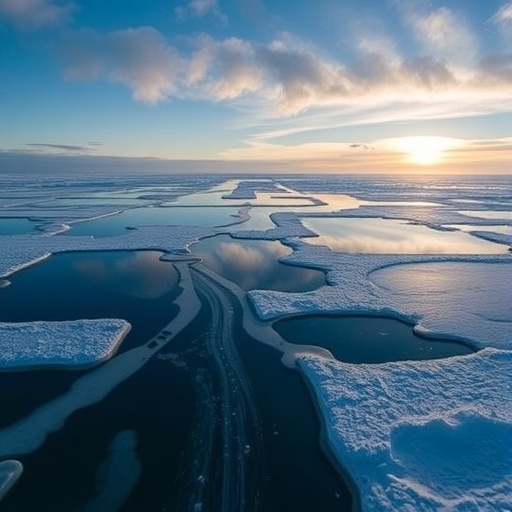
A hidden chemical legacy frozen into Arctic soils could be set for a dramatic return as the planet warms. A new study led by Yu H., Wang X., Wang C. and colleagues projects that the release of perfluoroalkyl substances, or PFAS, into surface waters over permafrost landscapes will increase under global warming. The finding adds a persistent and largely invisible dimension to climate change: thawing ground may not only reshape terrain, disrupt infrastructure and release greenhouse gases, but also mobilize industrial contaminants that have been stored in frozen soils for decades.
PFAS are a large family of synthetic chemicals prized for their resistance to heat, water, oil and chemical degradation. Those same properties have made them extraordinarily persistent in the environment. Used in products ranging from stain-resistant fabrics and nonstick materials to firefighting foams, food packaging and industrial coatings, many PFAS can travel long distances through air and water before accumulating in soils, sediments, plants, animals and people. Because the carbon–fluorine bond is among the strongest in organic chemistry, these compounds are often described as “forever chemicals,” a term that captures their durability but also the growing concern over their movement through ecosystems.
Permafrost is ground that remains frozen for at least two consecutive years, although vast areas of the Arctic have stayed frozen for centuries or even millennia. It is not a chemically inert block of ice. Permafrost contains mineral particles, organic matter, ancient water, microbial communities and pollutants deposited from the atmosphere or transported from distant regions. As temperatures rise, the active layer—the upper portion of soil that freezes and thaws seasonally—deepens. Thaw can also create thermokarst landscapes, slumping riverbanks, expanding ponds and new drainage pathways. Each of these changes can expose previously frozen material to liquid water and increase the possibility that contaminants will be carried into streams, lakes and wetlands.
The study focuses on perfluoroalkyl substances reaching surface waters, a pathway that is particularly important because rivers, ponds and shallow lakes connect terrestrial environments to food webs and human communities. When PFAS are released from thawing soils, they may dissolve in water, attach to suspended particles or accumulate in sediments before being transported downstream. Their behavior depends on molecular structure, soil chemistry, temperature, water flow and the amount of organic matter present. Some compounds are highly mobile and can move rapidly with water, while others are more strongly retained by soils or sediments. A warming climate can alter all of these controls at once, making contaminant transport less predictable and potentially more widespread.
The projected increase does not necessarily mean that every Arctic water body will experience the same rise in PFAS concentrations. Local conditions can determine whether chemicals are trapped in sediment, diluted by rainfall, concentrated during evaporation or flushed rapidly through a watershed. Seasonal pulses may also become more important than annual averages. Spring snowmelt, intense rainfall and sudden thaw events can produce short-lived surges of water that mobilize contaminants from exposed ground. Such pulses may be difficult to detect with occasional sampling, yet they can deliver chemicals to aquatic organisms at critical moments in their life cycles.
The implications extend beyond chemistry and hydrology. PFAS can persist in organisms and move through aquatic food webs, raising concerns for fish, migratory birds and mammals that depend on northern waters. Some compounds have been associated in toxicological and epidemiological research with immune-system effects, altered lipid metabolism, developmental impacts and other health concerns, although the risks vary widely across individual substances and exposure levels. The study’s projection therefore points to a climate-linked contaminant pathway rather than a single, uniform threat. It suggests that environmental monitoring in cold regions must account for chemicals released from the landscape itself, not only pollutants arriving through current industrial activity or atmospheric transport.
The research also highlights why permafrost thaw is increasingly viewed as a multiplier of environmental change. Warming can destabilize the physical structure of frozen terrain, transform drainage networks and accelerate the breakdown of organic material. At the same time, it can reactivate contaminants that were deposited when historical emissions were higher or when industrial compounds traveled north through the atmosphere. PFAS are especially concerning in this context because their persistence means that a delay between deposition and release does not eliminate the hazard. Instead, frozen ground may function as a temporary reservoir, postponing the movement of chemicals until climate conditions open new routes into surface waters.
For scientists and policymakers, the findings point toward a need for integrated surveillance across the Arctic and other permafrost regions. Chemical measurements should be paired with observations of soil temperature, thaw depth, hydrology, erosion and extreme-weather events. Monitoring programs will need to distinguish between older, long-chain PFAS and newer replacement compounds, because their mobility and environmental behavior can differ. The most informative studies will likely combine field sampling with watershed models capable of representing changing freeze–thaw cycles and sudden landscape disturbances. Without that integration, gradual contamination may be mistaken for isolated events, and brief but important transport pulses may go unnoticed.
The projected rise in PFAS release is a reminder that global warming can unlock more than carbon from frozen ground. It can mobilize a chemical inheritance created by modern society and deliver it into ecosystems that are already under pressure from rising temperatures, shrinking sea ice, altered vegetation and changing wildlife patterns. The study by Yu and colleagues does not present warming as a distant threat confined to climate statistics; it describes a mechanism through which atmospheric change can directly reshape the movement of persistent pollutants. As permafrost continues to thaw, the Arctic may become not only a visible front line of climate change, but also a source of contaminants whose environmental journey is only beginning.
Cite Scienmag News
Violet Maxwell. (August 25, 2026). Global warming projected to increase PFAS releases into permafrost surface waters. Scienmag. https://scienmag.com/global-warming-projected-to-increase-pfas-releases-into-permafrost-surface-waters/
Violet Maxwell. "Global warming projected to increase PFAS releases into permafrost surface waters." Scienmag, 25 August 2026, https://scienmag.com/global-warming-projected-to-increase-pfas-releases-into-permafrost-surface-waters/. Accessed 5 September 2026.
Violet Maxwell. "Global warming projected to increase PFAS releases into permafrost surface waters." Scienmag. August 25, 2026. https://scienmag.com/global-warming-projected-to-increase-pfas-releases-into-permafrost-surface-waters/


