


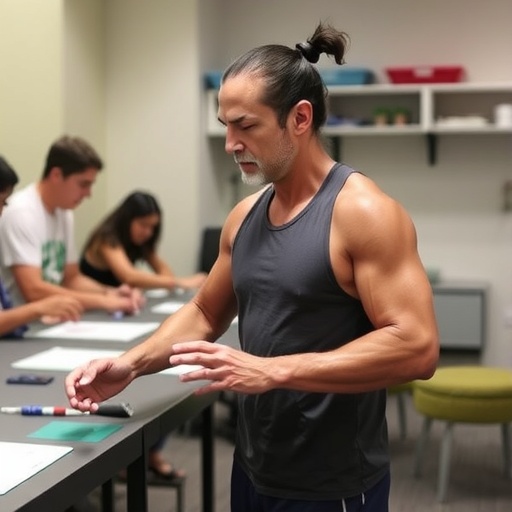
In a groundbreaking study that bridges the gap between theoretical knowledge and practical application, researchers have implemented an innovative experiential learning laboratory activity focused on skeletal muscle physiology within an undergraduate medical school curriculum. This initiative, spearheaded by a collaborative team of scholars including Dr. A. Martinez, Dr. D. Salinas, and Dr. M. Maddox, highlights the critical role of hands-on learning experiences in cultivating a deeper comprehension of physiological processes among medical students. The findings promise to reshape educational strategies in medical academia, emphasizing the necessity for curricula that not only relay essential information but also actively engage learners in the application of that information.
The experiential learning activity designed by the research team incorporates various methodologies to ensure that students not only observe but also engage with the concepts of skeletal muscle function. By simulating real-world medical scenarios, students are prompted to apply their theoretical knowledge in a controlled laboratory environment. This hands-on approach is particularly significant in the field of medical education, where understanding complex physiological interactions can be a daunting task without tangible experience.
Central to the laboratory activity is the exploration of muscle contraction mechanisms, including the roles of actin and myosin as they interact to produce movement. Students are provided with the opportunity to manipulate muscle fibers, allowing them to witness firsthand the biophysical interactions that occur at the cellular level. Such experiences reinforce the learning process and make abstract concepts more concrete, adding value to the educational experience and ultimately enhancing student retention of knowledge.
Research indicates that active learning strategies can significantly improve student outcomes compared to traditional lecture-based instruction. In this experiential lab, students engage in collaborative problem-solving exercises that promote critical thinking rather than rote memorization. As these future physicians work together to decipher how various factors, including pH, temperature, and electrical stimulation, impact muscle function, they develop a deeper understanding of the physiological underpinnings that dictate human movement and bodily responses.
The implications of the study extend beyond mere academic proficiency. Teaching strategies that incorporate experiential learning have been linked to increased student motivation and engagement, which are vital components for success in the demanding field of medicine. The research team notes that fostering teamwork skills is paramount, as collaborative practices are essential in a clinical setting where interdisciplinary cooperation often makes the difference in patient care outcomes.
Furthermore, the authors suggest that exposure to practical applications of theoretical principles equips students with the skills necessary for lifelong learning in a field that is constantly evolving. By enabling students to engage with scientific concepts actively, they become more adept at integrating new knowledge into their professional practice, which is of utmost importance in a landscape that continually witnesses advancements in medical science and technology.
Having implemented the lab activity in the curriculum, preliminary feedback from students reflects a positive shift in attitudes toward learning complex physiological topics. Many students report feeling more confident in their understanding of muscle physiology and express excitement about future applications of this knowledge in clinical scenarios. The researchers note that this enthusiasm for learning is a crucial aspect of cultivating effective future physicians who are keen to navigate the challenges of the medical field.
Moreover, the environmental setup of the lab fosters creativity and innovation among students. As learners work to design experiments that investigate different variables affecting muscle physiology, they tap into their natural curiosity and desire to explore the unknown. This creative engagement not only personalizes the learning experience but also inspires students to think deeply about their role in advancing medical science.
In a world where information is often consumed passively through digital media, the necessity for interactive and experiential educational models is more pressing than ever. This study underscores the importance of medical schools adopting progressive curricular frameworks that prioritize student engagement through experiential activities. Such methodologies not only prepare students for the clinical aspects of their future professions but also empower them with critical problem-solving skills that are essential in any healthcare setting.
In light of the research findings, this innovative approach to teaching skeletal muscle physiology could serve as a model for other areas of medical education. As the field grapples with the challenges of preparing students for a rapidly evolving healthcare landscape, applying similar experiential learning paradigms may pave the way for more effective training methodologies across disciplines.
Moreover, the researchers advocate for further studies to assess the long-term impacts of experiential learning on medical student performance and retention of knowledge. Understanding how these interactive learning experiences influence future clinical practice can provide valuable insights into optimizing medical education programs.
The study’s results contribute to a broader conversation about the critical interplay between educational strategies and healthcare outcomes. As medical students transition into their roles as practitioners, the foundational knowledge acquired through these experiential activities can have lasting effects on their ability to provide quality care to patients.
Through these efforts to innovate educational practices, we witness a transformative shift in medical curriculum delivery that prioritizes engaging, hands-on learning experiences. The work of Dr. Martinez and his colleagues is a testament to the power of experiential learning in shaping the next generation of healthcare professionals.
As we look to the future of medical education, studies like these empower educators and institutions to rethink how they approach teaching essential scientific concepts. The potential benefits to students, educators, and ultimately patients are too significant to overlook, signaling a bright and evolving future for healthcare education.
As advancements in teaching methods continue to unveil new possibilities for students and educators alike, embracing experiential learning approaches will be pivotal in ensuring that medical professionals are well-equipped to tackle the complexities of modern medicine.
By integrating innovative pedagogical methods such as those explored in this research, medical education stands to benefit not just those entering the field but society as a whole, responding to the need for well-rounded, capable, and knowledgeable healthcare providers.
Martinez, A., Salinas, D., Maddox, M. et al. An experiential learning lab activity on skeletal muscle physiology in undergraduate MD pre-clerkship curriculum.
Discov Educ (2025). https://doi.org/10.1007/s44217-025-00998-2
Cite Scienmag News
Celia A. (November 22, 2025). Exploring Skeletal Muscle Physiology Through Experiential Learning. Scienmag. https://scienmag.com/exploring-skeletal-muscle-physiology-through-experiential-learning/
Celia A. "Exploring Skeletal Muscle Physiology Through Experiential Learning." Scienmag, 22 November 2025, https://scienmag.com/exploring-skeletal-muscle-physiology-through-experiential-learning/. Accessed 29 August 2026.
Celia A. "Exploring Skeletal Muscle Physiology Through Experiential Learning." Scienmag. November 22, 2025. https://scienmag.com/exploring-skeletal-muscle-physiology-through-experiential-learning/


