


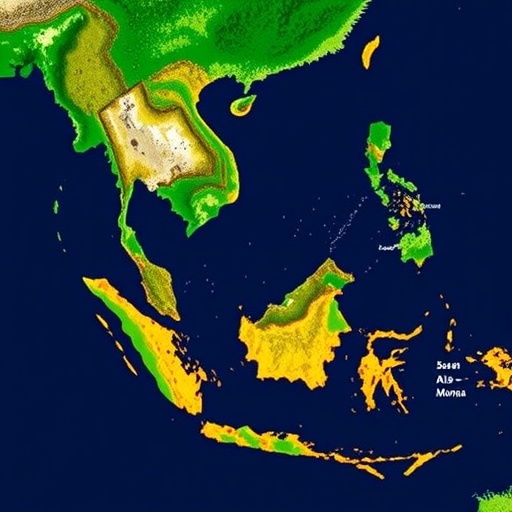
In a groundbreaking study published in Discover Sustainability, researchers led by Hasan et al. have made significant strides in understanding the complex relationship between unemployment, economic growth, innovation, and carbon emissions within the ASEAN (Association of Southeast Asian Nations) region. This research addresses a critical issue as the world grapples with climate change, emphasizing the need to understand how socio-economic factors influence environmental outcomes. By utilizing the PMG-ARDL (Pooled Mean Group – Autoregressive Distributed Lag) approach, the team has unraveled the much-debated environmental Phillips curve and its implications in this dynamic region.
The environmental Phillips curve concept traditionally suggests an inverse relationship between ecological degradation and economic performance—indicating that as economies grow, environmental quality may initially degrade before improving as societies become wealthier and more technologically advanced. Hasan and colleagues delve into this paradigm, providing empirical evidence on how unemployment rates and economic growth trajectories impact carbon emissions. Their findings indicate a nuanced interplay between these factors, challenging conventional assumptions about economic development and environmental preservation.
One of the key arguments presented by Hasan’s research is the role of innovation as a driving force for sustainable practices in ASEAN countries. The study underscores how advancements in technology can lead to more efficient resource use and lower carbon footprints. For instance, countries that invest in innovative technologies tend to adopt cleaner energy sources, thereby mitigating the negative aspects typically associated with industrialization. This highlights the necessity for policymakers to foster an environment conducive to technological innovation to achieve sustainable development goals.
Unemployment, often perceived solely as a socio-economic detriment, is re-examined in a broader context within the study. The authors suggest that higher unemployment rates can lead to reduced industrial output and, consequently, lower carbon emissions. However, this relationship must be approached with caution. While short-term reductions in emissions may occur during economic downturns, prolonged unemployment could hinder investments in sustainable technologies and practices, ultimately exacerbating environmental issues.
The study emphasizes that economic growth should not be viewed as an outright adversary to environmental sustainability. Instead, Hasan et al. suggest that strategic growth—guided by policies that integrate environmental considerations—can lead to a more balanced outcome. The research advocates for a transformative approach to economic development, where ecological and economic priorities align rather than compete against each other. For ASEAN nations, adopting such strategies may unlock pathways to achieving both economic resilience and environmental integrity.
In their analytical framework, the researchers employed the PMG-ARDL technique, a robust econometric tool that allows for the analysis of both short-term and long-term relationships among variables. By applying this method, they successfully captured the dynamics between unemployment, economic growth, innovation, and carbon emissions over time. This analytical rigor enhances the credibility of their findings, providing a solid foundation for policymakers looking to make informed decisions regarding environmental policies.
ASEAN’s diverse socio-economic landscape poses both challenges and opportunities in tackling climate change. The study reveals that countries within the region are at different stages of economic development and technological adoption, which impacts their ability to respond to environmental challenges. For instance, countries with robust innovation ecosystems tend to perform better in reducing emissions, paving the way for comprehensive policies that prioritize sustainability. Conversely, nations lagging in innovation may struggle to keep pace with global sustainability efforts, raising concerns about equity and shared responsibility in the face of climate change.
Moving forward, the implications of this research call for a multi-faceted approach to environmental policymaking. Governments in the ASEAN region must consider not only economic growth forecasts but also the potential impacts on employment and innovation. By fostering a comprehensive socio-economic strategy, these nations can create a conducive environment that drives both economic and environmental progress, setting a precedent for other regions grappling with similar issues.
The COVID-19 pandemic has highlighted the vulnerabilities of global economies and the urgency to rethink traditional growth paradigms. The findings of Hasan et al. serve as a timely reminder of the interconnections between economic activity, societal well-being, and environmental health. As countries emerge from the impacts of the pandemic, there is an opportunity to implement recovery strategies that prioritize innovation and sustainability over mere economic rebounds.
The importance of stakeholder engagement is also underscored in the research. Engaging local communities, businesses, and civil societies in dialogue about sustainable practices can enhance accountability and foster a collective commitment to reducing carbon emissions. Furthermore, educational initiatives aimed at promoting environmental awareness and innovation can empower individuals and organizations to contribute actively to sustainability efforts.
As policymakers move to implement the insights from this study, they must navigate potential trade-offs between short-term economic gains and long-term environmental sustainability. The challenge lies in crafting policies that recognize the interdependencies between various socio-economic factors while promoting a shared vision for a greener future.
In conclusion, Hasan et al.’s research on the environmental Phillips curve within ASEAN offers a comprehensive understanding of the intricate relationships between unemployment, economic growth, innovation, and carbon emissions. Their work encourages a re-evaluation of traditional economic narratives and emphasizes the necessity for a holistic approach to tackling climate change. As the ASEAN region continues to experience rapid development, it is imperative to align economic ambitions with environmental stewardship, paving the way toward a sustainable future that benefits both people and the planet.
Cite Scienmag News
Sloane Callahan. (November 22, 2025). Decoding ASEAN’s Environmental Phillips Curve Dynamics. Scienmag. https://scienmag.com/decoding-aseans-environmental-phillips-curve-dynamics/
Sloane Callahan. "Decoding ASEAN’s Environmental Phillips Curve Dynamics." Scienmag, 22 November 2025, https://scienmag.com/decoding-aseans-environmental-phillips-curve-dynamics/. Accessed 4 September 2026.
Sloane Callahan. "Decoding ASEAN’s Environmental Phillips Curve Dynamics." Scienmag. November 22, 2025. https://scienmag.com/decoding-aseans-environmental-phillips-curve-dynamics/


