


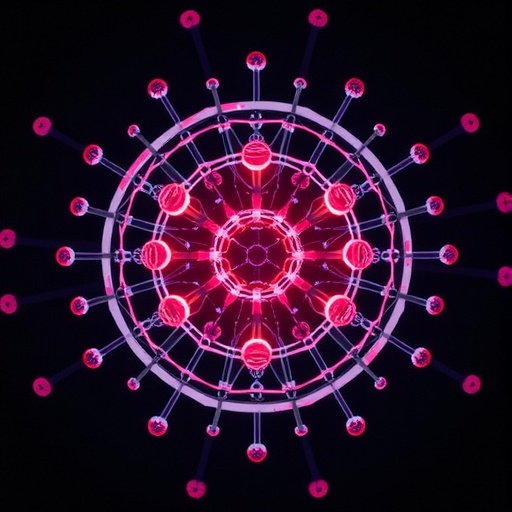
In a groundbreaking advancement at the crossroads of nanophotonics and topological physics, researchers have unveiled a programmable platform that can generate and manipulate plasmonic skyrmions with remarkable control and versatility. Plasmonic skyrmions, electromagnetic analogues of topologically stable quasiparticles, have long tantalized scientists with their promise for robust and energy-efficient information processing. Yet, until now, the practical realization of devices capable of encoding and modulating their intricate topological structures remained elusive. The new study, published in Nature Electronics, presents a novel approach that not only synthesizes diverse skyrmion topologies but also harnesses them for real-world applications in wireless communication and intelligent sensing, heralding a new era of resilient optoelectronic systems.
At the heart of this innovation is the concept of topological robustness inherent in skyrmions, which are swirling configurations originally conceived in magnetic materials but here realized within plasmonic electromagnetic fields. These configurations are defined by their nontrivial topology, rendering them stable against continuous deformations and perturbations. This stability is particularly vital for information carriers in noisy, turbulent environments, where conventional signals degrade rapidly. The platform introduced by the research team leverages this property to create electromagnetic fields with encoded topological information that can endure harsh channel conditions without loss of integrity.
The key challenge addressed concerns the programmability and tunability of skyrmions. Conventional methods typically produce fixed skyrmion states limited by the geometrical constraints of the nanostructures or strict material properties. The presented solution overcomes this by synthesizing what the authors term “harmonic skyrmions” in the temporal domain through ultrafast coding techniques. This dynamic approach enables on-demand generation of skyrmions with various topological types, such as Néel-type skyrmions and merons, which are half-skyrmions characterized by distinct magneto-optical patterns. The versatility thus achieved paves the way for intricate topological “alphabets” manipulable in real time.
The temporal encoding strategy involves modulating the plasmonic field’s phase and amplitude at ultrafast timescales, effectively creating skyrmion waveforms that vary harmonically with time. This not only permits rapid switching between different topologies but also expands the bandwidth and channel capacity of communication systems employing skyrmion carriers. The capacity to encode information in such multidimensional topological structures fundamentally redefines the architecture of robust wireless signaling, providing resilience against interference and environmental disruptions that plague existing technologies.
One particularly compelling demonstration is the application of programmable skyrmions in multi-channel wireless communication experiments. The research team showed that distinct topological modes could serve as independent parallel channels, each capable of transmitting data with high fidelity. This multiplexing capability, combined with the robustness of the skyrmions themselves, offers a promising route to boost data throughput in challenging scenarios such as turbulent atmospheric or underwater conditions. Such resilience is crucial for next-generation communication networks where reliability is paramount.
Beyond communication, the platform’s adaptability extends to intelligent sensing domains, where topological patterns can enhance the recognition and classification of complex objects. The integration of a convolutional neural network (CNN) with the skyrmion-generating system enabled high-accuracy recognition of twenty different animal figurines based on their interaction with encoded skyrmion fields. This synergy between topological photonics and artificial intelligence signifies a powerful paradigm for advanced sensing systems, marrying physical robustness with computational intelligence.
The fundamental physics underlying the programmable platform combines sophisticated plasmonic engineering with ultrafast optics. Surface plasmon polaritons (SPPs), which are collective electron oscillations coupled to electromagnetic fields at metal-dielectric interfaces, serve as the playground for skyrmion creation. By precisely tailoring the spatial and temporal distribution of these SPPs, the researchers synthesized complex field configurations exhibiting nontrivial topological charges and textures. This meticulous control required innovations in both the design of metasurfaces—a class of engineered nanostructured materials—and the ultrafast modulation techniques implemented through tailored laser pulse sequences.
Furthermore, the exploration of Néel-type skyrmions and merons within plasmonic environments uncovers new fundamental insights into how topological phases evolve in photonic systems. The Néel-type skyrmions, characterized by a radially symmetric spin texture, and the merons, topological modes with half-integer winding numbers, represent distinct classes of quasiparticles whose electromagnetic analogues can be selectively programmed. This richness adds to the taxonomy of topological photonics and opens avenues for exploring the interplay between topology, time-dependent fields, and material responses in nanoscale light-matter interaction regimes.
The implications of programmable plasmonic skyrmions also resonate with the broader pursuit of topological photonic computing and communication. By encoding information robustly in the spatial and temporal topology of light fields, this approach circumvents key limitations imposed by noise, scattering, and material imperfections. This enhancement in robustness is not merely incremental but transformative, as it introduces fundamentally new degrees of freedom for designing resilient systems at optical frequencies. It also aligns with trends towards integrated photonic chips capable of operating under variable and extreme environmental conditions, intensifying the push towards real-world deployments.
Crucially, the research demonstrates programmability at ultrafast timescales, effectively bridging the gap between static topological states and dynamic information processing. The temporal dimension of skyrmion encoding enables real-time modulation, which is essential for high-speed communication and adaptive sensing. This feature could allow devices to dynamically switch operational modes, respond to environmental changes, or encode multiplexed information streams without requiring physical reconfiguration of the underlying materials.
Moreover, the integration of machine learning with topological photonic platforms marks a milestone in active, intelligent photonic systems. The convolutional neural network employed interprets subtle variations in the skyrmion-encoded signals, achieving current-state-of-the-art recognition accuracy for diverse objects. This confluence suggests a future where topological photonic devices serve as front-end sensors feeding directly into AI processors, creating compact, robust, and autonomous sensing modules for applications ranging from environmental monitoring to biomedical diagnostics.
On the technical front, the stable generation of skyrmions in plasmonic fields involves overcoming intrinsic dissipative losses and maintaining coherence over relevant timescales and spatial extents. The authors tackled these challenges by optimizing metasurface designs and carefully calibrating the ultrafast excitation protocols, achieving stable skyrmion lifetimes sufficient for communication and sensing tasks. Such engineering finesse points towards practical device architectures that can strike a balance between complexity and scalability.
The potential real-world impacts of this technology extend broadly. The ability to encode information topologically with programmable electromagnetic skyrmions could revolutionize wireless communication by facilitating multichannel data transmission with exceptional noise immunity. Similarly, in sensing applications, the enhanced recognition capabilities enabled by topological encoding and AI processing could find uses in robotics, surveillance, and environmental science, where robustness and precision are critical. Furthermore, the underlying methodology could catalyze innovations across photonic computing, metrology, and secure information transfer.
Looking forward, this platform offers a tantalizing glimpse into future photonic technologies that harness the deep principles of topology and ultrafast dynamics to transcend current limitations. As demand grows for devices that can sustain high performance in unpredictable or harsh environments—such as space exploration, underwater communication, or disaster response—the robustness and programmability of plasmonic skyrmions provide an elegant and effective solution. The seamless integration of topological design, ultrafast laser control, nanofabrication, and machine learning portends a fertile ground for interdisciplinary advances.
The research thus represents a landmark achievement in the field of topological photonics and plasmonics, pushing the boundaries of what electromagnetic quasiparticles can achieve in practical applications. By transforming the theoretical concept of skyrmions into a highly controllable and multifunctional platform, the work stands to reshape the landscape of optical communication and sensing. It underscores the power of combining advanced materials, ultrafast technologies, and computational intelligence to address longstanding challenges in information science and photonics.
This discovery also invites further exploration into the fundamental interplay between topology and dynamics, hinting at new classes of topological excitations that may be realized through temporal modulation schemes. Such possibilities could unlock exotic functionalities, including topological protection amid non-equilibrium conditions, dynamic switching between topological phases, and topological quantum-like effects in classical photonics. The insights gained here may thus inspire a rich lineage of research bridging physics, engineering, and computing.
In sum, the programmable platform for plasmonic skyrmions developed by Chen, Li, Shen, and colleagues marks a transformative step towards harnessing the full potential of topological photonics for next-generation technology. Combining nanoscale engineering, ultrafast modulation, and artificial intelligence, it offers a robust, tunable, and intelligent framework for encoding and decoding information in ways that promise to revolutionize wireless communication and sensing. The implications are profound, positioning this approach at the forefront of future photonic innovations set to impact numerous scientific and technological domains.
Cite Scienmag News
Denise Maddox. (April 29, 2026). Programmable Skyrmions Revolutionize Communication and Sensing. Scienmag. https://scienmag.com/programmable-skyrmions-revolutionize-communication-and-sensing/
Denise Maddox. "Programmable Skyrmions Revolutionize Communication and Sensing." Scienmag, 29 April 2026, https://scienmag.com/programmable-skyrmions-revolutionize-communication-and-sensing/. Accessed 4 September 2026.
Denise Maddox. "Programmable Skyrmions Revolutionize Communication and Sensing." Scienmag. April 29, 2026. https://scienmag.com/programmable-skyrmions-revolutionize-communication-and-sensing/


