


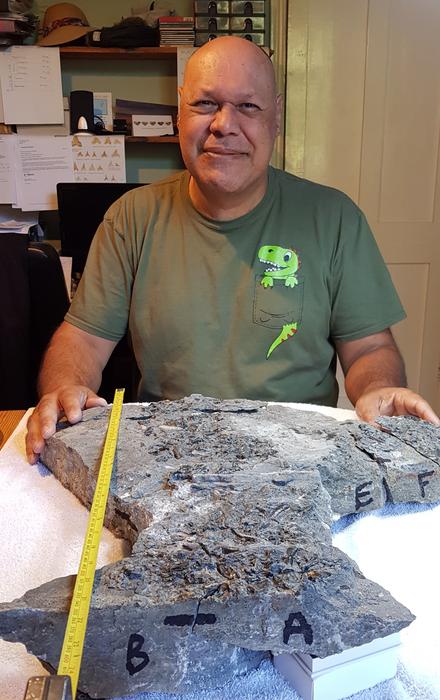
The identity of a local prehistoric marine reptile has finally been revealed after experts discovered that some of its remains actually belonged to fish.

Credit: Evangelos R. Matheau-Raven/Andrea Matheau-Raven
The identity of a local prehistoric marine reptile has finally been revealed after experts discovered that some of its remains actually belonged to fish.
Now scientists from the University of Bristol and University of Southampton can reveal that bones found in Triassic rocks in 1935 are one of the last thalattosaurs, a large sea-lizard that behaved like an otter.
For years it was assumed the ancient animal was one of the first choristoderes, another group of crocodile-like marine reptiles. However in the study, published today in Journal of Vertebrate Paleontology, the team examined the original name-bearing specimen from 1935. They compared this to a remarkable new specimen of Pachystropheus, known as ‘Annie’, that contains hundreds of bones from several individuals, as well as evidence of sharks, bony fish, and even terrestrial dinosaurs.
Jacob Quinn, who is studying for his Masters in Palaeobiology at Bristol’s School of Earth Sciences, travelled with the two specimens to Southampton where they were CT scanned, producing stacks of X-rays through the blocks that allowed him to reconstruct a complete 3D model of everything buried in the blocks.
“Thalattosaurs existed throughout the Triassic,” explained Jacob. “Some of them reached four metres (13 feet) in length and would have been the terrors of the seas. But our Pachystropheus was only a metre long, and half of that was its long tail. It had a long neck too, a small head the size of a matchbox, which we haven’t found, and four paddles. If it was like its relatives, it would have had lots of sharp little teeth, ideal for snatching fish and other small, wriggly prey.”
“Previously Pachystropheus had been identified as the first of the choristoderes, another group of crocodile-like marine reptiles, and it was treated as very important because it was the oldest,” said Professor Mike Benton, one of Jacob’s supervisors. “Jacob was able to show that some of the bones actually came from fishes, and the others that really belonged to Pachystropheus show it was actually a small thalattosaur. So, from being regarded as the first of the choristoderes, it’s now identified as the last of the thalattosaurs.”
Evangelos R. Matheau-Raven of Peterborough discovered Annie while on holiday in Somerset in 2018, and he then painstakingly pieced it back together and cleaned it to expose the bones in his spare time. He said: “I spotted parts of a fallen rock on the beach about 10m from the base of the cliff. I was thrilled as their exposed surfaces showed some fossil bones.
“It wasn’t until a few days later that I could see that the pieces collected two days apart fitted together. After a few weeks of preparation, we could see that something special was emerging.
“The specimen took me some 350 hours and about a year to complete.”
“Pachystropheus probably lived the life of a modern-day otter, eating small fish or invertebrates such as shrimps,” says Dr David Whiteside, another supervisor. “These slender reptiles had long necks, a tail flattened for swimming, and remarkably robust forelimbs for a marine animal, which suggests Pachystropheus may have come onto land to feed or to avoid predators. At the time, the Bristol area, and indeed much of Europe, was shallow seas, and these animals may have lived in a large colony in the warm, shallow waters surrounding the island archipelago.”
Annie will now be housed Bristol Museum & Art Gallery for further study.
“We are very happy that this incredible fossil is now part of the collection at Bristol Museum & Art Gallery, thanks to the kind assistance from the Friends of Bristol Museums, Galleries & Archives.
“We are excited to be able to share the story of this new fossil and all the work the team have has achieved with visitors to the museum,” says said Bristol Museum & Art Gallery geology curator, Deborah Hutchinson.”
The paper
‘The relationships and palaeoecology of Pachystropheus rhaeticus, an enigmatic latest Triassic marine reptile (Diapsida: Thalattosauria)’ by Jacob G. Quinn, Evangelos Matheau-Raven, David I./. Whiteside, John E. A. Marshall, Deborah J. Hutchinson, and Michael J. Benton, in Journal of Vertebrate Paleontology.
Journal
Journal of Vertebrate Paleontology
Method of Research
Imaging analysis
Subject of Research
Animals
Article Title
The relationships and palaeoecology of Pachystropheus rhaeticus, an enigmatic latest Triassic marine reptile (Diapsida: Thalattosauria)
Article Publication Date
4-Jun-2024
Cite Scienmag News
Violet Maxwell. (June 5, 2024). Fishy mystery of Bristol marine reptile solved. Scienmag. https://scienmag.com/fishy-mystery-of-bristol-marine-reptile-solved/
Violet Maxwell. "Fishy mystery of Bristol marine reptile solved." Scienmag, 5 June 2024, https://scienmag.com/fishy-mystery-of-bristol-marine-reptile-solved/. Accessed 4 September 2026.
Violet Maxwell. "Fishy mystery of Bristol marine reptile solved." Scienmag. June 5, 2024. https://scienmag.com/fishy-mystery-of-bristol-marine-reptile-solved/

