


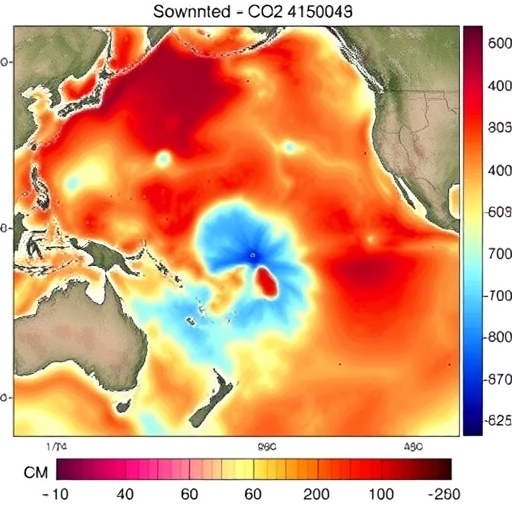
A groundbreaking collaborative study has unveiled a startling revelation about the carbon dioxide (CO₂) dynamics of the Southern Ocean during the austral winter months. Contrary to prevailing scientific assumptions, this vast oceanic region releases considerably more CO₂ into the atmosphere throughout the dark, cold winter season than earlier estimates suggested. The meticulous research indicates that previous assessments underestimated wintertime CO₂ outgassing by as much as 40%, unveiling new complexities in the Southern Ocean’s role within the global carbon cycle.
The Southern Ocean is strategically significant in the Earth’s biogeochemical equilibrium, acting as one of the largest sinks for anthropogenic CO₂ emissions. Its enigmatic nature stems from the extreme environmental conditions it endures, which include prolonged polar night and violent storms that restrict observational capabilities. This observational challenge has made the Southern Ocean the most uncertain variable in global ocean-atmosphere CO₂ flux estimations, hindering climate scientists from accurately predicting carbon cycle feedbacks and climate change trajectories.
Central to these uncertainties is the seasonal data sparsity during the polar winter months. Traditional remote sensing platforms, primarily reliant on passive satellite sensors that detect sunlight-reflected signals, become ineffective when sunlight is absent. Consequently, scientists have been compelled to rely heavily on ocean carbon models with limited observational correction during this period, leading to potentially significant inaccuracies in winter flux approximations.
To surmount this methodological challenge, an innovative multinational team, including experts from China’s Second Institute of Oceanography under the Ministry of Natural Resources and the Nanjing Institute of Geography and Limnology within the Chinese Academy of Sciences, pioneered the integration of 14 years of satellite LIDAR data from the CALIPSO (Cloud-Aerosol LIDAR and Infrared Pathfinder Satellite Observation) mission. LIDAR technology, unlike passive sensing systems, employs active laser pulses which illuminate and assess the ocean surface and atmosphere independently of natural light, thus providing unprecedented year-round observational coverage beneath the austral winter blackout.
The fusion of this active remote sensing data with advanced machine learning algorithms enabled the research team to dissect the complex CO₂ flux patterns in unprecedented detail, advancing beyond previous indirect inference methodologies. This comprehensive observational approach validated that the Southern Ocean’s carbon dioxide release during winter was indeed significantly underestimated — approximately 40% higher than prior figures suggested by global biogeochemical models.
These empirical insights not only adjust the magnitude of carbon outgassing but also compel a fundamental rethink of the Southern Ocean’s biogeochemical mechanistic frameworks. In light of this, the research introduced an original conceptual “three-loop framework” that compartmentalizes and explicates how distinct latitudinal bands within the Southern Ocean regulate CO₂ exchange processes via different dominant environmental drivers. This framework dissects the carbon cycle dynamics into three interrelated latitudinal loops, each governed by a unique interplay of physical and biological components.
The Antarctic Loop, situated south of 60 degrees south latitude, is primarily influenced by physical oceanographic factors, notably sea ice dynamics including formation and melt cycles, and the associated changes in salinity. These physical processes govern the solubility and flux of CO₂ between ocean and atmosphere, making this region a sensitive indicator for climate-induced alterations in polar ice cover and ocean stratification.
Moving northward to the Polar Front Loop, between 45 and 60 degrees south latitude, carbon flux regulation becomes more intricate, involving a synergistic interaction between atmospheric CO₂ concentrations and seasonal biological productivity, which is often indexed by chlorophyll levels. This region represents a highly dynamic interface where biological uptake and remineralization processes substantially modulate CO₂ exchange, reflecting a complex feedback system sensitive to climate variability and nutrient cycling.
Further north, in the Subpolar Loop located above 45 degrees south latitude, sea surface temperature exerts primary control over carbon turnover. Warmer waters reduce CO₂ solubility, enhancing outgassing, whereas cooler temperatures favor increased absorption. This thermal influence underscores the critical role of ocean warming trends in modulating the subtropical-extratropical carbon distribution and, by extension, global atmospheric CO₂ levels.
The implications of these revised Southern Ocean carbon flux estimates ripple across the global carbon budget framework. Accurately quantifying this substantial wintertime CO₂ source is vital for refining Earth system models that underpin projections made by entities such as the Intergovernmental Panel on Climate Change (IPCC). Enhanced model accuracy will improve climate scenario predictions, informing policymakers on sustainable mitigation strategies.
Moreover, the study exemplifies the transformative potential of active remote sensing technologies combined with machine learning in overcoming formidable environmental observation barriers. By harnessing LIDAR data capable of penetrating the darkness and atmospheric obscurities of polar winter, scientists now gain access to continuous, high-fidelity ocean–atmosphere exchange measurements, setting new benchmarks for precision in global carbon cycle monitoring.
This advancement also opens avenues for further interdisciplinary research that merges oceanography, atmospheric science, and data science, inspiring innovations that could be applied to other challenging Earth observation regions. The Southern Ocean’s newly unveiled winter carbon flux dynamics ultimately emphasize the ocean’s more dynamic and complex role in climate regulation than the scientific community had previously appreciated.
As this study gains traction, it is expected to galvanize a reexamination of existing global carbon models and foster enhanced remote sensing applications, thereby refining our comprehension of the planet’s changing climate system and aiding in the quest for sustainable stewardship of Earth’s natural carbon sinks.
News Publication Date:
November 5, 2023.
Web References:
10.1126/sciadv.aea0024
References:
Published in Science Advances, detailing comprehensive satellite LIDAR data analysis combined with machine learning for CO₂ flux quantification in the Southern Ocean.
Cite Scienmag News
Eleanor Cresswell. (November 5, 2025). New Study Shows Southern Ocean’s Winter CO₂ Emissions Underestimated by 40%. Scienmag. https://scienmag.com/new-study-shows-southern-oceans-winter-co%e2%82%82-emissions-underestimated-by-40/
Eleanor Cresswell. "New Study Shows Southern Ocean’s Winter CO₂ Emissions Underestimated by 40%." Scienmag, 5 November 2025, https://scienmag.com/new-study-shows-southern-oceans-winter-co%e2%82%82-emissions-underestimated-by-40/. Accessed 30 August 2026.
Eleanor Cresswell. "New Study Shows Southern Ocean’s Winter CO₂ Emissions Underestimated by 40%." Scienmag. November 5, 2025. https://scienmag.com/new-study-shows-southern-oceans-winter-co%e2%82%82-emissions-underestimated-by-40/


