


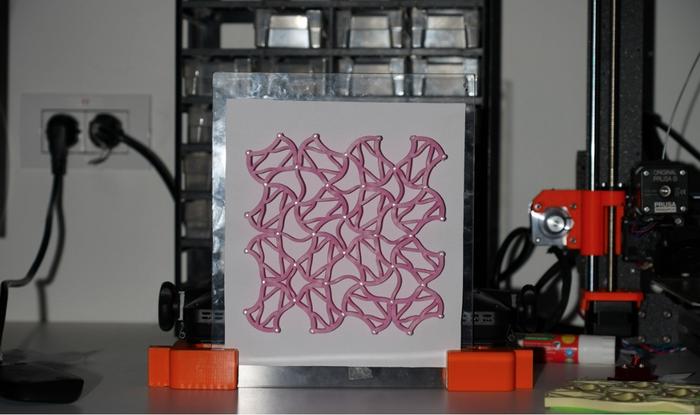
Researchers from Tel Aviv University and Los Alamos National Laboratory have developed a novel mechanical metamaterial that remembers the order of actions performed on it, much like a computer following a sequence of instructions. Unlike ordinary materials that respond in the same way to a sequence of external manipulations regardless of their order, the new metamaterial – named ‘Chaco’ after the archaeological site of Chaco Canyon in New Mexico – exhibits history-dependent behavior, thus opening a pathway to exciting applications in memory storage, robotics, and even mechanical computing. The research was led by Chaviva Sirote-Katz, Dor Shohat, Dr. Carl Merrigan, Prof. Yoav Lahini and Prof. Yair Shokef from Tel Aviv University, and Dr. Cristiano Nisoli from Los Alamos National Laboratory.

Credit: Tel Aviv University
Researchers from Tel Aviv University and Los Alamos National Laboratory have developed a novel mechanical metamaterial that remembers the order of actions performed on it, much like a computer following a sequence of instructions. Unlike ordinary materials that respond in the same way to a sequence of external manipulations regardless of their order, the new metamaterial – named ‘Chaco’ after the archaeological site of Chaco Canyon in New Mexico – exhibits history-dependent behavior, thus opening a pathway to exciting applications in memory storage, robotics, and even mechanical computing. The research was led by Chaviva Sirote-Katz, Dor Shohat, Dr. Carl Merrigan, Prof. Yoav Lahini and Prof. Yair Shokef from Tel Aviv University, and Dr. Cristiano Nisoli from Los Alamos National Laboratory.
Video describing the research:
A metamaterial is a designed structure made of building blocks that are much larger than atoms or molecules. The metamaterial’s physical properties are set mainly by the spatial arrangement of these blocks. This research focuses on a mechanical metamaterial which is comprised of an array of flexible beams that easily bend under compression. To obtain unique properties, the researchers built a metamaterial with innate frustration – namely with geometric arrangement of the beams that does not allow all beams to simultaneously respond to external pressure in the way that each beam would like.
“This material is like a mechanical memory storage device that can remember a sequence of inputs,” explains Dor Shohat, a Ph.D. student at Tel Aviv University who took part in the research. “Each of its mechanical building blocks has two stable states, just like a single bit of memory.”
The secret behind Chaco’s memory lies in its unique design inspired by the concept of frustration found in magnetic systems, which are known for their memory properties. Similar to how geometric frustration can prevent magnets from reaching a simple, ordered state, Chaco’s building blocks are arranged in a way that prevents them from easily settling into an ordered, low-energy configuration. This controlled frustration creates a multitude of possible states a property which allows the material to remember the sequence of actions it has experienced.
“By carefully designing the geometry of the material, we can control the way it responds to external forces,” adds Chaviva Sirote-Katz, another Ph.D. student involved in the research. “This allows us to create disorder and complex behaviors in a simple, ordered structure.”
Chaco’s ability to recognize sequences of actions is based on its non-Abelian nature, meaning the order of operations matters. For example, flipping two units within the material in one order may lead to a different final state than flipping them in the reverse order. This sensitivity to history allowed the researchers to encode information in the sequence of actions and later retrieve it by simply observing the final state of the material.
The study, published in Nature Communications, effectively links the realms of magnetism and mechanics. As magnetic materials exhibit a manifold of exotic behaviors generally not found in mechanical ones, the design recipe behind Chaco offers transportable novel design principles for mechanical materials with remarkable properties and functionalities. The research team posits that developing these principles will enable creating smart materials with inherent memory and an ability to perform computations.
Link to the scientific article:
Journal
Nature Communications
Cite Scienmag News
Neil Sanderson. (June 4, 2024). Researchers developed a new metamaterial that can detect the order of external operations. Scienmag. https://scienmag.com/researchers-developed-a-new-metamaterial-that-can-detect-the-order-of-external-operations/
Neil Sanderson. "Researchers developed a new metamaterial that can detect the order of external operations." Scienmag, 4 June 2024, https://scienmag.com/researchers-developed-a-new-metamaterial-that-can-detect-the-order-of-external-operations/. Accessed 4 September 2026.
Neil Sanderson. "Researchers developed a new metamaterial that can detect the order of external operations." Scienmag. June 4, 2024. https://scienmag.com/researchers-developed-a-new-metamaterial-that-can-detect-the-order-of-external-operations/

