


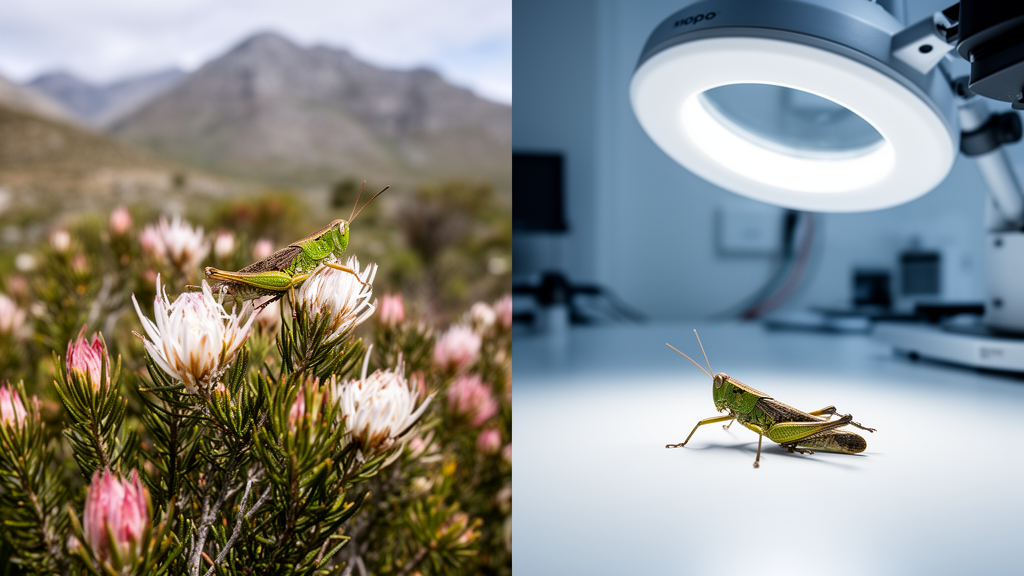
Hidden in the wetlands of South Africa’s Cape Floristic Region, a group of stick-like grasshoppers has been fooling scientists for nearly a century. The genus Betiscoides, a collection of wingless, reed-dwelling insects found nowhere else on Earth, was long thought to contain just three species. A new study published in the journal Evolutionary Systematics has now doubled down on that picture, using extended depth of field and three-dimensional imagery to describe two brand-new species and rewrite the genus’s entire taxonomic framework.
The challenge these insects pose is one that plagues taxonomists worldwide: cryptic species. These are distinct species that look so similar on the outside that traditional methods fail to tell them apart, even though genetics reveals they have long been evolving on separate paths. Insects, the most diverse class of animals, are particularly riddled with such hidden diversity, and this hidden variation is one of the main reasons scientists are still far from describing the estimated ten million species thought to share the planet with us.
Betiscoides seemed like an unsolvable case almost from the start. The taxonomist Key, who revised the genus in 1937, admitted in his manuscript that the genus had every appearance of being a difficult one. When molecular analyses later sequenced multiple genes from dozens of specimens, they uncovered a staggering 24 divergent evolutionary lineages within a genus officially recognized as containing only three species. All three known species are listed as endangered, confined to fragmented restio wetlands in one of the world’s six floral kingdoms, so knowing how many species actually exist is a matter of conservation urgency.
The new research, building on the earlier phylogenetic work, applied an unusual toolkit to the problem. Rather than relying on traditional two-dimensional microscopy and measuring eyepieces, the study used a Keyence VHX 7000 digital microscope to produce extended depth of field images, which stack many focal planes into one fully sharp picture, and true 3D surface models. The researcher behind the study also built complete 3D body models of specimens using a DISC3D scanner, importing 398 stacked images per insect into photogrammetry software to reconstruct the body as a digital mesh and calculate its exact volume.
The payoff was immediate. Fine-scale 3D profile analysis revealed that the prosternal process, a small plate on the underside of the thorax that earlier taxonomists had described vaguely as laminate, actually takes on distinct shapes including T-shaped, trapezoid, and lamelliform forms. What appeared in 2D images to be a concave depression in one species turned out, when viewed in 3D profile, to be a straight surface with a gradient of only about 54 micrometers, a difference invisible to conventional methods. Eye volume, measured by tracing a polygon along the eye’s callus line, proved sexually dimorphic in one new species but not the other.
Even the hairiness of the abdomen could be quantified. Using an automated shape-extraction function on high-resolution 3D images, the study counted 172 individual hairs on the abdomen tip of a single male specimen, a measurement that helps separate lineages that occur side by side in the same habitat. The approach failed on smooth, hairless structures, but combined with other diagnostic characters it provided an objective, replicable way to compare the amount and length of hairs that had previously been judged by eye alone.
Out of this work emerged two formally described species. Betiscoides nova, whose name means both new and extraordinary, was found on top of Jonaskop in the Western Cape and is distinguished by its robust body, trapezoid prosternal process bearing two kinds of hairs, and nearly identical head length and height. Betiscoides muris, named after the Latin word for mouse in reference to its delicate, slender build, lives on the plateau of the Groot Winterhoek Wilderness Area and sports dense, long hairs at the end of the male abdomen. Both species occupy waterlogged patches between restio plants, and both are proposed for endangered status because each is known from a single locality where habitat is in decline.
The study also firmed up the identities of the three older species by comparing freshly collected specimens from the type localities with museum type material, including images of holotypes held at the Natural History Museum in London. Genetic distances between the named species ranged from about 0.070 to 0.078, while the most divergent lineages in the genus differed by nearly 11 percent. The result is a fully revised definition of the genus, updated character descriptions, a new diagnostic key to all five recognized species, and a set of novel measurement standards, from eye-to-fastigium ratios to female genital characters such as valve angles and protrusion distances.
Why does this matter beyond a single genus of grasshoppers? The study’s broader ambition is to establish best-practice standards for image-based taxonomy that can feed directly into deep learning algorithms. Artificial intelligence tools for species identification are only as good as the training data behind them, and cryptic species have been a blind spot. High-resolution, calibrated 3D imagery provides the objective, quantifiable characters that algorithms need to detect the smallest differences among morphologically alike species. Because the method is noninvasive, it can even be applied to fragile, century-old museum type specimens and potentially to living insects in the field.
The study is candid about the limits. Automated hair counting still confuses hairs with other bright structures, dried and pinned specimens decay in ways that skew fine measurements, and pins themselves can destroy delicate features like the prosternal process. Human taxonomic expertise remains essential to avoid misinterpreting plastic characters. But the direction is clear: by measuring what researchers actually see, and turning it into reproducible numbers, 3D imaging is turning one of taxonomy’s most stubborn puzzles into a template for finding and protecting the world’s overlooked species before habitat destruction erases them for good.
Subject of Research: Using extended depth of field and 3D imagery to resolve cryptic species in the South African grasshopper genus Betiscoides
Article Title: Application of extended depth of field 3D imagery to tackle the challenges of cryptic species: a use case in the genus Betiscoides Sjöstedt, 1924 ( Orthoptera , Caelifera , Lentulidae ) and its taxonomic implications
Article References: Matenaar, D. (2024). Application of extended depth of field 3D imagery to tackle the challenges of cryptic species: a use case in the genus Betiscoides Sjöstedt, 1924 (Orthoptera, Caelifera, Lentulidae) and its taxonomic implications. Evolutionary Systematics, 8(1), 65-90. https://doi.org/10.3897/evolsyst.8.117735
Image Credits: AI Generated
DOI: 10.3897/evolsyst.8.117735
Keywords: Betiscoides, cryptic species, Orthoptera, 3D imaging, taxonomy, extended depth of field, Cape Floristic Region, South Africa, deep learning, conservation, biodiversity, Lentulidae
Cite Scienmag News
Gavin Prescott. (October 19, 2026). 3D Imaging Reveals Hidden Grasshopper Species in South Africa’s Fynbos. Scienmag. https://scienmag.com/3d-imaging-reveals-hidden-grasshopper-species-in-south-africas-fynbos/
Gavin Prescott. "3D Imaging Reveals Hidden Grasshopper Species in South Africa’s Fynbos." Scienmag, 19 October 2026, https://scienmag.com/3d-imaging-reveals-hidden-grasshopper-species-in-south-africas-fynbos/. Accessed 19 October 2026.
Gavin Prescott. "3D Imaging Reveals Hidden Grasshopper Species in South Africa’s Fynbos." Scienmag. October 19, 2026. https://scienmag.com/3d-imaging-reveals-hidden-grasshopper-species-in-south-africas-fynbos/


