


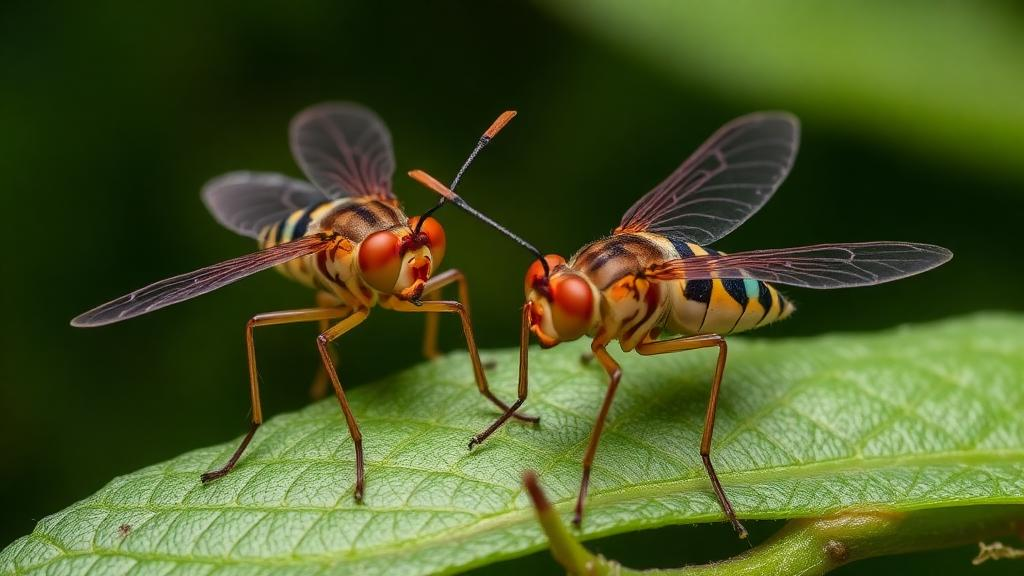
Two new species of the unusual mountain midge genus Deuterophlebia have been described from torrential streams in southwestern China, raising the country’s tally of known species to seven and making it the global center of documented diversity for the group. The species, Deuterophlebia pseudopoda and D. pachychaeta, were recovered as adults and pupae from the cold, fast-flowing Dulong River in Yunnan Province. Detailed anatomical comparisons and mitochondrial DNA barcodes support their separation from previously named species and reveal a striking degree of local specialization. Both discoveries concern a family of flies whose larvae move through rushing water using paired pseudopodia, whose adults mate at sunrise, and whose males die immediately afterward. The findings also sharpen a long-running biogeographic puzzle over whether the Himalayas helped shape the early evolution of Diptera, the order that includes flies, mosquitoes and bee-like insects.
The new insects belong to Deuterophlebiidae, a family represented by a single genus and frequently described as among the most anatomically primitive living fly lineages. A recent mitochondrial analysis placed the family as the earliest branching lineage of Diptera, although earlier studies usually proposed a closer relationship with the net-winged midges of the family Blephariceridae. Their larvae are unlike those of most other flies: each has paired, leg-like pseudopodia that allow it to grip submerged rocks in torrents. Adults have extremely long antennae, slender legs, dark bodies and wings with an enlarged cubital region. The life cycle is equally unusual. Males gather near streams at sunrise, mate, and die soon afterward, while females shed their wings, return to the water and deposit eggs. This combination of ancient-looking anatomy, restricted mountain habitats and a dramatic reproductive cycle has made mountain midges an increasingly prominent subject of entomological research.
Until 2022, China was largely blank on published distribution maps for Deuterophlebia. That year, researchers reported five species from southwestern and eastern China, abruptly changing the biogeographic picture and suggesting that the country might be a center of diversity for the family. The new study was prompted by fieldwork in Yunnan, where adults and pupae were collected during a trip in 2023. The authors examined the specimens under a stereomicroscope, dissected and cleared selected structures with dilute sodium hydroxide, and documented their heads, antennae, legs and terminalia with detailed photography. COI mitochondrial sequences were then used to calculate genetic distances among the seven Chinese species and to test whether the two morphologically unusual forms represented separate biological species.
Deuterophlebia pseudopoda is the smaller of the two new species, with male body length of approximately 2.2 to 2.6 millimetres and a body length of about 2.0 millimetres in the female. Its most immediately unusual feature is the extraordinary antenna. The final antennal segment is flattened and elongated, reaching roughly four times the length of the body and about 14 times the combined length of the five basal antennal articles. Males can be distinguished from all named congeners by their terminalia: the gonostylus is short, approximately equal in length to the gonocoxite and dorsal plate, while the posterior margin of the dorsal plate is slightly depressed but lacks a median cleft. The head is also distinctive, with a nearly trapezoidal form, a slightly convex median clypeal lobe and no projecting corner beside the compound eye.
The discovery name D. pseudopoda refers to the species’ pupal anatomy. The flattened, oval pupae measure about 2.3 millimetres long and 1.6 millimetres wide in males, and their abdominal segments VI and VII carry paired, foot-shaped posterolateral projections armed with spines. Those structures were unknown among the 15 species for which a clear pupal stage had previously been described. The pupae also possess a single sharp spine on each side of the mesothorax, three-filament gills and no conspicuous thoracic ridges. Adult structures are visible from the ventral surface, including a large elliptical antennal sheath that encircles the body. Males can be separated from females at this stage by the presence of that antennal ring and by expanded tips on the leg sheaths. The authors regard the pupal stage as the easiest feature set for identifying Chinese Deuterophlebia in practice, and descriptions are now available for the pupae of all seven Chinese species.
The second species, Deuterophlebia pachychaeta, is larger, with male adults approximately 3.0 millimetres long, females about 2.3 millimetres, and male pupae around 2.8 millimetres long and 2.0 millimetres wide. Its name combines terms referring to thick bristles, reflecting the conspicuously expanded bases of its pupal mesothoracic spines. Two spines occur on each side of the mesothorax, and each gill contains four filaments rather than the three seen in D. pseudopoda. Those features distinguish the pupae from most known species. The closest morphological comparison is D. acutirhina, which also has basally expanded spines, but those are less strongly expanded; D. pachychaeta additionally lacks the conspicuous dark abdominal dots recorded in D. acutirhina. In adults, males can be separated from similar Asian species by antennae longer than eight millimetres, microtrichia on the postgena and eight to ten digitiform setae on each of the first three antennal flagellomeres.
Female D. pachychaeta can be recognized by the combination of a smooth, convex median clypeal lobe, antennal form and a precise arrangement of setae. Its first four flagellomeres bear approximately two, four, 10 and two digitiform setae, while the final segment also carries four sharp setae. This differs from the set in D. pseudopoda and provides a separate identification route when females are available. The molecular results broadly support the morphological distinctions. Interspecific K2P distances among the seven Chinese species ranged from 0.086 to 0.175, whereas within-species distances were below 0.01. The smallest gap, 0.086, separated D. sinensis from D. yunnanensis; D. pachychaeta was only 0.091 from D. yunnanensis. The researchers tentatively group D. sinensis, D. yunnanensis and D. pachychaeta as close relatives, possibly members of one clade that may also include D. mirabilis, but emphasize that a reliable phylogenetic tree will require more specimens and molecular data.
Field observations offer clues to the ecological constraints shared by both new species. The type locality was the Dulong River during the dry season, when the channel was about 20 metres wide, two to three metres deep and unshaded, with stones of various sizes on the bed. Water temperature remained below 10 degrees Celsius. Pupae were found in torrent zones approximately 0.4 metres deep, where the current and depth made standing difficult. They clung tightly to rock surfaces with adhesive discs on abdominal segments III to V, while dead adults floated close to the banks. The researchers observed the same general association between pupae, rushing water and adult activity already known from other Deuterophlebia species. Such extreme specialization may also make these flies vulnerable to changes in flow, sedimentation, temperature and water chemistry, although the study did not directly assess their conservation status.
With these additions, China now contains half of all named Asian Deuterophlebia species and has the highest known species diversity worldwide. Seven species are reported only from China, while the type species, D. mirabilis, has also been collected in Xinjiang. Distribution maps reveal a pronounced Himalayan bias, and the Dulongjiang area can be included within a broad Himalayan region. Six species occur in or around the mountains, and some early-diverging lineages are restricted there. One hypothesis is that the genus originated in the Himalayan region, with rapid uplift, climatic differentiation and geographic isolation promoting speciation. Yet the timing of the Himalaya’s formation, roughly 50 million years ago, appears too recent to explain the much older evolutionary origins of early fly lineages. The fossil record and the presence of six species in western North America also remain difficult to reconcile with a simple Himalayan-origin scenario.
The more defensible conclusion is that the Himalayas and neighboring regions constitute one major center of Deuterophlebia speciation, with western North America representing another. Steep terrain could have generated many isolated streams and distinct local conditions, while mountain barriers and habitat changes promoted divergence among populations. The two Yunnan species illustrate both the biological richness of these environments and the value of studying the less conspicuous stages of insect life. Their discovery brings the known Chinese fauna to seven and provides new anatomical and genetic reference points for testing how an exceptionally specialized, early-branching fly lineage diversified across the world’s mountain streams.
Subject of Research: Taxonomic and molecular characterization of two new Deuterophlebia species from Yunnan, China
Article Title: Two new species of Deuterophlebia Edwards, 1922 from Southwestern China ( Diptera , Deuterophlebiidae )
Article References: Zheng, X., & Zhou, C. (2023). Two new species of Deuterophlebia Edwards, 1922 from Southwestern China (Diptera, Deuterophlebiidae). Deutsche Entomologische Zeitschrift, 70(2), 387-401. https://doi.org/10.3897/dez.70.108096
Image Credits: AI Generated
Keywords: Deuterophlebia, mountain midges, Diptera, Deuterophlebiidae, species discovery, Yunnan, China, pupal morphology, DNA barcoding, Himalayan biogeography, aquatic insects, taxonomy
Cite Scienmag News
Gavin Prescott. (October 19, 2026). Two new mountain midges double China’s Deuterophlebia diversity. Scienmag. https://scienmag.com/two-new-mountain-midges-double-chinas-deuterophlebia-diversity/
Gavin Prescott. "Two new mountain midges double China’s Deuterophlebia diversity." Scienmag, 19 October 2026, https://scienmag.com/two-new-mountain-midges-double-chinas-deuterophlebia-diversity/. Accessed 19 October 2026.
Gavin Prescott. "Two new mountain midges double China’s Deuterophlebia diversity." Scienmag. October 19, 2026. https://scienmag.com/two-new-mountain-midges-double-chinas-deuterophlebia-diversity/


