


Medical procedures capable of moving cells inside the body without making incisions have unique benefits. From faster recovery times to less trauma impacting the body, the list of reasons to do surgery without scalpels is growing with the technology used to perform noninvasive treatments.

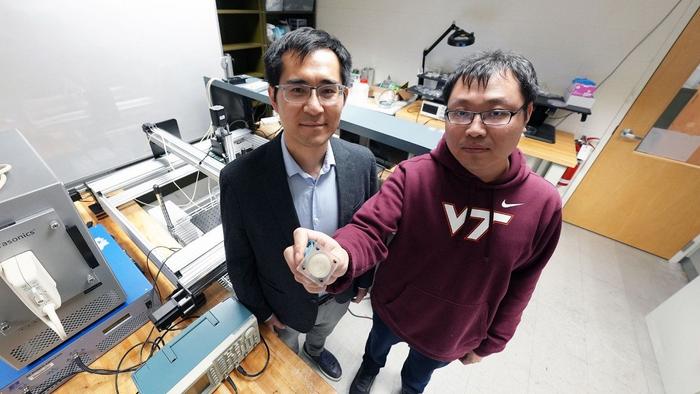
Credit: Photo by Alex Parrish for Virginia Tech.
Medical procedures capable of moving cells inside the body without making incisions have unique benefits. From faster recovery times to less trauma impacting the body, the list of reasons to do surgery without scalpels is growing with the technology used to perform noninvasive treatments.
A new method that might be available in the future is coming to life through research conducted by Zhenhua Tian’s team. The assistant professor in the Department of Mechanical Engineering is using tube-shaped acoustic energy to capture tiny biological materials such as cells and bacteria, moving the captive particles without touching them. The work has earned him a National Science Foundation Faculty Early Career Development Program (CAREER) award, reserved for early-career faculty who have the potential to serve as academic role models in research and education while building a firm foundation for a lifetime of leadership.
Tian’s team will use the $649,000 in funding from the award to further develop its work using acoustic energy to create invisible beams capable of trapping, translating, and rotating objects.
Three beams are better than one
The sounds that reach our ears are transmitted on waves of energy, but not all sounds can be heard by humans. Even if acoustic energy isn’t carrying our favorite song, it can perform other tasks.
Tian’s team works with one such set of sound waves called ultrasound waves. When the researchers deploy these waves through something called an acoustic vortex beam, it creates an invisible, hollow energy vortex. This miniature controllable energy tornado functions tweezers: When an object in the center of the vortex is surrounded by acoustic energy, the sound waves hold the object firmly.
While one beam can surround and capture an object, three crisscrossing beams working together create a small capture area, enabling very precise movement of the object suspended in the energy vortex. This three-beam approach can be wielded in different ways, but the result is an invisible tool, operated by acoustics, that can grab, turn, and rotate tiny objects.
To increase the precision with which objects can be moved, Tian’s team has also added a robotic arm that holds the acoustic emitter. While the crossed beams hold a particle, the robotics move the particle along paths.
Acoustic energy also can travel through solid objects, which means the beams created by Tian’s team can pass through muscle and bone without cutting into it. This might be a particle on a lab bench or it might be a blood clot in someone’s body.
Beyond lasers and magnets
Noninvasive approaches to moving biological matter such as Tian’s have been explored by other means. The 2018 Nobel Prize in Physics was awarded for optical tweezers, where the developers were able to use focused optical energy, essentially lasers, in the way Tian’s team now uses acoustics for biological and biomedical applications. However, optical energy is less optimal than acoustic when it comes to manipulating objects that are shielded by opaque barriers such as tissues and skulls.
“Using that method, you cannot efficiently manipulate a large object,” said Tian. “A 1-micrometer object can be moved easily, but for an object of several millimeters, using lasers is not an efficient method for moving it around. In contrast, the audio output from a cellphone is sufficient to perturb millimeter-scaled objects.”
Tian added, “The acoustic energy can also travel through materials, which means the acoustic vortex beams can pass through a barrier to move an object behind it. This is important for biomedical applications where noninvasive surgery might be needed.”
Magnetics also have been explored for object manipulation. Magnets are currently in use for surgery with magnetically guided needles and other applications, and there have been successes with those approaches. Of course, the use of the magnetic method requires the object to be made of specific materials that strongly respond to magnets.
“Acoustic tweezers are unique because objects of various materials in gas, liquid, and solid phases can be manipulated in a number of applications,” said Tian.
Bioprinting with living cells
Another possible application for invisible acoustic tweezers is bioprinting with living cells. Being able to precisely place cells could be a future method for
- Developing tissue models for biomedical research
- Manufacturing tissue replacements for regenerative medicine
- Creating new techniques for existing technology such as stereolithography and inkjet bioprinters, but with more precision
As one of the objectives of the CAREER awards is leading advances in research and education, Tian’s team anticipates transforming the acoustics research findings into easy-to-use tools that can be readily adopted by biomedical researchers and by doctors for clinical applications. Motivated by the desire to bring more effective means of both diagnostics and therapeutics to the world, Tian’s team hopes to produce a set of methods that will offer a host of new applications in science and health care.
Cite Scienmag News
Courtney Benton. (May 22, 2024). Zhenhua Tian receives National Science Foundation CAREER award to develop invisible acoustic tweezers. Scienmag. https://scienmag.com/zhenhua-tian-receives-national-science-foundation-career-award-to-develop-invisible-acoustic-tweezers/
Courtney Benton. "Zhenhua Tian receives National Science Foundation CAREER award to develop invisible acoustic tweezers." Scienmag, 22 May 2024, https://scienmag.com/zhenhua-tian-receives-national-science-foundation-career-award-to-develop-invisible-acoustic-tweezers/. Accessed 4 September 2026.
Courtney Benton. "Zhenhua Tian receives National Science Foundation CAREER award to develop invisible acoustic tweezers." Scienmag. May 22, 2024. https://scienmag.com/zhenhua-tian-receives-national-science-foundation-career-award-to-develop-invisible-acoustic-tweezers/

