


Hydroformylation — the reaction that stitches a formyl group and a hydrogen atom across a carbon–carbon double bond to make aldehydes — is one of the highest-volume homogeneous catalytic processes in the chemical industry. Its weakness has always been selectivity: when an unsymmetrical alkene enters the rhodium carbonyl cycle, the aldehyde can emerge in a linear or a branched form, and the linear isomer is usually the one worth having. For decades the industry has relied on dissolved rhodium complexes dressed in bulky, expensive and often toxic phosphine ligands to steer the reaction down the linear path. A team at the Instituto de Tecnología Química in Valencia, working with synchrotron and electron-microscopy collaborators in Spain, now reports a heterogeneous alternative that pushes linear-to-branched selectivity to numbers far beyond anything previously documented.
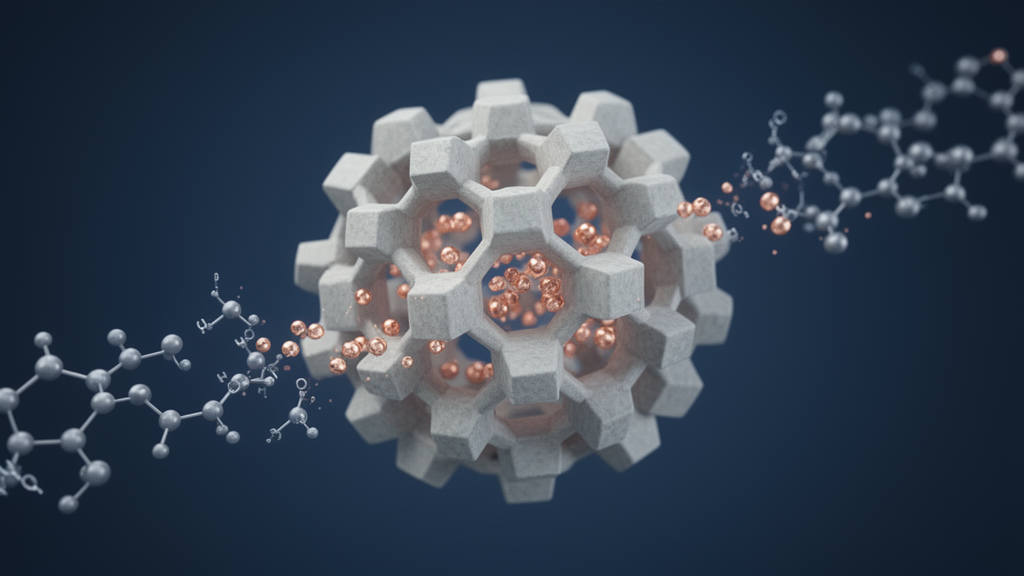
Writing in Nature, Minjie Zhao, Reisel Millán, Patricia Concepción, Avelino Corma and colleagues describe a catalyst in which subnanometre clusters of rhodium(III) oxide are confined inside the straight and zigzag channels of an MFI-type zeolite — the framework family best known as ZSM-5. The material, labelled KRh@MFI, looks deceptively simple: potassium-exchanged zeolite, a trace of rhodium, and nothing else. Yet under reaction conditions the confined Rh2O3 clusters are not passive containers of metal. Spectroscopic evidence collected during catalysis shows that they disrupt into isolated rhodium ions in two oxidation states, Rh3+ and Rh+, each sitting within the zeolite’s microporous architecture and each with its own catalytic personality.
That personality split is the heart of the discovery. Density functional theory calculations, cross-checked against infrared and X-ray absorption spectroscopy, indicate that hydroformylation at Rh3+ centres is energetically comparable to the pathway at Rh+ centres — both can plausibly convert an alkene, syngas and hydrogen into aldehyde. But the two sites differ sharply in what else they do. Rh+ is intrinsically prone to double-bond isomerization, the side reaction that migrates the C=C bond along the hydrocarbon chain. Isomerization is not a cosmetic nuisance: once an α-olefin such as 1-decene wanders into an internal position, subsequent hydroformylation yields a mixture of aldehydes whose linear fraction collapses. Rh3+, by contrast, is intrinsically more selective for hydroformylation and markedly less inclined to shuffle double bonds.
The Valencia group then did something chemically elegant: rather than trying to synthesize a material containing only Rh3+, they let both species coexist and selectively silenced the troublesome one. Small nitrogen-containing molecules — N-methylpyrrolidine (MP) and 1-methyl-2-pyrrolidone (NMP) — were fed alongside the reactants. These additives preferentially coordinate to the Rh+ sites inside the MFI channels, capping them like molecular plugs. The Rh+ isomerization function is thereby suppressed, while the Rh3+ sites remain catalytically accessible for hydroformylation. In effect, the researchers used a reversible, molecule-sized switch to convert a mixed-site catalyst into a single-function one, without any change to the solid itself.
The numbers that emerge from this strategy are extraordinary. With NMP as the additive, the catalyst delivers a linear-to-branched aldehyde ratio of 817 — a state-of-the-art figure — together with 96% selectivity to the linear aldehyde undecanal at 99.8% conversion of 1-decene. For a heterogeneous catalyst operating without phosphine ligands, these values rival or exceed what homogeneous industrial systems achieve, and they do so with a metal that is immobilized inside a robust inorganic framework rather than dissolved in the product stream. The work builds on the group’s earlier demonstration of low-temperature ethylene hydroformylation over phosphorus-stabilized rhodium sites in a one-pot-synthesized Rh-(O)-P-MFI zeolite, published in Nature Communications in 2023, and on a 2024 Nature paper reporting regioselective propene hydroformylation over rhodium-zeolite catalysts.
Characterization was as central to the study as catalysis. X-ray absorption spectroscopy performed at the CLÆSS beamline of the ALBA synchrotron allowed the team to track the oxidation state and coordination environment of rhodium under reaction conditions, distinguishing Rh3+ from Rh+ and confirming that the subnanometre oxide clusters fragment into isolated ions once the reaction atmosphere takes hold. Aberration-corrected electron microscopy at the University of Cádiz — high-angle annular dark-field scanning transmission electron microscopy and integrated differential phase-contrast imaging — provided direct visualization of the atomic dispersion within the zeolite channels. Infrared spectroscopy with carbon monoxide as a probe molecule, a technique with a long pedigree in rhodium-zeolite chemistry, helped fingerprint the individual site types.
The DFT analysis went beyond confirming feasibility. By mapping the energetics of the hydroformylation cycle at both Rh3+ and Rh+ centres, the calculations rationalized why the higher oxidation state favours formylation over isomerization: the electronic structure of Rh3+ stabilizes the key hydride-carbonyl intermediates along the aldehyde-forming pathway while disfavouring the alkyl intermediates that lead to double-bond migration. The apparent activation energies measured experimentally for hydroformylation and for isomerization, with and without MP present, matched this picture — the additive raised the barrier for the isomerization pathway far more than for the hydroformylation pathway, exactly as a site-blocking mechanism predicts.
Practicality matters as much as selectivity, and the team addressed it on two fronts. Recyclability experiments showed that the catalyst maintains its performance over repeated batches, an essential requirement for any solid that hopes to displace a homogeneous process. More significantly, the reaction was demonstrated in a semicontinuous operation mode, in which the solid catalyst remains in the reactor while reactants and products flow through — the configuration that industry would actually use. The additive strategy also proved tunable: beyond MP and NMP, the researchers screened a family of organic molecules including fluorinated and brominated variants, mapping how molecular structure governs the preference for Rh+ versus Rh3+ coordination.
The demonstration was not limited to a single substrate. The paper reports state-of-the-art results across a homologous series of C6 to C10 α-olefins, the linear terminal alkenes that serve as feedstocks for plasticizer alcohols and detergent precursors. Extending the record l/b ratio across this range suggests the site-isolation and additive-blocking strategy is a general principle rather than a peculiarity of one hydrocarbon chain length. Because α-olefin hydroformylation underpins a substantial fraction of global aldehyde production, even incremental selectivity gains translate into large savings in separation energy and raw material consumption; a jump to l/b ratios in the hundreds is in a different category altogether.
What the study ultimately offers is a design philosophy: instead of fighting to make every catalytic site identical, one can exploit the coexistence of site types and use small, reversible ligands to switch off the undesired function while the desired one keeps working. It is a strategy that echoes how enzymes use allosteric effectors, here transposed onto an industrial zeolite catalyst with nothing more exotic than a lactam solvent additive. If the approach generalizes to other metals, frameworks and reactions, the phosphine ligands that have defined hydroformylation since Otto Roelen’s era may finally face a credible heterogeneous challenger — one whose active sites are counted in single ions and whose selectivity is written into the walls of a zeolite.
Subject of Research: Regioselective hydroformylation catalysed by Rh3+ ions stabilized in an MFI zeolite
Article Title: Rh3+ stabilized in KRh@MFI catalyses regioselective hydroformylation
Article References: Rh3+ stabilized in KRh@MFI catalyses regioselective hydroformylation. (n.d.). https://doi.org/10.1038/s41586-026-11136-9
Image Credits: AI Generated
DOI: 10.1038/s41586-026-11136-9
Keywords: hydroformylation, rhodium, zeolite, MFI, regioselectivity, heterogeneous catalysis, single-site catalysts, DFT, olefins, N-methylpyrrolidone, aldehydes, catalyst selectivity
Cite Scienmag News
Denise Maddox. (October 16, 2026). Zeolite-Trapped Rhodium Ions Deliver Record Selectivity in Industrial Hydroformylation. Scienmag. https://scienmag.com/zeolite-trapped-rhodium-ions-deliver-record-selectivity-in-industrial-hydroformylation/
Denise Maddox. "Zeolite-Trapped Rhodium Ions Deliver Record Selectivity in Industrial Hydroformylation." Scienmag, 16 October 2026, https://scienmag.com/zeolite-trapped-rhodium-ions-deliver-record-selectivity-in-industrial-hydroformylation/. Accessed 16 October 2026.
Denise Maddox. "Zeolite-Trapped Rhodium Ions Deliver Record Selectivity in Industrial Hydroformylation." Scienmag. October 16, 2026. https://scienmag.com/zeolite-trapped-rhodium-ions-deliver-record-selectivity-in-industrial-hydroformylation/


