


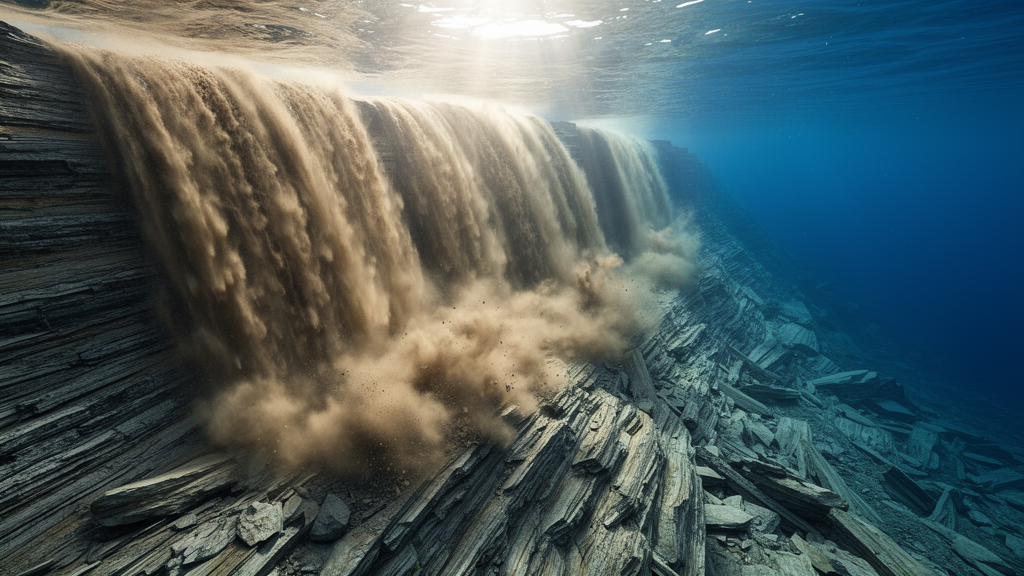
Deep beneath the hills of the Ligurian Alps in northwestern Italy, a sequence of jumbled, block-filled rocks known as the Colla Domenica Shales has puzzled geologists for half a century. These chaotic deposits, packed with fragments of sandstone, limestone, quartzite and even basalt, were long interpreted as the product of mud diapirism, in which water-rich sediments squeezed upward through the crust under the weight of an advancing mountain belt. A new multidisciplinary study published in the Swiss Journal of Geosciences overturns that view, arguing instead that the chaos was created by catastrophic underwater avalanches, or mass-transport deposits, that roared across a dying ocean basin during the Paleocene and Eocene epochs, roughly 56 to 40 million years ago.
The research team, working as part of the Italian Geological Cartography Project, combined detailed field mapping at 1:10,000 scale with sedimentological logging, calcareous nannofossil biostratigraphy, petrographic point-counting and whole-rock geochemistry. Their target was the Western Ligurian Flysch, a stack of detached sedimentary nappes that once blanketed the Piemontese–Ligurian Ocean, a branch of the Alpine Tethys that separated the European margin from the Adria microplate. Understanding how these chaotic layers formed is central to reconstructing how that ocean closed and how the Alpine chain was assembled.
One of the most consequential field observations concerns the base of the Colla Domenica Shales itself. Near the locality of Colla Domenica, the team identified a sharp, erosional surface rather than a tectonic contact. There are no shear zones, cataclasites or other structures that would indicate the shales were scraped off as a separate thrust sheet. This single but powerful observation suggests that the Colla Domenica Shales and the overlying Leverone Formation should no longer be treated as an independent tectonic unit. Instead, they appear to represent the uppermost part of the neighboring Borghetto d’Arroscia–Alassio and Arnasco–Castelbianco units, deposited directly onto older turbiditic successions on the basin floor.
The sedimentology of the chaotic intervals provides equally telling clues. At the type locality near Colle di Nava, the researchers measured a stratigraphic log roughly 170 meters thick and documented a vertical progression from thin, fine-grained turbidites into increasingly thick and coarse chaotic horizons. The main mass-transport event begins with an erosional basal surface marked by scours, above which shear planes and S–C structures record mechanical shearing during emplacement. Higher up, the deposit becomes a matrix-supported paraconglomerate in which clasts of wildly varying shapes and sizes, from a few centimeters to meter-scale basalt blocks, float randomly in a shaly matrix. Soft-sediment folding, liquefaction structures and boudinage of stratal fragments all point to rapid, high-energy gravity flows rather than slow tectonic grinding.
Crucially, the internal architecture of these chaotic layers lacks the litho-structural zoning that would be expected if rising mud diapirs had built them, and the block-in-matrix fabrics do not display the regionally coherent, structurally ordered patterns typical of tectonic mélanges. The authors therefore classify the deposits as polygenetic mélanges, bodies whose primary fabric was produced by gravity-driven mass wasting and whose present-day foliations and boudinage reflect only a subordinate Alpine tectonic overprint. The vertical stacking of facies closely resembles the classic Pyrenean megaturbidites, in which erosional bases, pluri-metric megablocks and basal breccias pass upward into thick, mud-rich turbidites.
Biostratigraphy helped pin down the timing. Most of the twenty samples processed for calcareous nannofossils proved barren, a common problem in deeply buried and weakly metamorphosed fine-grained rocks, but a few fossiliferous horizons yielded diagnostic assemblages. In the Colla Domenica Shales, rare specimens of Ellipsolithus macellus constrain the minimum age to the Danian–Ypresian interval, while the stratigraphic position above the Ypresian Leuso–Quartarole Sandstones points to an upper Ypresian, possibly Lutetian, depositional age. The Leverone Formation contains Ericsonia formosa, which ranges from the Lutetian to the lowermost Rupelian. Cretaceous taxa in both formations record significant reworking of older sediments, a hallmark of tectonically active settings where material is repeatedly stripped from uplifted basins and redeposited.
Petrographic analysis of sandstones from the bounding formations revealed a consistent siliciclastic composition dominated by monocrystalline quartz, with feldspar and minor micas, plotting in the litharkose field and in the recycled orogen provenance field of tectonic discrimination diagrams. This points to erosion of exhumed Variscan basement, most plausibly the Sardinia–Corsica block on the European margin. Textural contrasts between the two formations carry additional information: the Leuso–Quartarole Sandstones are moderately to poorly sorted with sub-rounded grains, indicating longer transport and higher textural maturity, whereas the Leverone Formation sandstones are very poorly sorted and angular, implying shorter travel distances as the basin narrowed and the depocenter migrated toward the proximal European margin.
Geochemistry added a surprising dimension. Pelitic matrix samples from the Colla Domenica Shales show silica contents between 62 and 72 weight percent and Chemical Index of Alteration values clustering around 78, matching average shale compositions and indicating a well-weathered continental source consistent with the Sardinia–Corsica provenance. One sample, however, stands out with markedly higher calcium and sodium contents and a CIA of only 47, signaling the incorporation of ophiolitic detritus derived from the accretionary prism. Even more striking are the basalt clasts embedded in the main chaotic horizon. Their major and trace element signatures, including flat rare earth element patterns and the absence of niobium–tantalum anomalies, identify them as transitional mid-ocean ridge basalts, closely comparable to the Balagne suite of northern Corsica, which formed during early seafloor spreading in the nascent Piemontese–Ligurian Ocean.
Together, these lines of evidence support a coherent geodynamic model. During the late Ypresian and Lutetian, the Piemontese–Ligurian Ocean was in its final stages of closure, subducting beneath the southern Alpine margin while an accretionary prism advanced toward the European continent. The growing wedge shed enormous mass-transport deposits northward into a narrow, confined foreland basin, while turbidity currents fed by rivers draining the Sardinia–Corsica block supplied siliciclastic sediment from the opposite direction. Fold vergences within the chaotic beds, after correcting for the roughly 50-degree counterclockwise rotation that the region underwent during the Oligocene and Miocene, indicate transport from the prism toward the European margin, confirming the dual provenance recorded in the geochemistry.
The study also places the Ligurian deposits within a broader regional framework. Analogous chaotic units, such as the Paleocene–Eocene Bocco Shale in the Northern Apennines and the Wildflysch facies of the Niesen Nappe in the Western Alps, share the same signature of turbidites interlayered with ophiolite-bearing debris flows at the boundary between continental margins and oceanic domains. This recurring pattern demonstrates that the coexistence of organized turbidites and chaotic, block-in-matrix horizons is a diagnostic feature of trench and proximal deep-marine settings shaped by active subduction. By reinterpreting the Colla Domenica Shales as gravity-driven mass-transport deposits rather than tectonic mélanges or diapiric bodies, the researchers have refined the record of how the Piemontese–Ligurian Ocean closed, how depocenters migrated as the basin narrowed, and how the sediment routing systems of an ancient convergent margin responded to the relentless advance of an accretionary wedge in the final moments before continental collision.
Subject of Research: Sedimentary and tectonic evolution of Paleocene–Eocene chaotic deposits in the Western Ligurian Flysch of the Ligurian Alps, Italy
Article Title: Sedimentary and tectonic evolution of Paleocene-Eocene chaotic facies from Western Ligurian Flysch (Italy)
Article References: Lombardi, S., Stori, L., Mueller, P., Bonazzi, M., Cobianchi, M., Federico, L., Crispini, L., Seno, S., & Maino, M. (2026). Sedimentary and tectonic evolution of Paleocene-Eocene chaotic facies from Western Ligurian Flysch (Italy). Swiss Journal of Geosciences, 119, 165-196. https://doi.org/10.3897/sjg.119.193211
Image Credits: AI Generated
Keywords: mass-transport deposits, Western Ligurian Flysch, Colla Domenica Shales, Piemontese–Ligurian Ocean, accretionary prism, turbidites, polygenetic mélange, Ligurian Alps, Alpine orogeny, basalt geochemistry, sediment provenance, foreland basin
Cite Scienmag News
Violet Maxwell. (October 16, 2026). Ancient Underwater Avalanches Rewrote the History of Italy’s Chaotic Rocks. Scienmag. https://scienmag.com/ancient-underwater-avalanches-rewrote-the-history-of-italys-chaotic-rocks/
Violet Maxwell. "Ancient Underwater Avalanches Rewrote the History of Italy’s Chaotic Rocks." Scienmag, 16 October 2026, https://scienmag.com/ancient-underwater-avalanches-rewrote-the-history-of-italys-chaotic-rocks/. Accessed 16 October 2026.
Violet Maxwell. "Ancient Underwater Avalanches Rewrote the History of Italy’s Chaotic Rocks." Scienmag. October 16, 2026. https://scienmag.com/ancient-underwater-avalanches-rewrote-the-history-of-italys-chaotic-rocks/


